Last Updated on October 6, 2026
Yes, and the only thing that reliably ruins it is timing.
A second coat goes on inside the first hour, or after two full days. The stretch between those two moments is where paint wrinkles, crackles and lifts, and nearly everybody who has had that happen was being patient and waiting, doing what felt careful.
The recoat window, and the dead zone in the middle

A standard acrylic-alkyd aerosol is dry to the touch in 20 minutes, ready to handle in an hour, dry through in 24 hours and fully hard in 5 to 7 days. Recoat within 1 hour or after 48 hours. Automotive enamel aerosol runs to the same rule: touch dry in 15 minutes, handle in 1 to 2 hours, recoat inside the hour or past the second day.
The reason is solvent. In the first hour the film underneath is still soft and still releasing solvent, so a new coat melts into it and the two cure as one. After 48 hours the film has cross-linked far enough to shrug off the solvent in the next coat.
Between those two points the film is in the worst possible state. It is set on the surface but still soft underneath, and the solvent in the fresh coat softens the skin without being able to penetrate evenly. The skin swells, the layer beneath holds it back, and the surface buckles. That is what wrinkling is, and crackling and alligatoring are the same fault at different severities.
What to do if you are already in the dead zone
Stop. Do not add one more light coat to even it out, because a light coat carries solvent too. A clear coat that fights its base and spraying in direct sun cause the same buckling, but the timing gap accounts for most of it.
Leave it alone for a full 48 hours from the last coat you sprayed. If it has already wrinkled, waiting will not flatten it. Let it cure hard for 48 hours, sand the damaged area back to a smooth edge with 320 grit, feather the edge into the sound paint around it, wipe the dust off and spray again.
Prep depends on how old the old paint is
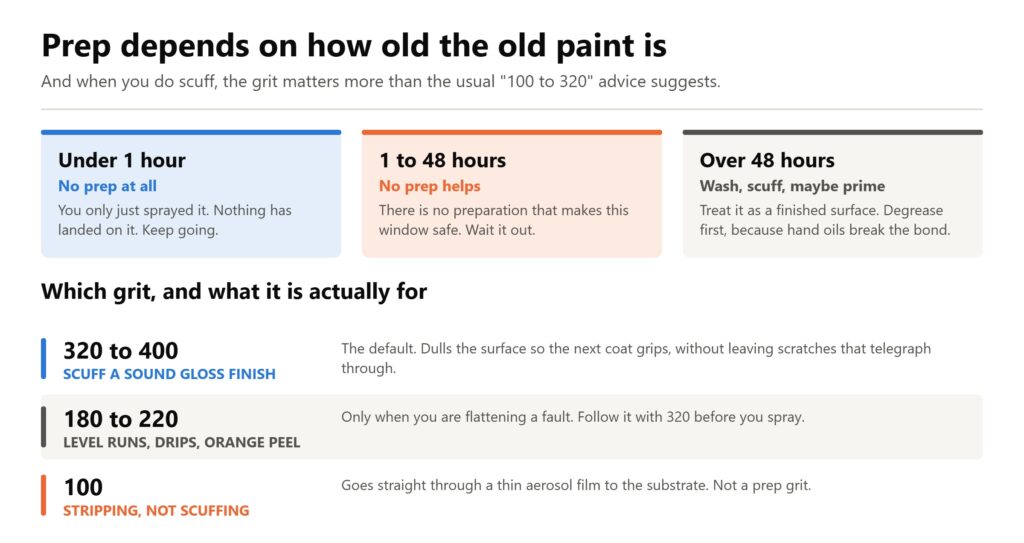
Under an hour old, you need no preparation at all. The surface is clean because you only just sprayed it. Keep going.
Between 1 and 48 hours, there is no prep that makes it safe. Wait.
Older than 48 hours, treat it as a finished surface. Wash it to get grease, dust and hand oils off, because anything on the surface becomes a bond-breaker. Then scuff it.
On grit, the usual advice is a range from 100 to 320, which is close to useless. Those are different jobs. For dulling a sound gloss finish so the next coat grips, 320 to 400 is right and anything coarser leaves scratches that telegraph through. Drop to 180 or 220 only when you are levelling runs, drips or orange peel. 100 grit belongs to stripping, not scuffing, and on a thin aerosol film it will go straight through to the substrate.
Prime when you are covering a dark color with a light one, when you are changing paint chemistry, or when the old finish is unknown. On a known, sound, same-chemistry finish you can skip it.
Which paints go over spray paint
Once you are past 48 hours, what you can paint over spray paint comes down to chemistry rather than brand. Aerosol paint is almost always a solvent-borne enamel, which means a lacquer topcoat will attack it and a water-based topcoat will struggle to grip it.
| New coat | Over cured aerosol enamel | What to do |
|---|---|---|
| Enamel, aerosol or brushed | Holds | Clean, scuff, spray |
| Acrylic or latex | Peels without prep | Scuff to 320, then a bonding primer |
| Lacquer | Lifts the coat below | Do not. Strip it back instead |
| Clear coat | Only if the chemistry matches | Check the base and the clear agree |
| Chalk or craft paint | Scratches off bare | Scuff, prime, and seal over the top |
| Primer | Holds | Choose it for what goes on top, not what is underneath |
The one that catches people is lacquer over enamel. Lacquer carries hot solvents that re-dissolve a cured enamel film, so the new coat sinks and the old one lifts. It does not matter how long you waited. The reverse is fine: enamel over fully cured lacquer behaves itself.
Craft acrylic over a cured aerosol finish is the other common disappointment. It will go on and it will look fine, then it will scratch off with a fingernail, because there is nothing for a water-based film to key into on a glossy cured enamel. Scuff with 320 and put a bonding primer down first and it holds.
How many coats to cover the old color
Going darker is easy and usually takes two light coats. Going lighter is where people get into trouble, because the instinct is to lay it on heavy and heavy is what runs.
Light over dark takes three to four light coats, or two coats over a white or gray primer, and the primer route uses less paint and dries flatter. Red and yellow are the worst offenders in either direction, because both are low-hiding pigments and will ghost through anything you put over them without a primer underneath.
Judge coverage when the coat is dry, never while it is wet. Wet paint always looks like it has covered, and the patchiness shows up twenty minutes later. Keeping the can moving and the passes overlapping by about a third does more for coverage than adding paint.
How to tell whether the old paint is actually cured
Dry and cured are different states, and the clock is only a guide. Two tests settle it in under a minute, both done somewhere that will not show.
Press a thumbnail into the film and hold for five seconds. A cured finish takes the pressure and springs back. If you leave a crescent, it is still soft all the way down and a fresh coat will buckle it.
Then rub a cotton bud dipped in mineral spirits over the same spot, half a dozen light passes. Color on the bud means the solvent is still able to pull the film apart, so give it another day. A clean bud means you are past 48 hours in every sense that matters.
Spraying over brushed latex or latex paint
This is the other way people get wrinkling, and the timing is on a different scale. Latex wall paint is touch dry in an hour but takes two to four weeks to cure properly, and solvent-borne aerosol over latex that is still curing will lift it in exactly the same way.
Over fully cured latex, scuff with 320, wipe the dust off and the enamel holds well. Be aware that the soft layer stays soft underneath: the hard aerosol film on top will dent wherever the latex gives, which is why spraying enamel over a latex-painted wall rarely looks right for long. On furniture and trim, where the latex sits on something rigid, it is fine.
Metal, plastic, wood and car panels
On metal the rules above apply unchanged, with one addition: check for rust creeping under the old paint before you recoat. New paint over a rusting edge buys you a few months.
On plastic, use a paint labeled for plastic or a plastic-specific adhesion promoter. Scuffing plastic is risky because the films are thin and the substrate is soft, so chemistry does the work instead of abrasion.
On wood, the old aerosol film is sitting on a surface that moves. Scuff, do not sand hard, or you will cut through to bare timber in the high spots and get a patchy second coat.
Car panels are the exception worth taking seriously. Aerosol over a factory finish will never match, because factory paint is basecoat plus clear applied under heat. For a visible panel, that is bodyshop work. Aerosol is for wheels, trim, brackets and things under the hood.
Frequently asked questions
What paint goes over spray paint?
Another solvent-borne enamel, in aerosol or brushed form, goes straight over cured spray paint. Water-based acrylic and latex need the surface scuffed and a bonding primer underneath. Lacquer is the one to avoid, because its solvents lift the enamel below it.
How soon can I paint over spray paint?
Immediately is fine. Mid-afternoon on the same day is not. If you are still inside the first hour of your last pass, carry straight on and both coats will harden as a single film. Once that hour has gone, your next safe moment is two days away, and there is no shortcut through the middle. Cold or damp conditions stretch everything, so an unheated garage in winter wants longer, never less.
Can you paint over Rustoleum spray paint?
Yes. Those cans are where the timing rule above is printed, so follow it exactly. On chemistry, Rust-Oleum aerosols are acrylic-modified alkyd: a brushed or sprayed enamel sits on them happily, anything water-based wants a bonding primer underneath, and a lacquer topcoat will pull them apart.
Will acrylic paint stick to Rustoleum spray paint?
Not on its own. A cured enamel aerosol leaves a hard, glossy, non-porous surface and acrylic has nothing to bite. Scuff it to a dull finish with 320 grit, wipe the dust off, lay down a bonding primer and the acrylic will then hold.
Which is better, Krylon or Rustoleum?
They are close enough that the choice rarely matters for a repaint. Both are solvent-borne, both print the same recoat rule, and both will wrinkle if you ignore it. Pick on color range and on what the can says about your surface rather than on the badge.
Can you spray paint over spray paint on metal?
Yes, with the same timing. The extra step on metal is checking the edges and fixings for rust first, because paint over active rust lifts within a season. Treat or remove the rust, prime the bare spot, then carry on.
Final word
Yes, you can spray paint over spray paint. The answer that saves you the job is the timing: within the hour, or after two days, and nothing in between. Everything else, the cleaning, the scuff, the primer, only matters once the old paint is older than 48 hours, and by then it is ordinary surface prep like any other.
