Last Updated on October 12, 2026
No. And the more useful thing to know is that the question cannot be answered yes, because waterproof is not a property anyone measures in a paint film.
Spray paint sheds water once it has cured. That is worth having, and for most outdoor projects it is enough. But sheds water and keeps water out are different jobs, and the second one belongs to a different kind of product entirely.
No spray paint data sheet claims waterproof
Pull the technical data sheet for a professional-grade spray enamel and read what it actually promises. Rust prevention. Resistance to abrasion, fading, chipping and dulling. Suitable for ferrous and non-ferrous metal and wood.
What is not there: the word waterproof. No water-resistance rating. No immersion guidance. No figure for how long the film takes to become weatherproof, in a document that otherwise lists dry time, recoat time, coverage, heat resistance and shelf life to the hour and the square foot.
That silence is the answer. A manufacturer who could put a waterproof claim on a can would put it on the can.
Waterproof is not a number anyone publishes
There is a measurement for how much moisture passes through a coating. It is called permeance, measured in perms, and the building code sorts coatings into bands using it.
| Classification | Permeance | What it means |
|---|---|---|
| Class I vapor retarder | 0.1 perm or less | Almost nothing gets through |
| Class II vapor retarder | Over 0.1 up to 1.0 perm | Strongly slows moisture |
| Class III vapor retarder | Over 1.0 up to 10 perms | Slows moisture |
| Vapor permeable | 5.0 perms or more | Moisture moves through freely |
| Spray paint | Not published | No manufacturer states one |
Two things are worth noticing in that table. The first is that the scale tops out at a band called vapor permeable rather than a band called waterproof, because the code lexicon does not contain the words waterproof or vapor impermeable for coatings at all. The second is the bottom row.
Even the measurement that does exist is shakier than it looks. The test method states plainly that a value obtained under one set of conditions may not hold under another, and round-robin testing puts lab-to-lab variability at around 20 percent. One specifier reported a 300 percent gap between two accredited labs testing the same material.
So when a blog tells you a particular spray paint is waterproof, ask what number that is based on. There isn’t one.
The recoat window that decides it
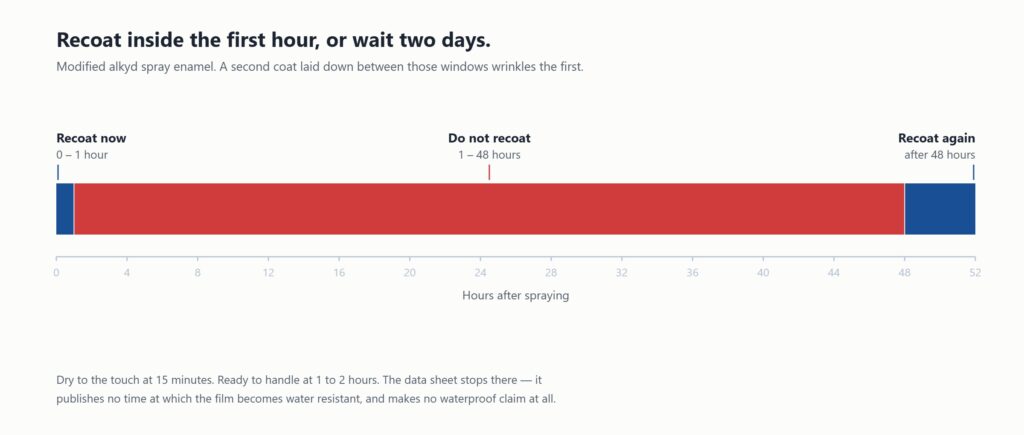
Here is the number that actually decides whether your paint survives weather, and it has nothing to do with waterproofing.
A modified alkyd spray enamel dries to the touch in 15 minutes and is ready to handle in one to two hours. The second coat has to go on within the first hour, or after 48 hours. In between, the first coat is still curing underneath, and fresh solvent landing on it lifts and wrinkles the film.
Think about how that collides with weather. You spray a coat in the afternoon. It rains overnight. You come out in the morning, see a patchy finish and lay on another coat at hour 16 to tidy it up. That second coat is landing squarely in the middle of the forbidden window, and the wrinkling that follows gets blamed on the rain.
The rain was not the problem. The timing was.
Water gets behind paint, not through it
Picture a painted garden bench left out through a wet winter. When the finish fails, it does not dissolve. It lifts, in sheets, usually starting at an edge or a screw hole or the cut end of a board.
That is moisture arriving from behind, through bare wood that was never sealed, and pushing the film off from underneath. The paint on the face of the board can be in perfect condition while the whole panel peels.
Which is why the preparation decides more than the can does. Water finds the edge you did not coat, the underside you could not reach, the end grain you forgot drinks moisture faster than any other part of the board. Seal those and an ordinary spray enamel lasts years outdoors. Skip them and the most expensive can on the shelf peels in one season.
Three conditions that decide the outcome
All three come off the same data sheet, and all three are things you control for free.
One more figure worth having before you start: a 15-ounce can covers roughly 14 square feet, which is why one can rarely takes a bench through two coats. Hold the can 10 to 16 inches off the surface and lay on two or more light passes rather than one heavy one.
Temperature between 50 and 90°F. Outside that range the film does not form properly, and a film that never formed properly was never going to resist anything.
Relative humidity below 85 percent. This is the one that catches people out. Spraying on a muggy day, or at dusk when the air is cooling toward dew point, traps moisture in the film as it sets. The paint looks fine and fails early.
Not on galvanized metal. Stated outright on the data sheet for professional enamel. Zinc and alkyd resins react, and the coating releases later regardless of how carefully it went on. Galvanized needs a primer made for it.
If you need waterproof, you do not need paint
Ask the internet this question and you will often be pointed at rubberized aerosol sealers. That answer is not wrong so much as it is answering a different question, and the swap is worth understanding.
Paint is a decorative film that happens to shed water. A sealer is a barrier membrane that happens to have a color. One is chosen for how it looks, the other for what it keeps out, and they fail in different ways: paint chips, a sealer splits.
So the honest decision is which job you are actually doing. Coloring a planter that will get rained on is a paint job. Stopping a gutter leaking is a sealing job. Trying to do the second with a can of color is how people end up repainting every spring.
For wood that will live outdoors, the useful pairing is a penetrating primer that soaks into the surface, then paint over it. The primer does the moisture work. The paint does the looking good.
Frequently asked questions
What paint is 100% waterproof?
None of them, in the sense people usually mean. Every organic coating lets some moisture through, which is why the measurement scale runs from almost nothing through to freely, with no band at zero. Products sold as waterproof are generally elastomeric or rubberized sealers rather than paints, and they are rated for sealing rather than for appearance.
Will acrylic paint hold up outside in the weather?
Yes, with the same two conditions as anything else: it has to cure fully before it meets weather, and what is underneath it has to be sealed. Acrylic films stay flexible as they age, which helps on wood and plastic that move with temperature. What they do not tolerate is being rained on before they set.
Is Rust-Oleum oil based?
The professional enamel sprays use a modified alkyd resin, and alkyd is an oil-based chemistry, so yes for that range. Rust-Oleum also sells water-based lines, so the brand is not the answer on its own. The resin type is printed on the technical data sheet for each product, which is the only place worth checking.
Can you spray paint over oil paint?
Over a sound, fully cured oil-based coat, yes, provided you scuff the surface first so the new film has something to grip. The data sheet is specific about it: smooth, hard or glossy finishes need sanding to create a profile. Spraying onto gloss without that step is the most common reason a finish peels away in sheets later.
So, is spray paint waterproof?
No, and now the question looks like the wrong one to be asking. Is spray paint waterproof has no yes available to it, because the word has no measurement behind it in the first place.
What you can act on is concrete. Let it cure before it meets weather. Recoat inside the first hour or after two days, never between. Spray between 50 and 90°F with humidity under 85 percent. Seal the edges, the undersides and the end grain, because that is where water gets in. Keep it off galvanized metal unless you have primed for it.
Get those right and the can stops being the variable. Get them wrong and nothing in the aisle rescues the job. If you want the technique side, our guide to spray painting properly covers the passes, and how long paint takes to dry goes deeper on cure times. The figures quoted here come from the published technical data sheet if you want to check them.
