Last Updated on October 6, 2026
The short answer: the safe way to get spray paint off skin is to work cooking oil into the paint, add a squeeze of dish soap on top of the oil, rub for a minute, then rinse under warm water. The oil softens the binder, the detergent lifts both the paint and the oil off your skin. It takes two or three rounds on dried paint and it does not need a single solvent.
That is the whole method. Everything below is the detail: which household items actually help, which ones should never go anywhere near skin, and the one situation where paint on your hand is a hospital job rather than a cleaning job.

Step by step
- Try warm water and soap first. If the paint is still wet, this alone often finishes the job. Water-based spray paint that has not yet flashed off will come away easily.
- Pour on a cooking oil. Olive, sunflower, vegetable or baby oil all work. So does butter at a push. Use enough to coat the paint rather than a drop.
- Work it in for a full minute. This is the step people rush. The oil needs time to get into the paint film and soften it.
- Add dish soap directly on top of the oil. Do not rinse the oil off first. The detergent needs to grab both the oil and the softened paint at once.
- Rub, then rinse warm. Use your fingertips, a flannel or a soft nail brush. The paint should start rolling off in small flakes.
- Repeat if needed, then moisturize. Two or three rounds is normal on dried paint. Finish with hand cream – the detergent strips your skin’s own oils along with the paint.

What actually helps, and what each one is for
| What | Use it for | Watch out for |
|---|---|---|
| Cooking or baby oil | The main event. Softens the paint on any skin, including faces | Nothing. This is the safe default |
| dish soap | Lifting the oil and loosened paint away | Drying if repeated – moisturize after |
| Baking soda paste | Mild grit for the last stubborn specks | Not on the face or broken skin |
| Sugar or salt in the oil | Same idea, gentler than sand or grit | Stings badly on any cut |
| Dedicated hand cleaner or paint wipes | Fast, and designed for skin | Costs money for something oil does free |
| Rubbing alcohol | Small spots only, as a last resort | Strips the skin badly. Never on the face |
Oil and detergent handles the overwhelming majority of cases. If you reach for it often, a tub of proper paint-removing hand wipes lives in the van for a reason – they are simply quicker.

What not to put on your skin
Plenty of advice online reaches straight for solvents. Most of it is wrong, and some of it is genuinely harmful. Paint on skin is a nuisance, not an emergency – it does not justify any of the following.
- Paint stripper or paint remover. These are formulated to destroy a paint film chemically. On skin they cause chemical burns, and the caustic types keep burning until they are neutralized. Never.
- Paint thinner, mineral spirits, turpentine or brake cleaner. They defat the skin, cause contact dermatitis with repeated use, and are absorbed through it. There is no version of this that beats cooking oil.
- Gasoline. Absorbed readily, damaging to skin, and flammable while it sits on you.
- Acetone or acetone nail polish remover, used freely. A dab on one fingertip is survivable. Soaking a hand in it is not a good idea – it dries and cracks skin fast, and cracked skin absorbs whatever comes next.
- Wire wool, sandpaper, grit or sand. These take paint off by taking skin off with it. A sugar or baking soda paste does the same job without breaking the surface.
- Bleach. Does nothing useful to paint and irritates skin.
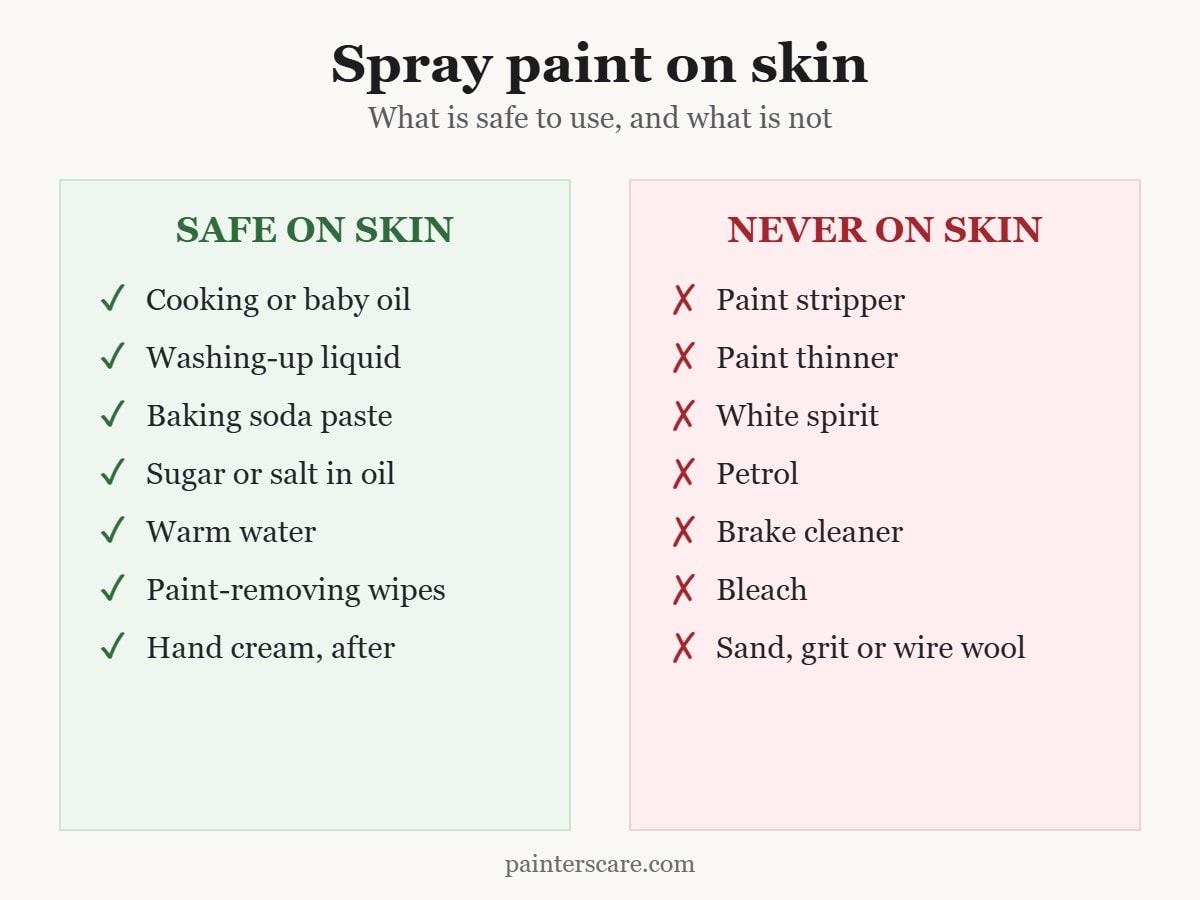
The reason oil works is that it gets between the paint and your skin rather than dissolving anything. That is why it is safe enough to use on a face, and a solvent is not.
Water-based or oil-based? It changes how long it takes
Most rattle-can spray paint sold for household use is either an acrylic lacquer or an enamel. Both go off quickly, which is why spray paint feels harder to remove than latex paint off a roller.
Water-based or acrylic paint that is still wet washes off with soap and water. Once it has flashed off – and spray paint does that in minutes – you are into the oil method.
Oil-based and enamel paint is more stubborn from the start and usually needs two or three rounds of oil and detergent. Give the oil longer to sit on it. If you want the detail on cure times, see how long spray paint takes to dry.
Paint on a face, near eyes, or on a child
Oil and a soft cloth only. No alcohol, no acetone, no abrasive, no wipes designed for hands.
If spray paint has gone in an eye, do not try to clean it out. Rinse with clean lukewarm water for fifteen minutes, holding the eyelid open, and get medical advice. Aerosol propellant and pigment in an eye needs checking properly.
On a small child, the same applies but with less patience for scrubbing – oil, a gentle wipe, and accept that a faint stain may need a day or two to wear off. Their skin renews quickly and a shadow of paint is doing no harm.
When paint on skin is a medical emergency
There is one case where this stops being a cleaning question. If paint has been forced under the skin by an airless sprayer, that is a high-pressure injection injury and it is a surgical emergency – go to A&E immediately and tell them what was injected.
Airless units run at thousands of psi, enough to push paint through skin from a tip held close, often through a pinhole you can barely see. It typically looks trivial for the first hour: a small mark, a numb fingertip, not much blood. Under the surface the paint is tracking along the tendon sheath, and solvent-based products cause tissue death quickly. Delay is what costs people fingers – reviews of these injuries consistently describe them as time-critical and frequently underestimated at first presentation (high-pressure injection injury: case report and systematic review, National Library of Medicine).
To be clear about what this does not mean: an aerosol can cannot do this. Overspray from a rattle can that has landed on your hand is just paint on skin, and the oil method is all you need. The warning is specific to airless equipment and to paint that has gone through the skin.
If you use an airless unit, this is the reason the trigger lock and the tip guard exist, and the reason nobody should ever test a tip against their hand. Our airless sprayer guide covers the safety features worth having.
If you just leave it
Paint on skin is not absorbed and it does not stain permanently. Skin sheds constantly, so even a patch you give up on is gone in roughly three to five days, faster on hands that get washed all day and slower in the creases of knuckles and around nails.

Not getting it on you next time
Nitrile gloves, and barrier cream on your wrists and forearms where gloves stop. A cheap box of nitriles costs less than one tub of specialist wipes and makes the whole question disappear.
The other half of it is overspray drift, which is what puts paint on your face and arms rather than your hands. Spray with the can moving, keep it the distance off the surface that the label asks for, and work with ventilation. If you are spraying anything for more than a few minutes, wear a proper respirator – the paint landing on your skin is also the paint you are breathing.
Getting it off everything else
Different surfaces want different approaches, and almost none of them want the oil trick:
- Spray paint on a mirror or glass – a blade scraper, carefully.
- Homemade paint removers for wood and furniture.
- Paint strippers for a full strip-back.
- Heat guns for layered paint on woodwork.
- Stopping spray paint rubbing off once the job is done properly.
Skin is the one surface where the usual solvents are the wrong answer. For everything else, matching the method to the surface sets out what to use where.
Frequently asked questions
Does rubbing alcohol remove spray paint from skin?
It does, on small spots. It also strips your skin’s natural oils and leaves it dry and tight, and it stings on any cut. Use it only on a stubborn speck that oil has not shifted after a few rounds, never on the face, and moisturize afterwards.
What happens if you get spray paint on your skin?
For most people, nothing. Dried paint sits on the surface and is not absorbed. Wet solvent-based paint can irritate, and repeated exposure without gloves can cause contact dermatitis over time. The exception is paint forced under the skin by an airless sprayer, which is a medical emergency.
What removes dried spray paint from hands?
Oil worked in for a minute, then dish soap on top of the oil, then warm water. Two or three rounds. For the last specks, a paste of baking soda or sugar mixed into the oil gives you gentle grit.
How long will spray paint stay on skin?
Three to five days if you do nothing, as the outer layer of skin sheds. Hands clear faster because they get washed; knuckle creases and the skin around nails hold on longest.
How do you get spray paint off skin quickly?
Catch it while wet – soap and warm water alone will do it in the first minute or two. Once dry, the oil and detergent method is the fastest safe route. There is no instant option that is not a solvent, and the solvents are not worth it.
Is spray paint toxic after it dries?
Dried paint on skin is inert and is not absorbed. The hazard with spray paint is inhaling the aerosol and solvent vapor while you are spraying, not the dried film afterwards.
Will nail polish remover get spray paint off?
A dab on a cotton bud will lift a small spot. Do not soak your hands in it. Acetone dries and cracks skin quickly, and cracked skin then absorbs more of whatever you put on it. Non-acetone remover is gentler but also weaker.
Does WD-40 remove spray paint from skin?
It works, and it is not the worst option, but it is a petroleum distillate and it is not made for skin. Cooking oil does the same job by the same mechanism without the solvent. If you do use it, wash thoroughly with soap immediately afterwards.
How do you remove spray paint from hair?
Oil again – work it through the affected strands, leave it a few minutes, then shampoo twice. Do not use solvent or acetone anywhere near hair or scalp. If a large area is covered, cutting it out is often less damaging than repeated washing.
Better still, avoid it next time: our guide to spray painting covers the gloves, respirator and setup worth having in place before you start.
