Last Updated on October 9, 2026
Flat paint looks wonderful and cleans badly, and those two facts have the same cause. The finish that hides every roller mark and every patch of bad plaster is the same finish that has nowhere for dirt to sit except inside the paint film. So the honest version of how to clean flat paint walls is not a magic product. It is a method, applied gently, that stops at the right moment.
Here is the short answer, then the parts nobody tells you: which cleaner suits which mark, what to do about the shiny patch you have probably already made, and the point at which cleaning stops being the answer.

How to clean flat paint walls: the short answer
To clean flat paint walls, dust the wall dry first, then wipe it with a barely damp microfiber cloth and a solution of one teaspoon of dish soap in four liters (one gallon) of warm water. Blot marks rather than scrubbing them, work in sections of about a meter, keep a second dry cloth in your other hand, and stop the moment the mark lifts. Pressure, not water, is what ruins flat paint.
- Dust the whole wall dry, top to bottom.
- Mix one teaspoon of dish soap into four liters of warm water.
- Test on a hidden patch — behind a door, below a radiator.
- Wring the cloth until it feels cool, not wet.
- Blot the mark, then wipe in straight overlapping strokes.
- Dry the section immediately with a clean cloth.
That is the whole routine for ordinary grime. Everything below is for when ordinary grime is not what you are dealing with.
Why flat paint is so hard to clean
Every paint is a mixture of pigment and binder. The binder is the glue that dries into a continuous plastic film; the pigment is the solid powder that provides color and opacity. The ratio between them is called pigment volume concentration, and it is the single number that decides how a paint behaves once it is dry.
Push the pigment level high enough and you cross a threshold coatings chemists call the critical pigment volume concentration. Past that point there is no longer enough binder to coat every pigment particle and fill the gaps between them, so microscopic air voids open up inside the dried film, and resistance to moisture and staining drops sharply at the same time. Flat paint sits above that threshold. Semi-gloss sits well below it.
Two consequences follow, and between them they explain every frustration you have had with a matte wall:
- Dirt goes in, not on. A greasy fingerprint on semi-gloss sits on top of a sealed film and lifts off. The same fingerprint on flat paint wicks into the voids. You are no longer cleaning a surface; you are trying to extract something from inside it.
- The surface is fragile. Those voids are what scatter light and make the finish look flat. Crush them — with a scourer, a melamine sponge, or just hard rubbing — and the surface flattens out, reflects light, and goes shiny. That is burnishing, and it is covered further down.
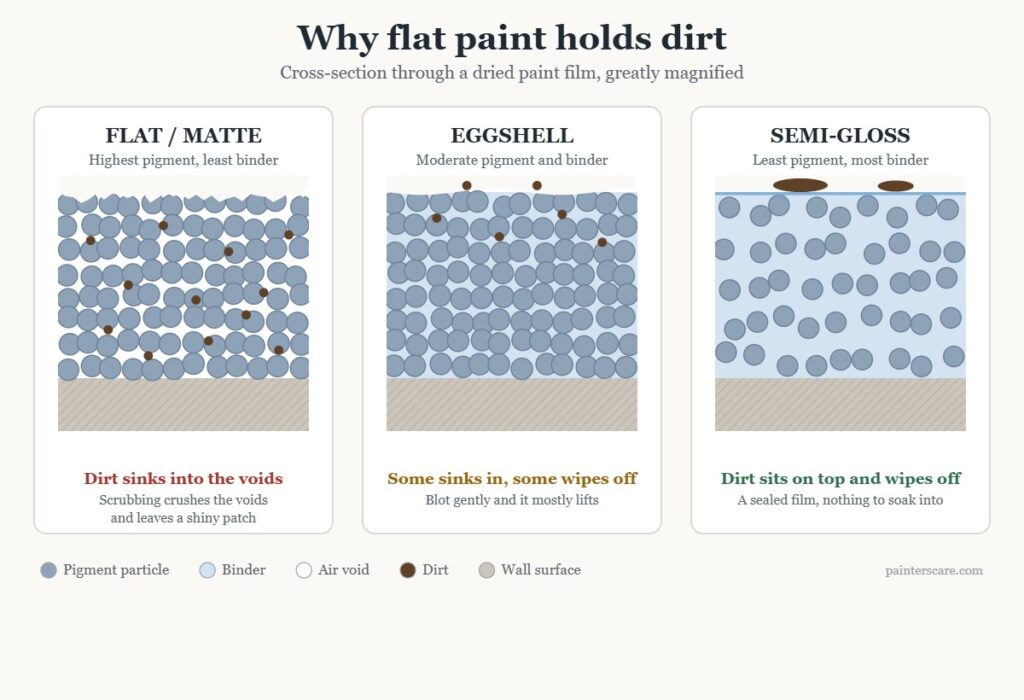
This is also why a wall painted in flat and a wall painted in eggshell can be the same color, the same brand and the same age, and behave completely differently the first time someone leans a hand on them. If you are choosing paint for a hallway or a kid’s bedroom, our full chart of paint sheens room by room is worth two minutes before you buy.
What you need
- Two or three microfiber cloths — one damp, one dry, one spare
- A vacuum with a soft brush head, or a clean dry microfiber mop on a pole
- Two buckets: cleaning solution in one, plain warm water in the other
- dish soap (Fairy, Dawn — any mild dish soap)
- A spray bottle, for control rather than coverage
- Old towels along the baseboard

Nothing on that list is abrasive and nothing on it is a solvent. That is deliberate. If you clean walls often enough to want proper kit, our roundup of the best wall cleaning tools for DIYers covers the pole-mounted mops and pads that make a whole-room wash bearable.
How to clean flat paint walls, step by step
Step 1: Dust the whole wall dry
Do not skip this and do not do it with anything damp. A flat wall carries a fine layer of household dust, cooking aerosol and skin cells that you cannot see until water hits it. Introduce moisture first and you turn that layer into a thin mud that you then smear across the wall in streaks, and those streaks are far harder to remove than the dust was.
Work top to bottom with a vacuum brush head or a dry microfiber mop. Do the ceiling line, the picture rail, the tops of door frames and the baseboards. Five minutes here saves half an hour later.
Step 2: Mix the mildest solution that will work
One teaspoon of dish soap to four liters of warm water. That is it. Not a capful, not a squirt — a teaspoon. Too much detergent leaves a residue that dries as a dull film, and on flat paint that film is visible from across the room.
Fill the second bucket with plain warm water. You will use it to rinse the cloth between sections, which is the difference between moving dirt around and actually removing it.
Step 3: Test somewhere nobody looks
Behind a door, low down beside a radiator, inside a cabinet recess. Wipe a coin-sized patch, let it dry fully — three or four minutes — and look at it from an angle with the light behind you. You are checking for two things: color coming away onto the cloth, and a change in sheen. If the cloth picks up color, the paint is either very cheap, very old or was applied over an unsealed surface, and washing is off the table entirely.
Step 4: Blot first, wipe second
Spray the cloth, never the wall. Liquid running down flat paint leaves a tide mark that outlasts the stain you were trying to remove.
Press the damp cloth onto the mark and hold it there for a few seconds. You are letting the water do the work of softening whatever is in the film, rather than asking friction to do it. Then wipe — straight strokes, light pressure, no circles. Circular scrubbing is the fastest way to produce a shiny ring around a mark that is now slightly cleaner and much more obvious.
Step 5: Work in sections and keep the edge wet
Roughly a meter square at a time, top to bottom, overlapping each section into the one before while it is still damp. This is the same wet-edge principle you use when painting, and for the same reason: a boundary that dries before you reach it shows up as a line.
Step 6: Dry each section as you go
Second cloth, clean and dry, straight after the damp one. Do not leave flat paint to air-dry — the water carries dissolved dirt and detergent, and wherever it evaporates last is where that residue concentrates. Blotting it off wet is the whole trick to a streak-free finish.
Which cleaner for which mark
Soap and water handles general grime. It does not handle wax crayon, and it does not handle thirty years of nicotine. This is the part the generic advice skips, and it is usually the reason people end up scrubbing a hole in their wall.
| Mark | What to use | Avoid | Realistic outcome |
|---|---|---|---|
| Fingerprints, general grime | Mild soap and water, blotted | Any scouring pad | Comes out fully |
| Greasy kitchen film | Warm water with a little extra dish soap; two passes | Degreaser sprays, TSP | Comes out, may need a second go |
| Scuff marks (shoes, furniture) | Damp cloth, blot and lift; a pencil eraser on stubborn ones | Melamine sponges | Usually comes out |
| Pencil | Soft white eraser, then damp blot | Solvents | Comes out fully |
| Wax crayon | Hair dryer on low to soften the wax, blot the wax off with paper towel, then soap and water | Rubbing while cold | Usually comes out, wax may leave a faint sheen |
| Coffee, juice, food splashes | Blot immediately with plain water while wet | Letting it dry | Good if fresh, poor once dry |
| Biro and marker | Nothing safe works | Alcohol, acetone, hairspray | Touch up or repaint |
| Nicotine or smoke film | Sugar soap, heavily diluted, as a pre-paint wash only | Trying to clean it and keep the paint | Needs a stain-blocking primer and repaint |
| Mold spots | Dilute bleach solution, blotted, then rinsed | Scrubbing | Kills the mold, usually leaves a mark |
| Water stain from a leak | Nothing — it is coming through from behind | Cleaning at all | Fix the leak, stain-block, repaint |
The pattern in that table is worth naming. Marks that sit on top of the paint come off. Marks that have soaked into the paint, or that are coming through it from behind, do not — and every extra minute you spend attacking them makes the damage worse than the mark.
The shiny patch problem, and how to fix it
This is the damage almost everyone does, and almost nothing written about cleaning flat paint walls tells you how to undo it.
Burnishing is what happens when you rub a matte surface hard enough to compress it. The tiny irregularities that were scattering light in all directions get flattened into a smoother plane, and a smoother plane reflects. The result is a patch that is often cleaner than the wall around it and looks far worse, because it catches the light when you walk past.
You have not removed the paint. You have changed its texture. Which means no amount of further cleaning will bring it back, and rubbing the surrounding area to match only spreads the problem.
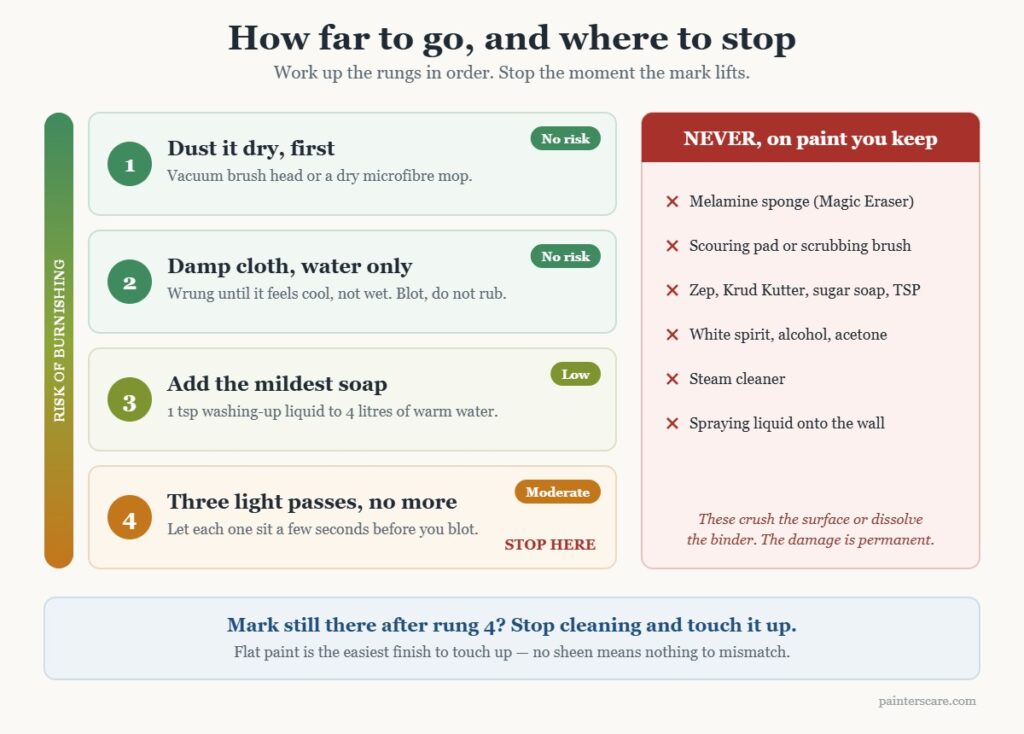
There are three honest options once a patch is burnished:
- Leave it. A faint burnish low on a wall, behind furniture or in a room with soft lighting genuinely is not worth chasing. Judge it from where people actually stand.
- Touch it up. Flat paint is the most forgiving finish there is to touch up, because there is no sheen for the new patch to mismatch against. More on this below.
- Repaint the wall, corner to corner. The nuclear option, and the only one that is guaranteed invisible.
Prevention costs nothing: stop cleaning the instant a mark stops fading. If three light passes have not shifted it, a fourth heavy one will not either — it will just burnish the area around it.
Can you use a Magic Eraser on flat paint?
No, and it is worth understanding why, because the product is recommended constantly for exactly this job.
A melamine foam sponge is not a sponge in any useful sense and it contains no cleaning agent. It is an abrasive. The polymer strands are extremely hard at a microscopic scale, so the foam works like exceptionally fine sandpaper, reaching into tiny grooves and pits. It removes marks by removing a thin layer of whatever the mark is sitting on.
On a glazed tile or a laminate countertop, that layer is grime and the surface underneath is unharmed. On flat paint, that layer is the paint. You will see the mark disappear, which is why the advice keeps circulating, and you will then see a dull, slightly lighter, slightly different-textured patch appear as the wall dries — because you have sanded the top of the film off and exposed fresh pigment underneath.
If you have already done it, treat the patch exactly like a burnish: leave it, touch it up, or repaint the wall.
Is Zep or sugar soap safe on flat paint?
Heavy-duty wall cleaners — Zep, Krud Kutter, sugar soap, trisodium phosphate — are formulated to strip grease and dull a glossy surface so that new paint will grip it. Dulling the surface is a feature when you are about to repaint. It is a disaster when you are not.
These products are alkaline, and alkali attacks the binder that is already in short supply in a flat paint film. Used at label strength on a matte wall, the usual outcome is a patch that looks clean while wet and chalky once dry, often with a faint outline showing where the product reached.
The rule is simple: heavy-duty cleaners belong to the preparation stage of a repaint, not to routine cleaning. If you intend to keep the paint you have, the strongest thing that should touch it is dish soap.
How to clean flat paint walls without streaks
Streaks are the most common complaint, and they almost never come from the cleaner. They come from four habits:
- Cleaning over dust. Covered above, and responsible for most of them.
- Too much detergent. The residue dries as a film. If in doubt, use less soap and more passes.
- A cloth that is too wet. Water running downwards deposits dirt in a line at the bottom of its run. Wring until the cloth feels cool rather than damp.
- Letting sections air-dry. Whatever is dissolved in the water ends up concentrated wherever it dries last.
Fix those four and the streaking problem disappears without changing product at all. The two-cloth method — damp in one hand, dry in the other, never more than a few seconds apart — solves three of them by itself.
When cleaning is not the answer: touching up flat paint
Here is the good news that offsets everything else in this article. Flat paint is genuinely easy to touch up — easier than eggshell, satin or any gloss — for the same reason it is hard to clean. There is no sheen, so there is nothing for a new patch to reflect differently.
Five minutes with a pot of the original paint will beat an hour of scrubbing, and will look better afterwards. To make a touch-up genuinely invisible:
- Use the original paint, and stir it properly. Settled pigment is the main cause of a touch-up drying a shade off. Stir for a full minute, not a quick swirl.
- Apply it with the same tool as the original coat. A brushed patch on a rolled wall shows up in raking light because the texture differs, not the color. A small foam or short-nap mini roller is the safe choice — our guide to choosing a paint roller for walls covers nap length if you are unsure what was used.
- Keep the patch small and feather the edge. Roll outward from the center with a nearly dry roller so the new paint thins out rather than stopping at a hard line.
- Let it dry fully before judging it. Flat paint dries lighter than it looks wet. Give it a couple of hours.
If the wall is more patch than paint, or the original tin is long gone, repaint corner to corner. Stopping halfway across a wall never works, whatever the finish.
And if you are repainting anyway, this is the moment to ask whether flat was the right call for that room. In a hallway, a stairwell, a kitchen or a child’s bedroom, a modern washable matte or an eggshell gives you nearly the same look with a film you can actually wipe. Our comparison of eggshell vs satin paint lays out where each one belongs.
Cleaning flat paint walls before repainting
Completely different job, and the rules invert. You are no longer protecting the existing finish — you are removing everything that would stop new paint sticking to it, and you do not care what the old surface looks like afterwards.
- Dust and vacuum as before.
- Wash with sugar soap at label dilution, or a proper degreaser in a kitchen.
- Rinse with clean water — this step gets skipped constantly, and leftover sugar soap stops paint adhering.
- Let the wall dry completely, which means overnight in a cool room.
- Spot-prime any stain that is still visible with a stain-blocking primer, not ordinary undercoat.
Nicotine, smoke damage and water stains all need that stain-blocking primer. They bleed through latex paint no matter how many coats you apply, and finding that out after two coats of finish paint is a miserable way to spend a weekend.
How often should you wash flat painted walls?
Less often than you would wash any other finish, and more often than you probably do. A full wash once a year is plenty for a bedroom or living room. Kitchens and hallways benefit from twice.
Spot cleaning is the opposite: do it immediately. A splash blotted while wet lifts completely; the same splash found a week later has soaked into the film and is now a repaint. Keep a dry microfiber cloth in the kitchen drawer and the odds shift a long way in your favor.
Frequently asked questions
Can you clean flat paint walls at all?
Yes, but gently and with limits. Dust, fingerprints, light scuffs and fresh splashes all come off with a barely damp microfiber cloth and a very dilute dish soap solution. What flat paint cannot survive is pressure, abrasives or strong alkaline cleaners, and it will not give up ink, dried food or nicotine at all.
Why is flat paint so hard to clean?
Flat paint carries more pigment relative to binder than any other finish, which leaves microscopic air voids throughout the dried film. Dirt sinks into those voids instead of sitting on the surface, so there is nothing to simply wipe away. The same voids make the surface easy to crush, which is why hard rubbing produces a shiny patch.
Can I use a Magic Eraser on flat paint?
No. Melamine foam is a fine abrasive that works like exceptionally fine sandpaper, and it removes marks by sanding off the surface they sit on. On flat paint that surface is the paint itself, so the mark disappears and a dull, slightly lighter patch takes its place once the wall dries.
Can you clean flat paint walls with vinegar?
You can, but there is little reason to. A heavily diluted vinegar solution — roughly 8.5 fl oz (250 ml) in four liters of water — is mild enough not to harm the film and cuts light grease. It is not more effective than dish soap, it smells, and at stronger dilutions the acidity starts working on the binder. Use soap unless you have a specific reason not to.
What is the best cleaner for flat paint walls?
One teaspoon of dish soap in four liters of warm water. There is no specialist product that outperforms it on matte latex paint, and most of the ones marketed for walls are degreasers strong enough to dull the finish. The technique matters far more than the chemistry here.
How do you clean matte walls without removing paint?
Test a hidden patch first, keep the cloth barely damp, blot rather than scrub, and stop as soon as a mark stops fading. If color transfers onto the cloth during the test, the paint is too fragile to wash and touching up is the only safe route.
Does flat paint come off when you wash it?
Good-quality flat paint applied over a sealed surface will not come off with gentle washing. Cheap contract latex paint, very old paint, and paint applied straight onto bare plaster or filler without a mist coat often will — which is exactly what the hidden-patch test is for.
Will a steam cleaner work on flat paint walls?
Avoid it. Steam drives moisture into a porous film and softens the binder, and the usual result on matte latex paint is a blotchy patch or lifted paint. Steam is useful for stripping wallpaper, not for cleaning walls you want to keep.
Is there a flat paint that can be washed?
Yes. Most major manufacturers now sell a washable or scuff-resistant matte, which uses modified binders to close up the film while keeping the light-scattering surface. It looks close to traditional flat and cleans far better, though still not as well as eggshell. If you are repainting a high-traffic room, it is the obvious upgrade.
How do I get grease off flat paint walls above the stove?
Warm water with slightly more dish soap than usual, applied in two or three light passes rather than one hard one, letting each pass sit for a few seconds before blotting. Resist degreasers — they will lift the grease and dull the paint with it. If the film has built up over years, cleaning will only ever get you part of the way, and repainting with a washable matte or eggshell is the real fix.
The short version
Dust dry, wipe barely damp, blot rather than scrub, dry as you go, and stop early. Keep abrasives and heavy-duty cleaners away from any wall you intend to keep. And accept that flat paint has a category of mark it will simply never give up — for those, a five-minute touch-up with the original tin is not a failure, it is the correct tool.
