Last Updated on October 9, 2026
To remove paint, match the method to the surface. A solvent gel stripper is the safe default on almost anything, heat suits thick paint on solid timber, abrasives suit flat steel, and a plain solvent wipe handles fresh splashes. Get the surface wrong and you damage the thing you are stripping, not just the paint.
Walls are the exception to most of this. On interior drywall the right answer is usually not to strip at all, and our guide to removing paint from walls explains why scraping, feathering and skimming beats a stripper on paper-faced board.
That is the whole problem with most paint-removal advice. It leads with the method — stripper, heat gun, sander — and leaves you to work out whether your particular door, radiator, window or hinge can survive it. The order is backwards. What you are taking the paint off decides everything, and it takes about a minute to establish.
This page is the routing layer. Find your surface below, get the short answer, then follow the link to the full guide for that job.
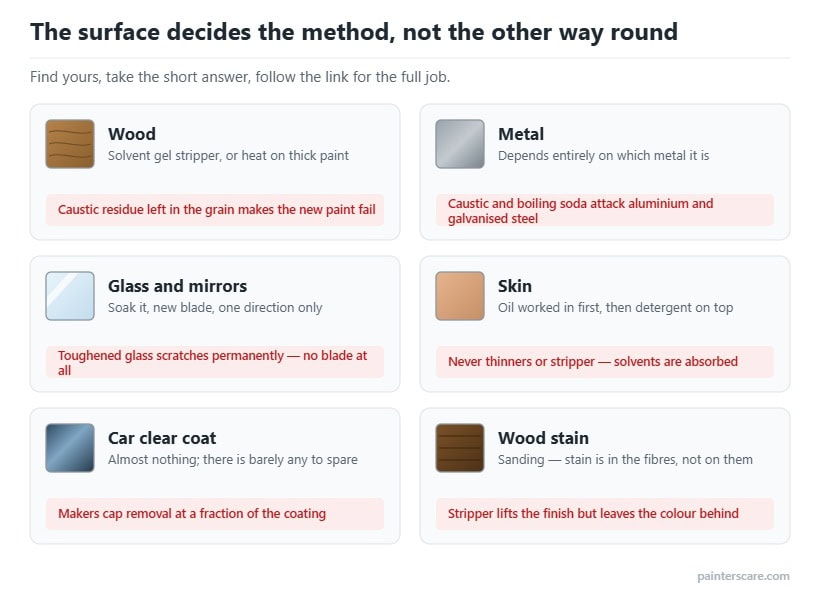
Start here: what are you taking the paint off?
| Surface | What works | The thing that catches people out | Full guide |
|---|---|---|---|
| Wood | Solvent gel stripper, or heat on thick paint | Caustic residue left in the grain makes the new paint fail | Removing paint from wood |
| Metal | Depends entirely on which metal | Caustic and boiling soda chemically attack aluminum and galvanized steel | Removing paint from metal |
| Glass and mirrors | Soak and a new blade, one direction only | Toughened glass scratches permanently; a blade must never touch it | Removing paint from glass |
| Skin | Oil first, then detergent on top of the oil | Solvents strip skin and get absorbed; never use thinners | Getting paint off skin |
| Car clear coat | Almost nothing; the layer is thinner than you think | Manufacturers cap removal at a fraction of the coating | Fixing peeling clear coat |
| Wood stain rather than paint | Sanding, usually; stain is in the fibers not on them | Stripper lifts the finish but leaves the color behind | Removing stain from wood |
Two surfaces are missing from that table because they behave differently enough to need care: plastic, where acetone will fog or melt the item faster than it lifts the paint, and drywall walls, where almost any stripper destroys the paper face and filling is usually the better answer.
Plastic is also the surface where the wrong solvent does the most damage, because the removers that work on wood and metal dissolve it. Our guide to removing paint from plastic goes through which solvent each resin code can survive.
The four methods, and what each is actually for
Everything is a variation on four approaches. Picking between them is mostly about how much you care about the surface underneath.
| Method | Best for | Speed | Main risk |
|---|---|---|---|
| Solvent gel stripper | Detail, moldings, mixed metals, anything you care about | Slow — 20 min to overnight | Almost none to the substrate; the risk is impatience |
| Caustic stripper | Thick old paint on plain steel or iron | Fast | Destroys aluminum, zinc and plating; burns skin |
| Heat | Thick paint on solid timber, window frames, doors | Fast | Scorching, cracked glass, and lead fumes on old paint |
| Abrasive | Flat steel, large areas, bare-back jobs | Fastest | Warps thin sheet, gouges soft metal, makes dust |
One trick matters more than which brand you buy. Modern strippers are mostly benzyl alcohol or dibasic ester rather than the old dichloromethane, which means they work by staying wet. Lay the gel on thick — 2 to 3 mm — then cover it with plastic wrap or a cut-open carrier bag so it cannot evaporate. That single step is the difference between a stripper that appears useless and one that lifts four layers in a go.
For the tool-based routes, we have separate guides to using a heat gun for paint removal and to choosing a paint stripping disc, which covers the mounting trap that catches most first-time buyers.
Which paint is it? The cotton bud test
Before you buy anything, find out what you are dealing with. Dab a cotton bud in denatured alcohol or isopropyl alcohol, rub a hidden patch for thirty seconds, and look at the bud.
- Color transfers and the paint goes tacky — water-based. Latex paint or acrylic. Often comes off with hot water and detergent alone, no stripper needed.
- Nothing happens — oil-based, alkyd or enamel. This is the one that needs a stripper or heat.
- It dissolves quickly and smells sharp — lacquer, usually from an aerosol. Acetone redissolves it completely.
- Nothing happens and the finish is unusually hard and even — powder coat. Solvents barely touch it; you need blasting or a purpose-made remover.
That test takes a minute and decides whether you need a $20 tin or a bowl of soapy water.
Why vinegar and baking soda cancel each other out
Mixing vinegar and baking soda neutralizes both of them, so the recipe you keep seeing has no working vinegar left in it by the time you use it. It turns up everywhere, including on major paint brands’ own sites and inside Google’s answer box: half water, half distilled vinegar, a quarter cup of baking soda per quart, brought to the boil, drop your hardware in.
It does not work the way it is described, and the reason is first-year chemistry.

Vinegar is acetic acid. Baking soda is sodium bicarbonate, a base. Put them together and they neutralize each other, one molecule of acid to one of bicarbonate, producing sodium acetate, water and carbon dioxide. The fizzing people take as evidence that something powerful is happening is the sound of both ingredients destroying each other.
Run the quantities in that recipe and it is worse than a draw. A quarter cup of baking soda is roughly 55 g, about 0.65 moles. A quart of half-and-half vinegar gives you around 473 ml of 5% vinegar, which is roughly 24 g of acetic acid, about 0.39 moles. The reaction is one to one.
- Every drop of the vinegar is consumed. There is no acid left in the pot at all.
- Around 40% of the baking soda survives, because it was in excess to begin with.
- Boiling then converts that leftover bicarbonate to carbonate — washing soda — taking the pot to somewhere around pH 11.
So the “vinegar method” ends up as a hot alkaline bath with no vinegar in it. That matters for two reasons. It is not doing what the instructions claim, and an alkaline bath is precisely the thing that attacks aluminum and the zinc on galvanized steel, which is covered in detail in the guide to removing paint from metal.
The honest version of the method is simpler and safer: hot water and a squirt of dish soap, an hour or two in an old steel pan or a slow stove. The heat and the water are what release the paint. Leave both the vinegar and the soda out and the method works on more metals, not fewer. The same applies to most kitchen-cabinet recipes — our look at which homemade paint removers actually work goes through them one at a time.
Check for lead before you choose a method
Assume lead in any paintwork from before the 1980s until a swab test says otherwise, and change the method rather than the ambition. The official line is not to strip it at all unless you have to: leave sound paintwork in place and paint over it.
The dates are later than most people assume. The HSE’s guidance on lead in construction states that lead pigments were widely used in paints for homes, schools and offices “until the 1960s” and that lead “was not removed from all commonly used paint until the early 1980s”. It sits underneath later paintwork in older buildings, so the layer you can see tells you nothing. In the US the federal ban on lead paint for homes came in 1978.
HSE’s advice is to strip back old paint only if it is flaking, chipping, giving off dust or particles, or is a risk to children. Otherwise key it with wet abrasive paper and paint over it. That is not a fudge — intact paint is not a hazard, and disturbing it is what creates one.
If you do have to remove it, the acceptable methods are narrower:
- Chemical stripper, which keeps the lead in a wet sludge you can bag rather than in the air. This is the reason to prefer chemical stripping on old work generally.
- Wet abrasive paper and a scraper. Wet, not dry — dry sanding is what puts lead dust into the room and the carpet, where it stays.
- A hot air gun or infrared equipment, kept below 500 °C. Heat is not banned, but overheating is: HSE specifically says not to use blowtorches or gas torches on leaded paint.
- On-tool extraction with an H or M class unit if you are using power tools.
Wear an FFP3 disposable mask or a half mask with a P3 filter, sheet the area off, keep children and pregnant women well away from it, wash your hands and forearms before eating or drinking, and do not wash contaminated clothing at home.
What not to do
- Buying the strongest thing on the shelf. Caustic strippers are the most aggressive product widely sold and the most likely to ruin what is underneath. Strength is only the right question once you know the surface can take it.
- Spreading stripper thin. It works by dwelling wet. A thin coat dries and does nothing, and people conclude the product is useless.
- Using a steel scraper on anything soft. Plastic or wood scrapers on metal, glass and fine timber. A steel blade leaves marks that show through the new finish.
- A heat gun near glass. Uneven heating cracks panes and blows the seal on double glazing.
- Skipping the neutralizing rinse. Residue left in a seam or in open grain will lift your new paint months later.
- Working indoors without ventilation. Vapor is the hazard people underestimate, more than skin contact. Our guide to using thinners and solvents properly covers ventilation and disposal.
Frequently asked questions
What is the easiest way to remove paint?
A solvent gel stripper laid on thick and covered with plastic wrap, left for twenty minutes to overnight, then lifted with a plastic scraper. It is not the fastest method, but it needs the least skill, works on almost every surface, and is the one least likely to damage what is underneath. On small steel hardware, an hour in hot soapy water beats it for effort per piece.
Does vinegar remove paint?
Only barely, and only on fresh water-based paint. Vinegar is about 5% acetic acid, which will soften latex paint that has not fully cured but does nothing to a cured oil-based or enamel film. It is genuinely good at rust and mineral deposits, which is a different job people often confuse with this one. Mixing it with baking soda makes it useless, because the two neutralize each other.
Will rubbing alcohol remove paint?
Isopropyl alcohol shifts fresh latex paint and acrylic craft paint, and it is the safest thing to try first because it will not harm most surfaces, platings or finishes. It does very little to cured enamel or oil-based paint. Use it at 70% or stronger and keep the surface wet for a few minutes rather than letting it flash off. It is also the basis of the cotton bud test for identifying what paint you have.
Will Dawn or dish soap remove paint?
On fresh water-based paint, yes, and better than most people expect — detergent plus hot water is the correct first attempt for latex splashes on almost any surface. On cured paint it does nothing on its own, but it is still worth adding to a hot water soak for small metal hardware, where it helps the water get under the film.
How do you get dried paint off?
Soften it before you touch it with anything hard. Water-based paint re-swells with hot water and detergent given ten minutes. Oil-based and enamel need a solvent stripper and dwell time under a cover so it cannot dry out. Only then lift it with a scraper made of something softer than the surface. Dried paint fails when people scrape first and soften second.
Does WD-40 remove paint?
No. It is a light oil with a carrier solvent, not a paint remover, and it will not dissolve a cured film. It can soften very fresh spatter and it is good at adhesive and sticker residue. It leaves an oily film that has to come off completely before you repaint, or the new paint will not key.
Do I need to remove old paint before repainting?
Usually not. Sound, intact paint is a fine base — clean it, key it with a light sand and paint over it. You only need to strip when the paint is peeling, blistering or crazed, when there are so many layers that detail has been lost, or when you are going from oil-based to water-based, because those two will not bond to each other. Stripping a sound surface is work you have invented for yourself.
What is the fastest way to strip paint from a large area?
An abrasive stripping disc on an angle grinder, on flat steel or masonry. On timber, an infrared or steam stripper covers ground faster than gel and without the dust, and it keeps lead paint damp rather than airborne. Neither is suitable for detail work, soft metals or anything plated, where speed and safety point in opposite directions.
