To remove paint from plastic, find the recycling number moulded into the item first, then pick the solvent that number can survive. Isopropyl alcohol is safe on almost everything except ABS. Acetone is safe on almost nothing. Start with the mildest thing that works, and test a hidden spot before you commit.
Every guide to this question names a solvent. Almost none of them asks what the plastic is, which is the only thing that decides whether the solvent takes the paint off or takes the surface with it.
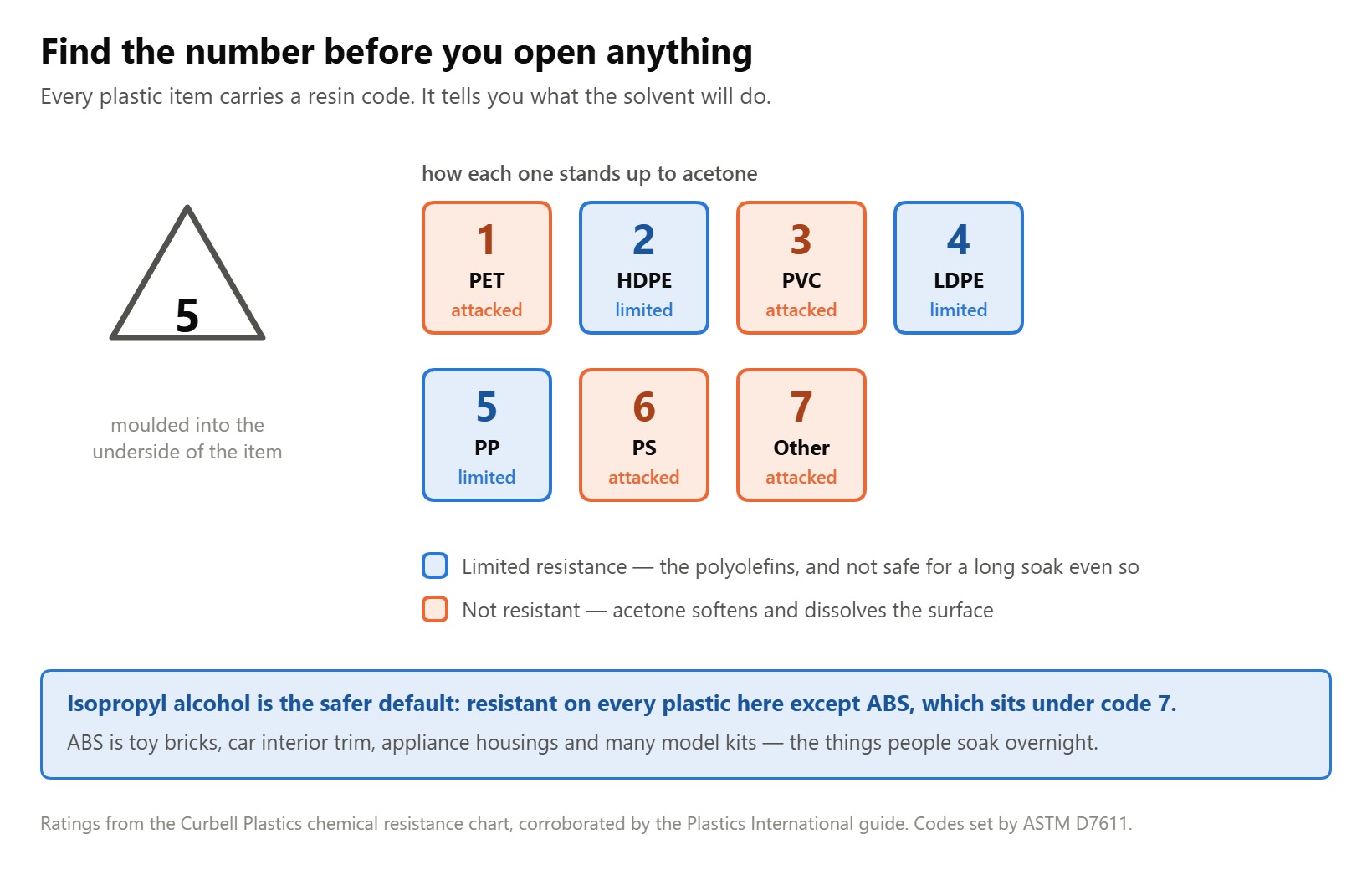
Turn the item over. Somewhere on it there is a small triangle with a number from 1 to 7 inside. That is the resin identification code, standardised as ASTM D7611, and it is the most useful thing on the object. Plastics suppliers publish chemical resistance charts against exactly those polymers, so once you know the number you can look up what will attack it instead of guessing.
What do the numbers mean?
Seven codes, and for paint removal they fall into three groups that behave completely differently.
| Code | Plastic | You will find it in |
|---|---|---|
| 1 | PET, PETE | Drinks bottles, some packaging and trays |
| 2 | HDPE | Milk bottles, buckets, garden furniture, play equipment |
| 3 | PVC | Pipe, window frames, guttering, cheap garden chairs |
| 4 | LDPE | Bags, squeezy bottles, flexible tubing |
| 5 | PP | Food tubs, storage boxes, many car parts |
| 6 | PS | Disposable cutlery, model kits, cup lids |
| 7 | Other | ABS, polycarbonate and acrylic all live here |
Code 7 is the one to slow down on, because it is a bin for everything that is not codes 1 to 6, and the three plastics most likely to be in your hands all sit in it. ABS is car interior trim, toy bricks, appliance housings and a lot of model kits. Polycarbonate is headlight lenses, safety glazing and power tool bodies. Acrylic is signage, glazing panels and display cases. They do not react the same way as each other, so a 7 on its own is not an answer. If the item is unmarked, treat it as the most fragile thing it could be.
Which solvents are safe on which plastic?
Below are the published resistance ratings from Curbell Plastics’ chemical resistance chart, which agree with the Plastics International guide on every material listed in both.
| Plastic | Isopropyl alcohol | Acetone |
|---|---|---|
| ABS (7) | Limited | Not resistant |
| Polycarbonate (7) | Resistant | Not resistant |
| Acrylic (7) | Resistant | Not resistant |
| Polystyrene (6) | Resistant | Not resistant |
| PP (5) | Resistant | Limited |
| LDPE (4) | Resistant | Limited |
| PVC (3) | Resistant | Not resistant |
| HDPE (2) | Resistant | Limited |
| PETG | Resistant | Not resistant |
Two things fall out of that table, and both contradict the advice you will be given everywhere else.
Acetone is not a plastic-safe solvent
It is rated not resistant on ABS, acrylic, polycarbonate, polystyrene, PVC and PETG. The only plastics that survive it are the polyolefins, HDPE, LDPE and polypropylene, and even they are rated limited rather than resistant. So acetone is the wrong answer on nearly everything, and on the code 7 group it does not just mar the surface. It dissolves it.
Nail polish remover is mostly acetone. So is a lot of what gets recommended casually for “just a spot of paint”.
Isopropyl alcohol is safe on everything except the one you probably have
IPA is rated resistant on every plastic in the table but one. The exception is ABS, where both charts drop it to limited.
That matters because the standard advice online is a long IPA soak, twenty minutes at the short end and twenty-four hours at the long end, and ABS is exactly the plastic people are most often soaking: model kits, toy bricks, car interior trim, radio and appliance housings. Limited resistance means some effect over time, which is precisely the case a long immersion creates. On ABS, wipe rather than soak, work in short passes, and stop when the paint lifts rather than leaving it in a tub overnight.
What actually works, in order
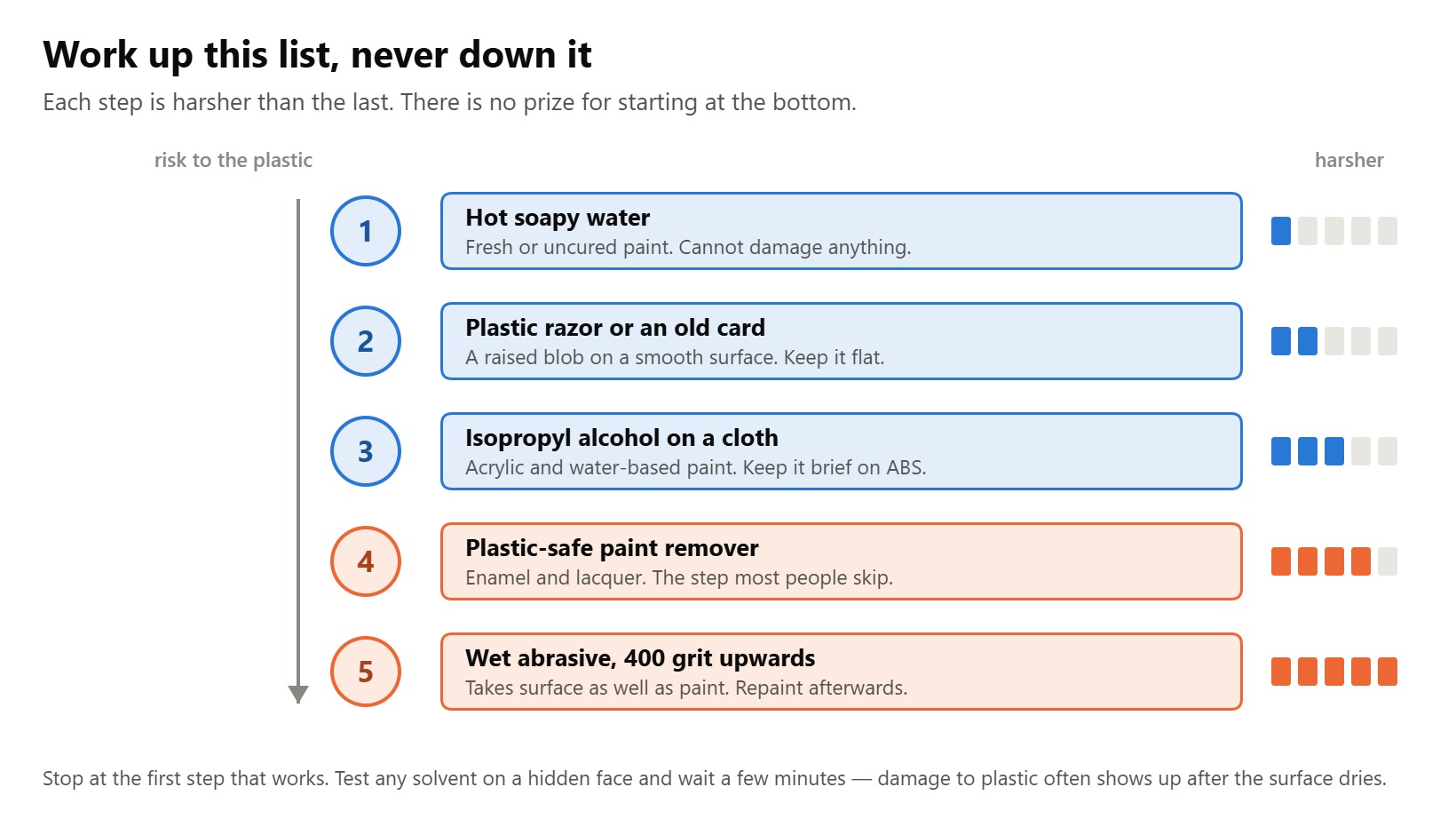
Work up this list, not down it. Each step is harsher than the last, and there is no prize for starting at the bottom.
- Hot soapy water and a plastic scraper. Fresh emulsion and most water-based paint comes off with nothing else, especially if it has not fully cured. Costs nothing and cannot damage anything.
- A plastic razor blade or an old credit card. For a raised blob of dried paint on a smooth surface. Keep it flat to the surface, not dug in.
- Isopropyl alcohol on a cloth. The first real solvent, and the right default for acrylic and water-based paint. Wipe, wait, wipe again. Safe on everything except ABS, where you keep it brief.
- A dedicated plastic-safe paint remover. Slower than a general stripper and more expensive, and formulated not to attack the substrate. This is the step most people skip.
- Wet abrasive, 400 grit upwards. Last resort, and accept that you are removing surface as well as paint. Fine if the item is going to be repainted, wrong if it is not.
Test whatever you choose on a hidden face first, and give it a few minutes before you judge it. Solvent damage to plastic is often not instant. It shows up as a dulled patch or a fine web of cracks a little while after the surface dries.
What about brake fluid?
It keeps being recommended, it does strip paint, and it is a poor idea in a domestic setting.
Every recommendation of it traces back to hobby forums rather than to any published guidance, and none of them mentions the handling. Glycol-ether brake fluid is a skin and eye irritant, it strips paint off whatever else it touches including the car it came from, and it is hazardous waste, so you cannot pour the used soak down a drain or into a garden. For a single toy or bumper trim, a plastic-safe remover costs a few pounds and does not leave you with a litre of contaminated fluid to dispose of.
The same goes for oven cleaner, the other forum favourite. Caustic soda attacks aluminium and some plastics, and the fumes are worse in a kitchen than anything you were trying to avoid.
How do you remove spray paint from plastic?
The same way, with one extra thing in your favour: timing. Spray paint takes a long time to reach full hardness on plastic. Rust-Oleum’s own guidance puts full adhesion on plastic at five to seven days, so a coat that went on this morning is far easier to lift than one from last month.
If the overspray is fresh, hot soapy water and a plastic scraper will often take it. If it has cured, you are back to the table above, and the paint type matters as well as the plastic. Acrylic and water-based spray paints give way to isopropyl alcohol; enamel and lacquer generally will not, and need a plastic-safe remover. Our guide to how long spray paint takes to dry explains which is which, and the spray paints made for plastic covers what to use if you are recoating afterwards.
Restoring the surface afterwards
Bare plastic that has had paint and solvent on it usually looks worse than you expected. That is normal, and mostly fixable.
Wash the whole item with warm soapy water to get the solvent residue off, then dry it completely. A dulled or slightly hazy area can often be brought back with a plastic polish or a fine cutting compound worked by hand. Deeper scuffing from abrasive needs wet sanding through the grits, 600 then 1000 then 2000, before polishing, and at that point you are refinishing rather than cleaning.
What will not come back is crazing. If the solvent has put a fine web of cracks into the surface, that is the polymer itself failing, and no amount of polishing reaches it. Repainting is the only cover.
Frequently asked questions
What is the best paint remover for plastic?
A remover sold specifically as plastic-safe, used after you have checked the resin code. There is no single best product because the right one depends on the polymer and the paint: isopropyl alcohol handles acrylic and water-based paint on most plastics, while enamel and lacquer need a purpose-made plastic-safe stripper. What is reliably wrong is a general-purpose paint stripper meant for wood and metal, which is formulated to attack coatings without regard for what is under them.
Will vinegar remove paint from plastic?
Barely. Warm vinegar will soften a thin film of fresh water-based paint enough to scrape it, and that is the limit of it. Vinegar is a dilute weak acid, and cured paint is not something acid dissolves. It is harmless to try on any plastic, which is its only real advantage, but if hot soapy water has not worked then vinegar will not either.
Does WD-40 remove paint from plastic?
Sometimes, for small marks. It is a light petroleum solvent blend, so it can lift fresh overspray and paint transfer without attacking most plastics. It will not shift a cured coat. The catch is the oily residue, which has to be washed off with detergent before anything can be painted or glued to that surface afterwards, so it is a cleaner rather than a stripper.
Does isopropyl alcohol damage plastic?
On most plastics, no. Published resistance charts rate isopropyl alcohol as resistant on polycarbonate, acrylic, polystyrene, PVC, HDPE, LDPE, polypropylene and PETG. The exception is ABS, rated limited, which means some effect over sustained contact. Since resistance depends on time as well as concentration, the practical rule is that wiping is fine on anything and long soaking is only fine on the plastics rated resistant.
Can rubbing alcohol remove paint?
Yes, for acrylic and water-based paint. Rubbing alcohol is isopropyl alcohol diluted with water, usually to 70%, and the higher the concentration the better it works on paint. It will not touch cured oil-based paint, enamel or lacquer, because those cure by chemical reaction rather than by drying and alcohol does not reverse that.
Will Dawn or washing-up liquid remove paint from plastic?
Only while the paint is still wet or very fresh. Detergent in hot water lifts uncured water-based paint well and is always the first thing to try, because it cannot harm any plastic. Once the film has cured it is no longer soluble and detergent does nothing except make the surface easier to scrape.
Can you use acetone on plastic?
Almost never. Acetone is rated not resistant on ABS, acrylic, polycarbonate, polystyrene, PVC and PETG, and only limited on HDPE, LDPE and polypropylene. On the code 7 plastics it softens and dissolves the surface rather than just marking it, and the damage is permanent. Nail polish remover is mostly acetone, which is why it so often leaves a cloudy patch behind.
How do you remove paint from plastic without damaging it?
Check the resin code, start with hot soapy water, move up to isopropyl alcohol on a cloth, and only then to a plastic-safe remover. Test on a hidden area and wait a few minutes before judging, because solvent damage often appears after the surface dries rather than on contact. Never start with acetone or a general paint stripper, and keep soaking times short on ABS.
How do you remove paint from a plastic car bumper?
Most modern bumper covers are polypropylene or a polypropylene blend, which is one of the more solvent-tolerant plastics, but they are also usually painted from the factory, so a stripper that removes the mark will remove the finish under it too. If the bumper is painted, treat it as paintwork and use a light cutting compound on transfer marks rather than a solvent. If it is bare black plastic, isopropyl alcohol first, then a plastic-safe remover.
Will a heat gun remove paint from plastic?
No. Plastic softens and deforms well below the temperature at which paint blisters, so the substrate fails before the coating does. Heat is a good method on timber and metal and a reliably bad one here. Our guide to removing paint with a heat gun covers where it does belong, and glass is the other surface where the usual advice does not transfer.
What should you never mix isopropyl alcohol with?
Bleach, above everything else. Sodium hypochlorite and isopropyl alcohol react to form chloroform and related chlorinated compounds, and the reaction happens at room temperature in an ordinary bucket. Never combine the two, never use alcohol to wipe something you have just cleaned with bleach, and keep the two off the same rag. Alcohol is also flammable, so keep it away from a heat gun, a pilot light or anything that sparks, and work with a window open.
Can you mix washing-up liquid and isopropyl alcohol?
It is safe to mix, and it will not help you strip paint. Detergent and alcohol are commonly combined in glass and screen cleaners, and nothing hazardous happens. But the detergent does not make the alcohol a better solvent; it only helps lift the loosened residue and stops it redepositing. Use the alcohol neat on the paint, then wash the item with warm soapy water afterwards, which is the same work in the right order.
What cleans plastic without damaging it?
Warm water and a mild detergent, on every plastic there is. That is the only cleaner with no caveat attached, and it handles most household grime. Isopropyl alcohol is the next step for marks detergent will not shift, and it is rated resistant on every plastic in the table above except ABS. For cloudiness or fine scratches rather than dirt, a dedicated plastic polish works where a cleaner cannot. Avoid anything containing acetone, and avoid abrasive cream cleaners on clear plastic, which dull it permanently.
What to remember
The plastic decides, not the paint and not the technique. Find the number in the triangle before you open anything, and if there is no number, assume the item is the most delicate thing it could be.
Three things worth holding on to. Acetone is not a plastic-safe solvent and never was. Isopropyl alcohol is safe on everything except ABS, which is exactly the plastic most people soak. And start with hot soapy water, because a surprising amount of this problem is solved by the mildest thing on the list. For the other surfaces, our guide to matching the removal method to the surface covers the four that actually work, and getting spray paint off skin is the one case where you should not reach for a solvent at all. The full ratings are in Curbell’s chemical resistance chart if you want to check a plastic that is not in the table above.
