Last Updated on October 6, 2026
Almost every guide to getting paint off glass gives you the same answer: wet it, then scrape it with a razor blade. That advice is mostly right, and it is also how people put permanent scratches in windows they cannot replace for $250.
The reason is not technique. It is that not all glass takes a blade. Toughened (tempered) glass carries microscopic particles fused into its surface from the furnace it was made in — invisible, harmless, and impossible to remove. Drag a blade across them and you drag them across the glass. The scratch that leaves cannot be polished out, and no manufacturer will replace the pane, because the particles are a normal feature of the product.
The awkward part is that the panes people most often get paint on — shower screens, patio doors, the glass panel beside a front door, anything low down — are exactly the ones the building regulations require to be toughened.
So this guide starts with a 30-second check, not a shopping list. Once you know what you are looking at, the rest is straightforward.
First, work out what your glass actually is
Three questions, in this order. Each one takes seconds and each one can change the method completely.
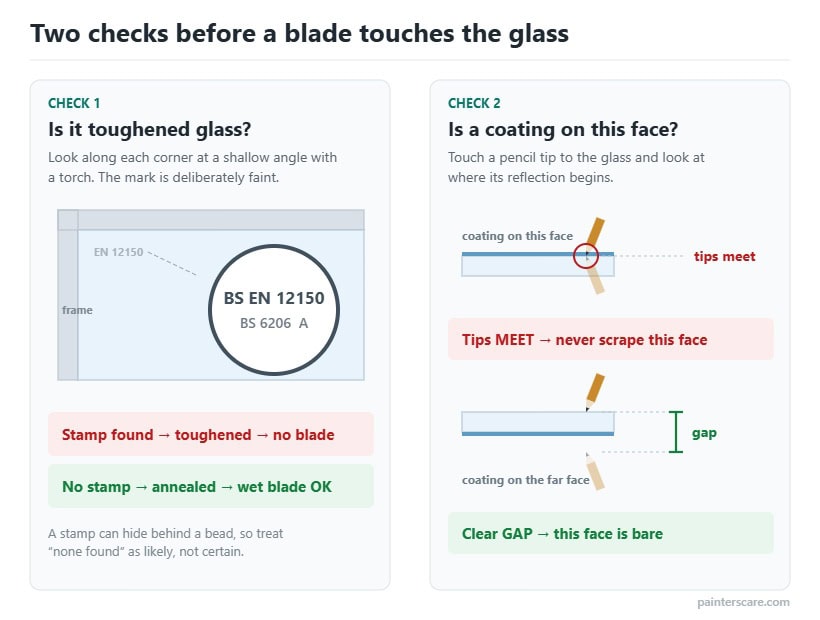
Is it toughened? Check the corner for a mark
Toughened safety glass has to be permanently identified. Look in the corners of the pane, right at the edge, for a small etched or sandblasted stamp — usually a maker’s name plus a standard number. In the UK that is normally BS EN 12150; in the US it is a reference to 16 CFR 1201 or ANSI Z97.1. Installers call it the “bug”.
It is deliberately discreet, so you may need to get your eye close and shine a flashlight along the glass at a shallow angle. If you find one, put the blade down and skip to the sections below on solvents.
If the pane has no mark at all it is probably annealed (ordinary) float glass, which is what most older single-glazed windows and most mirrors are made from. Annealed glass takes a blade reasonably well. Be aware, though, that a mark can be hidden behind a frame or bead, so treat “no mark found” as likely rather than certain — and assume toughened glass anywhere the regulations demand it: shower and bath screens, doors, the glass panels either side of a door, low-level glazing, and glass in a balustrade.
Is there a coating on the surface you are about to scrape?
Low-emissivity glass, reflective glass and applied window film all have a layer on them that a blade will take straight off, leaving a permanently cloudy patch. Modern sealed units usually have the delicate coating tucked away inside the unit, but not always, and retrofit film is always on the surface you can touch.
The industry test for this is quick. Hold a pencil so the tip touches the glass and look at the reflection. If the reflected tip meets the real tip, the coating is on that side, exposed. If there is a visible gap between them, that surface is uncoated and the coating is somewhere else. For film, run a fingernail from the frame onto the glass — you will feel the edge of the film as a small step.
Is it a mirror?
A mirror is annealed glass with a silver layer and two or three coats of protective backing paint on the reverse. The front face scrapes like any other annealed pane. The problem is the edge, which on most mirrors is not sealed — and solvent that creeps around it will attack the silver from behind. There is a dedicated section on that further down.
One trap worth ruling out first: check you are actually looking at glass. A lot of greenhouse glazing, shed windows, cabinet fronts and picture frames are acrylic or polycarbonate. Both scratch if you look at them hard, and acetone will fog acrylic instantly and irreversibly. Tap it — plastic sounds dull, glass rings — or check the edge, which on plastic is usually slightly soft and rounded.
| What you have | How to tell | Blade? | Use instead |
|---|---|---|---|
| Annealed float glass | No corner stamp; older single glazing, most mirrors | Yes, wet, new blade | — |
| Toughened / tempered | Etched stamp in a corner; shower screens, doors, low glazing | No | Solvent and dwell time only |
| Exposed Low-E or reflective | Pencil tip meets its reflection on that face | Never | Mild soapy water; nothing aggressive |
| Applied window film | Fingernail catches a step at the frame | Never | Soapy water; replace the film if paint has soaked it |
| Mirror | Backing paint visible on the reverse | Yes on the face, keeping solvent off the edges | — |
| Frosted, etched or textured | Matte or patterned surface | No — a blade cannot reach the low spots | Solvent and a stiff nylon brush |
| Acrylic or polycarbonate | Sounds dull when tapped; soft edges | No | Soapy water or mineral spirits only — never acetone |
Why a blade scratches toughened glass and not ordinary glass
This is worth understanding, because it is the difference between a job that goes fine and a pane you have to live with.
Toughened glass is made by running ordinary float glass through a furnace at around 620 °C on steel rollers, then quenching it with blasts of air. While the glass is soft and moving over those rollers, debris in the furnace — glass dust from cutting, grit carried in by the quench air, particles off the furnace roof — touches the hot surface and sinks slightly into it.
The materials standard for heat-treated glass, ASTM C1048, addresses this directly. It states that “minute particles (fines), typically invisible to the naked eye, may adhere to one or both glass surfaces”, and — this is the part that matters to you — that such particles are “inherent in the heat-treating process and are not a cause for rejection”.
In other words: every sheet of toughened glass has them, they are not a defect, and a scratch you cause by dragging them around is yours. The glass industry’s own technical bulletin on the subject is blunt about the consequence — that using metal blades will scratch glass, particularly toughened glass. You can read the GANA technical bulletin on heat-treated glass surfaces in full.
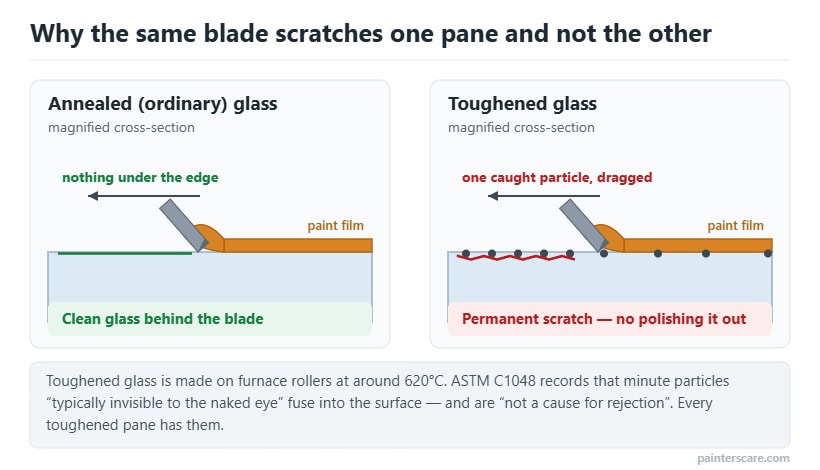
There is a further wrinkle that catches careful people out. Those particles can often be felt but not seen. Someone cleaning a new shower screen runs a hand over it, feels grit, assumes it is dirt, and reaches for a blade to take it off — and turns an invisible non-defect into a visible permanent one.
For completeness: the guidance the glass and window-cleaning trades publish jointly says razor blades and metal scrapers “should not be part of routine cleaning” on any glass, and should never be used on coated surfaces at all. Blades are treated as a restoration technique for paint and construction residue, not a cleaning tool — which is exactly the job you are doing, so a blade on annealed glass is legitimate. Just do it knowing it is the aggressive option.
What kind of paint is on there?
Paint does not bond chemically to glass — there is nothing for it to soak into. What it does is shrink onto the surface as it dries and grip mechanically. That is good news: the film is sitting on top rather than locked in. But the solvent that will soften it depends entirely on what the paint is, and guessing wastes an afternoon.
| Paint | Where you meet it | What softens it | Dwell |
|---|---|---|---|
| Latex paint / latex | Wall and ceiling overspill, roller spatter | Hot water and dish soap | 10–15 min, re-wet |
| Acrylic craft paint | Hobby work, window painting | Isopropyl alcohol or hot soapy water | 5–10 min |
| Spray paint (lacquer type) | Most aerosol cans, graffiti | Acetone or lacquer thinner — redissolves fully | 1–3 min |
| Spray paint (enamel type) | Aerosols marked enamel, model paint | Does not redissolve; needs a stripper or a blade | 15 min+ |
| Oil-based / alkyd gloss | Frames, baseboardss, doors | mineral spirits if fresh; stripper if fully cured | 15–30 min |
| Primer and overspray mist | Fine haze from spraying nearby | Water and a blade; it is very thin | 5 min |
The distinction that trips most people up is lacquer versus enamel, because both come out of a rattle can and look identical on the glass. Lacquer dries purely by solvent evaporation, so the right solvent turns it back into wet paint — acetone will wipe a lacquer overspray off glass almost like magic. Enamel cures by oxidation into a tougher, cross-linked film that solvent will soften at the edges but will not dissolve. If acetone is not obviously working within a couple of minutes, you have enamel, and you need dwell time and mechanical help rather than a stronger wipe.
Acetone is safe on the glass itself — soda-lime glass does not care about it. It is not safe on acrylic glazing, on mirror backing, on window film, on painted frames, or on the rubber and plastic seals around a sealed unit. Which is why the method below is about controlling where the solvent goes as much as which solvent you pick. If you need a gentler homemade option first, our guide to homemade paint removers and which recipes actually work covers what is worth mixing and what is a waste of vinegar.
The method for ordinary glass and windows
This is for annealed glass with no coating and no film — an old single-glazed window, the outer face of most sealed units, a plain mirror. You need a new carbon steel blade in a proper glass scraper, a spray bottle of hot water with a squirt of dish soap, a squeegee, and microfiber cloths.
- Test one small area first. Pick an inconspicuous corner, do about 50 mm of it, then stop and inspect the glass in daylight at a shallow angle. Scratches are nearly invisible under a gray sky and glaring at a low sun. This single step is the difference between one bad corner and one bad window.
- Soak the glass, do not mist it. Wet the paint and the area around it until it is running. The water is not there to soften the paint so much as to float debris away from under the blade — most scratching happens because grit gets trapped, not because the blade itself is sharp.
- Let it dwell. Five minutes for latex paint, longer for anything oil-based. Re-wet whenever it starts to dry. Dried-out solvent or water does nothing but concentrate grit.
- Hold the blade at about 30–45°. Flatter than feels natural. A steep blade digs; a shallow one lifts the film off.
- Push in one direction only. Lift the blade clear at the end of every stroke and start again. Never draw it back and forth — that is how a trapped particle gets dragged twice.
- Change the blade often. Every few minutes, and immediately if you feel any drag or hear grinding. A blunt or nicked blade is the single biggest cause of scratches, and blades cost pennies.
- Squeegee and re-soak between passes. Clear the slurry of paint flakes off the glass rather than pushing it around under the blade.
- Finish with glass cleaner and a dry microfiber. Any residual film will show up badly in low sun.
For spray-paint overspray specifically, add a solvent step before the blade: lay a solvent-dampened cloth over the area, leave it two minutes, wipe, and repeat. Half the time the blade never comes out at all. Wear nitrile gloves — and if you do get it on your hands, getting spray paint off skin is its own small problem.
Two things about working on a window rather than a loose pane. Keep solvent off the glazing bead, the frame paint and the rubber gasket, because acetone will lift all three — a strip of masking tape along the edge takes ten seconds. And do not work on glass in direct sunlight; the surface gets too hot, solvent flashes off before it can act, and water dries into streaks.
Mirrors: the one real difference
Every guide treats a mirror as glass, which is right about the front and wrong about the edges.
A mirror is a sheet of annealed glass with a thin silver layer deposited on the back, a protective layer over that, then two coats of backing paint. On a bathroom mirror the edges are usually sealed. On a cheap frameless mirror, a closet door or an old mirror in a frame, they very often are not.
Solvent or standing water that reaches an unsealed edge creeps between the glass and the silver by capillary action and attacks the silver from behind. The result is the gray-black mottling you see creeping in from the edges of old mirrors — desilvering. It appears days or weeks later, it spreads, and there is no fix; the mirror has to be resilvered or replaced.
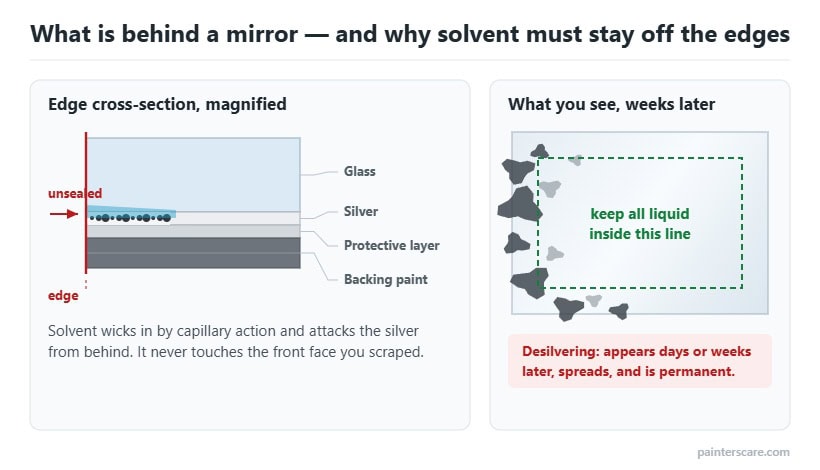
So the rules for a mirror are narrow but simple:
- Work on the front face only, and keep everything at least 25 mm away from the edges. Mask the perimeter with tape before you start.
- Apply solvent to a cloth, never to the mirror. Never let liquid pool and run to an edge.
- Lay the mirror flat and face up if you can, so gravity is not carrying solvent to the bottom edge.
- Keep ammonia away from it entirely, including ordinary glass cleaner that contains it. Ammonia attacks silver.
- Never work on the back. If paint has got onto the backing paint, leave it — the backing is the only thing protecting the silver, and stripping it does far more harm than a paint mark you cannot see from the front.
- Paint right at the very edge of a frameless mirror is a job to walk away from. Accept the mark.
Tinted, coated, frosted and textured glass
These are the cases where the standard advice does real damage, so they need their own approach.
Applied window film. Paint on film is generally a loss. Film is a soft polyester laminate; solvent attacks the adhesive and the scratch-resistant top layer, and a blade cuts straight through it. Try hot soapy water and a soft cloth and nothing else. If that fails, the honest answer is to strip and replace the film on that pane, which is cheaper than it sounds.
Exposed Low-E or reflective coating. Same conclusion for the same reasons. The coating is microns thick and a blade removes it in one pass, leaving a patch that reads as a different color in daylight and is more obvious than the paint was. Soapy water and patience only.
Body-tinted glass. This is different and often confused with film — the color is in the glass itself rather than on it, so it scrapes like plain glass. The pencil test tells you which you have. The only extra rule is not to work on it in sun, because dark glass gets much hotter.
Frosted, etched, sandblasted and patterned glass. A blade is useless here because it rides on the high points and cannot reach paint sitting in the texture, and it will polish shiny streaks into the matte finish where it does touch. Use solvent and a stiff nylon brush — an old toothbrush for small areas — working in small circles, then rinse thoroughly. Expect it to take several rounds. Never use a wire brush or an abrasive pad; it will burnish the surface permanently.
Leaded and stained glass. Solvent will attack the lead cement and any cold-painted detail. This is a specialist job and worth treating as one.
What not to do
Most of the permanent damage done to glass in this job comes from four specific shortcuts.
- A heat gun on a glazed window. This is the worst of them. Heating one patch while the rest of the pane and the cold frame stay put creates tensile stress at the glass edge, and annealed glass tolerates a temperature difference across a pane of only around 40 °C before that becomes a fracture risk. A heat gun runs several hundred degrees. It is also the fastest way to blow the seal on a double-glazed unit. Heat guns are excellent for paint removal on timber and metal; on installed glass they are a gamble with a whole window.
- Scraping dry. Every bit of grit on the glass goes under the blade. Wet scraping is not a nicety, it is the mechanism that prevents scratches.
- Back-and-forth strokes. Same reason. One direction, lift, return, repeat.
- Abrasives. Steel wool, scouring pads, wire brushes, wet-and-dry paper, bicarbonate paste, cutting compound. All of them will take the paint off and all of them will leave a dull patch that is more visible from further away than the paint was. There is no grade of abrasive that is fine enough to be safe and coarse enough to be useful.
- Caustic strippers and oven cleaner. Sodium hydroxide will not harm glass in the short term but it destroys aluminum and timber frames, ruins mirror backing on contact, and is genuinely dangerous overhead at eye level. There is no reason to reach for it on a non-porous surface where a blade or a solvent works.
- Old blades. A nicked blade cuts a groove with every pass. Change it far more often than feels necessary.
A note on mineral spirits and thinners generally: they will soften oil-based paint but they leave an oily residue that makes glass look smeared no matter how much you buff it. Always finish with a proper glass cleaner or a dilute vinegar rinse. Our guide to using paint thinner properly covers the ventilation and disposal side, which matters more indoors than people assume.
Stopping it happening next time
Removing paint from glass is slow and slightly risky every single time, so the arithmetic on prevention is very favorable. A roll of masking film and ten minutes of taping beats an hour with a blade and the chance of a scratch.
Two things worth knowing. First, low-tack masking film left on glass in direct sun will bake on and become its own removal job, so take it off the same day where you can. Second, if you are painting glass on purpose rather than by accident, the products made for the job behave completely differently from ordinary paint — our roundup of spray paints made for glass covers which ones actually stay put.
Glass has its own rules, and so does every other material. If the job spans more than one, our guide to matching the removal method to the surface routes you to the right approach for each.
Frequently asked questions
How do you remove dried paint from glass?
Soak the paint with hot soapy water, leave it five to ten minutes to swell, then lift it with a new blade in a glass scraper held at about 30–45° and pushed in one direction only. Keep the glass running wet throughout so grit floats away instead of being dragged under the blade. Dried paint on glass is only gripping mechanically, so it comes off in sheets once it is properly wet. Do not do this at all on toughened, coated or filmed glass — use solvent and dwell time there instead.
What is the best paint remover for glass?
For aerosol and lacquer paint, acetone — it redissolves the film completely and does not affect glass. For latex paint, hot water with dish soap genuinely outperforms solvent, because latex paint re-swells with water. For cured oil-based gloss, a methylene-chloride-free gel stripper left to dwell. Commercial products like Goof Off are solvent blends and work on the same principle as acetone at a higher price, though the gel consistency is useful on vertical glass; the same cautions apply, and Goof Off is far more aggressive than people expect on anything that is not glass.
Does WD-40 remove paint from glass?
Not really — it is a light oil with a carrier solvent, not a paint remover, and it will not dissolve a cured film. What it is genuinely good for is lubricating the glass ahead of a blade, which reduces drag and therefore reduces scratching, and it will soften very fresh paint. It leaves an oily residue that needs a proper glass cleaner afterwards. If you have it to hand it is worth a try on fresh spatter; it is not worth buying for the job.
Will rubbing alcohol remove paint from glass?
Isopropyl alcohol works well on fresh latex paint and on acrylic craft paint, and it is the safest thing to try first because it will not harm mirror backing, seals or most coatings. It does very little to cured enamel or oil-based gloss. Use it at 70% or higher, keep the surface wet rather than letting it flash off, and give it a few minutes.
Can you use a razor blade on a mirror?
Yes, on the front face. Mirrors are made from annealed glass, not toughened, so the surface takes a blade as well as any old window does. The risk on a mirror is not the blade but the liquid: keep water and solvent at least 25 mm from the edges, because anything that wicks behind an unsealed edge attacks the silver and causes permanent black mottling that spreads.
Does vinegar remove paint from glass?
Vinegar is about 5% acetic acid and will not dissolve a cured paint film. Warmed and left to dwell it will help soften fresh latex paint, and it is very good as a final rinse for streak-free glass. As an actual paint remover it is oversold. Hot water with detergent does the softening job better, and for anything cured you need a real solvent.
Will acetone damage glass?
No. Soda-lime glass is chemically unaffected by acetone, so there is no risk to the pane itself. Everything around it is another matter: acetone fogs acrylic and polycarbonate immediately, strips window film, softens frame paint, degrades the rubber gaskets in a sealed unit, and destroys mirror backing. Apply it to a cloth rather than to the glass, mask the frame edges, and ventilate the room.
How do you get paint off a window without scratching it?
Keep the glass soaking wet, use a brand-new blade, push in one direction only at a shallow angle, and test a small corner in daylight before committing to the whole pane. Most scratches are caused by grit trapped under the blade rather than the blade itself, so water is the safety mechanism. If the pane carries a toughened-glass stamp in the corner, or a coating that the pencil test shows is exposed, do not use a blade at all — solvent and dwell time are the only safe route.
