Last Updated on October 6, 2026
To spray paint, clean and lightly sand the surface, prime bare wood, metal or plastic, then shake the can for a full minute and spray from 10 to 16 inches away in steady overlapping passes. Build two or three light coats rather than one heavy one, and recoat within an hour or leave it 48.
Almost every guide to spray painting tells you the same five things: clean it, sand it, prime it, shake it, spray light coats. All of that is correct, and none of it explains why the job you did last weekend wrinkled, or why the second coat lifted the first, or why the finish went milky.
Those faults almost always come from three numbers that the guides leave out: the temperature you sprayed at, the humidity, and how long you left it between coats. All three are printed on the can, and all three are easy to get wrong while following the standard advice perfectly. Most explanations of how to spray paint skip every one of them.
How to spray paint, step by step
The whole job in order, before the detail on each part:
- Check the temperature and humidity. You want 10-32°C and humidity under 70%.
- Wash the item with warm water and dish soap to strip grease, then let it dry completely.
- Scuff the surface with 180-220 grit paper so the paint has something to key into.
- Wipe off every trace of dust with a lint-free cloth or isopropyl alcohol.
- Mask and sheet a far bigger area than you think you need.
- Prime bare wood, metal or plastic. Skip it only on a sound existing finish.
- Shake the can for a full minute after the ball starts rattling.
- Spray from 10-16 inches in steady passes, overlapping each by about half.
- Apply two or three light coats a few minutes apart.
- Recoat within the hour, or wait 48 hours. Not in between.
Steps one and ten are the two that get skipped, and they are the two that cause most ruined jobs.
The recoat window is a window, not a minimum
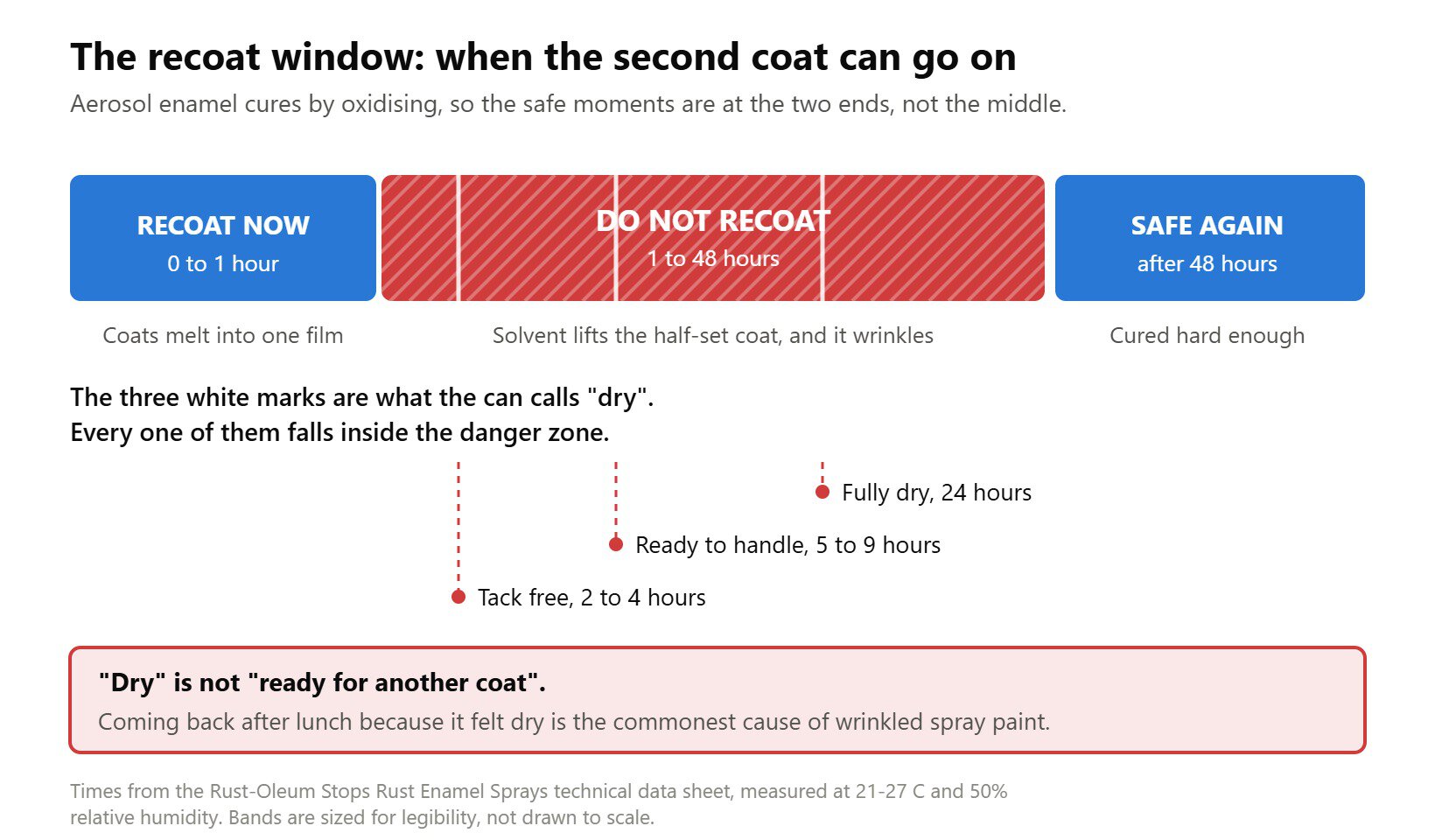
Recoat within one hour, or wait at least 48 hours. The gap in between is the one time you must not put a second coat on, and it is exactly when most people do it.
This is not folklore. Rust-Oleum repeats it in the same words across its whole aerosol range. The Stops Rust Enamel Sprays puts it plainly: apply a second coat or clear coat within 1 hour or after 48 hours. Painter’s Touch 2X says the same. So does the Automotive Enamel sheet, which adds that if you recoat after 48 hours you should repeat the surface preparation first.
The reason is what the solvent does. These are oil-modified alkyd paints that cure by oxidizing, not by simply drying. Inside the first hour the film is still wet enough that a new coat melts into it and the two become one layer. After about 48 hours the film has cured hard enough to resist the next coat’s solvent, so it sits cleanly on top. In between, the surface has skinned over but the paint underneath is still soft, and the solvent in coat two dissolves that half-set film from above. It swells, it puckers, and you get the wrinkling that looks like the paint has been crumpled.
Which makes the usual advice actively dangerous. “Let each coat dry before adding the next” sounds careful, and it walks you straight into the failure zone. If you sprayed at ten in the morning, came back after lunch because it felt dry, and the second coat wrinkled, that is the whole explanation. Nothing was wrong with your technique.
Two practical consequences. First, if you are doing several coats, plan to do them all in one session inside the hour. Second, if you miss that window, walk away and come back in two days. There is no useful middle ground. Our guide to how long spray paint takes to dry breaks the timings down by surface and condition, and spraying over existing spray paint covers what to do when the old coat is already cured hard.
One exception worth knowing: primer is different. Rust-Oleum’s sheet states that primers may be top coated immediately, so you do not need to wait for primer to fully cure before color goes on. That is the opposite of what most guides say.
What temperature and humidity do you need?
Between 10 and 32°C (50-90°F), with relative humidity below 70%. Outside that range the paint will still come out of the can, but it will not form a proper film, and every dry time on the label becomes meaningless.
Here is the part nobody mentions. The dry times printed on the can are laboratory figures measured under specific conditions. Rust-Oleum quotes theirs at 21-27°C and 50% relative humidity, and says in as many words: allow more time at cooler temperatures. So “dries to touch in 2-4 hours” is not a promise about your garage in November. It is a measurement taken at shirtsleeve temperature and half humidity.
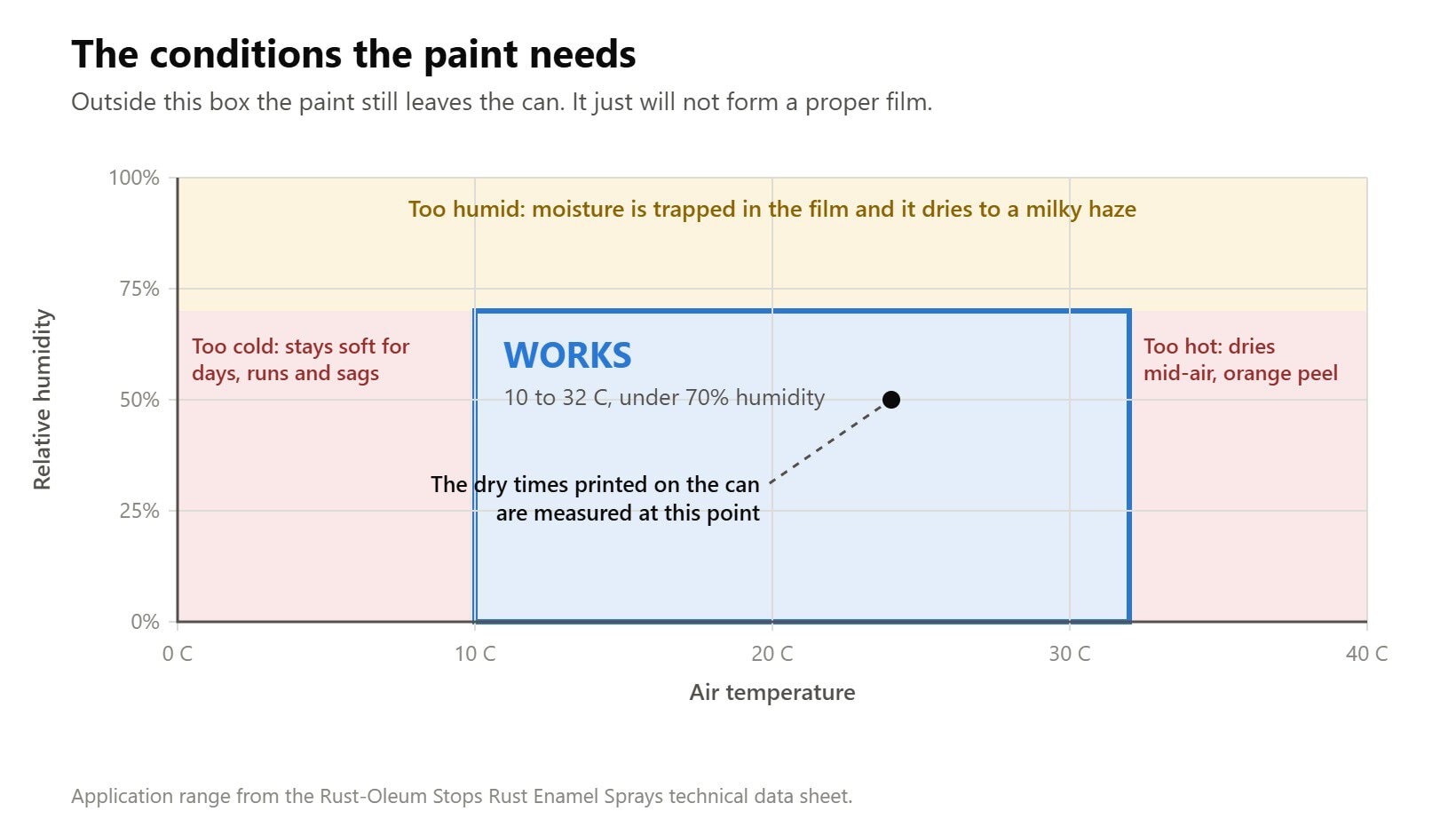
One case the chart cannot show: a cold object sprayed in a warm room. The air is fine, the metal is not, and condensation forms under the paint, which is why it flakes weeks later. Let the item reach room temperature before you start.
If you are working in a British winter, the practical answer is to spray in the warmest part of the day, or to warm the space and the item first and keep them warm while it cures. Not to spray and then move it somewhere cold.
How far should you hold the can?
Rust-Oleum specifies 10 to 16 inches from the surface for its enamel sprays. You will see 8 to 12 inches quoted in a lot of guides, including Google’s own summary of this question, and for most rattle cans that is too close.
Too close and you lay down more paint than the surface can hold, which gives you runs on a vertical face and a thick soft film everywhere else. Too far and the droplets start drying in the air before they land, which gives you that sandy, dusty texture. When in doubt, check the can for your specific product, because the figure genuinely varies between paints.
The technique that matters more than the distance:
- Keep the can the same distance throughout the pass. Do not swing your arm in an arc, which is what happens naturally and puts twice as much paint in the middle as at the edges.
- Start the spray off the edge of the object and release it after you pass the other edge.
- Overlap each pass by about half.
- Keep the can moving the whole time it is spraying.
- Shake often during use, not just at the start.
How many cans will you actually need?
Far more than you expect. Practical coverage for a 12 oz can is 6 to 10 square feet, which is under one square meter, and that figure already assumes 15% of the paint is lost to overspray.
That is per coat. A dining chair takes most of a can per coat once you account for spindles and the underside. Two coats on a chair is realistically two cans. A single can will not do a bookcase, and it will not do a bicycle frame properly either.
This matters more than it sounds because of the recoat window. Running out of paint halfway through coat two means either an unfinished job or a 48-hour wait. Buy one more can than you think you need.
Do you need primer?
On bare wood, bare metal or plastic, yes. On a sound existing painted finish that you have cleaned and scuffed, usually not. Primer is doing two jobs: giving the topcoat something to grip, and sealing a surface that would otherwise drink the paint unevenly.
Plastic is the one where people get caught out, because ordinary spray paint has very little to bond to on a smooth polymer. It needs either a dedicated plastic primer or a paint formulated for plastic. We go into which products work in our guide to spray paints for plastic, and the broader question of skipping it entirely in can you spray paint without primer.
Spraying different surfaces
The method above is the same everywhere. What changes is the preparation and the product, and on some surfaces the wrong product will fail no matter how well you spray.
| Surface | What it needs | Full guide |
|---|---|---|
| Metal | Rust treatment first, then a metal primer. Not for galvanized without a specific primer. | Spray paint for metal |
| Plastic | A plastic-specific paint or primer. Degrease thoroughly, scuff gently. | Spray paint for plastic |
| Wood and furniture | Grain filling and sealing, or the grain will telegraph through. | Spray paint for wood furniture |
| Glass | Meticulous degreasing. Adhesion is the whole battle. | Spray paint for glass |
| Chrome | Etching or a self-etching primer. Nothing keys to bare chrome. | Chrome spray paint |
| Wheels and rims | Heat and brake dust resistance, plus thorough degreasing. | Spray paint for rims and wheels |
| Car bodywork | Automotive enamel or 2K, and far more prep than anything else here. | Automotive spray paint |
| Firearms | Heat-cured coatings for durability against handling and solvents. | Spray paint for guns |
| Art and lettering | Low-pressure cans and interchangeable caps for line control. | Spray paints for art |
If the job is bigger than a few items, an aerosol stops making sense on both cost and coverage. At that point you are looking at a sprayer, and our guide to using a paint sprayer covers the whole different set of rules that applies, starting with the fact that you thin paint for a sprayer and never for an aerosol.
Why did my spray paint go wrong?
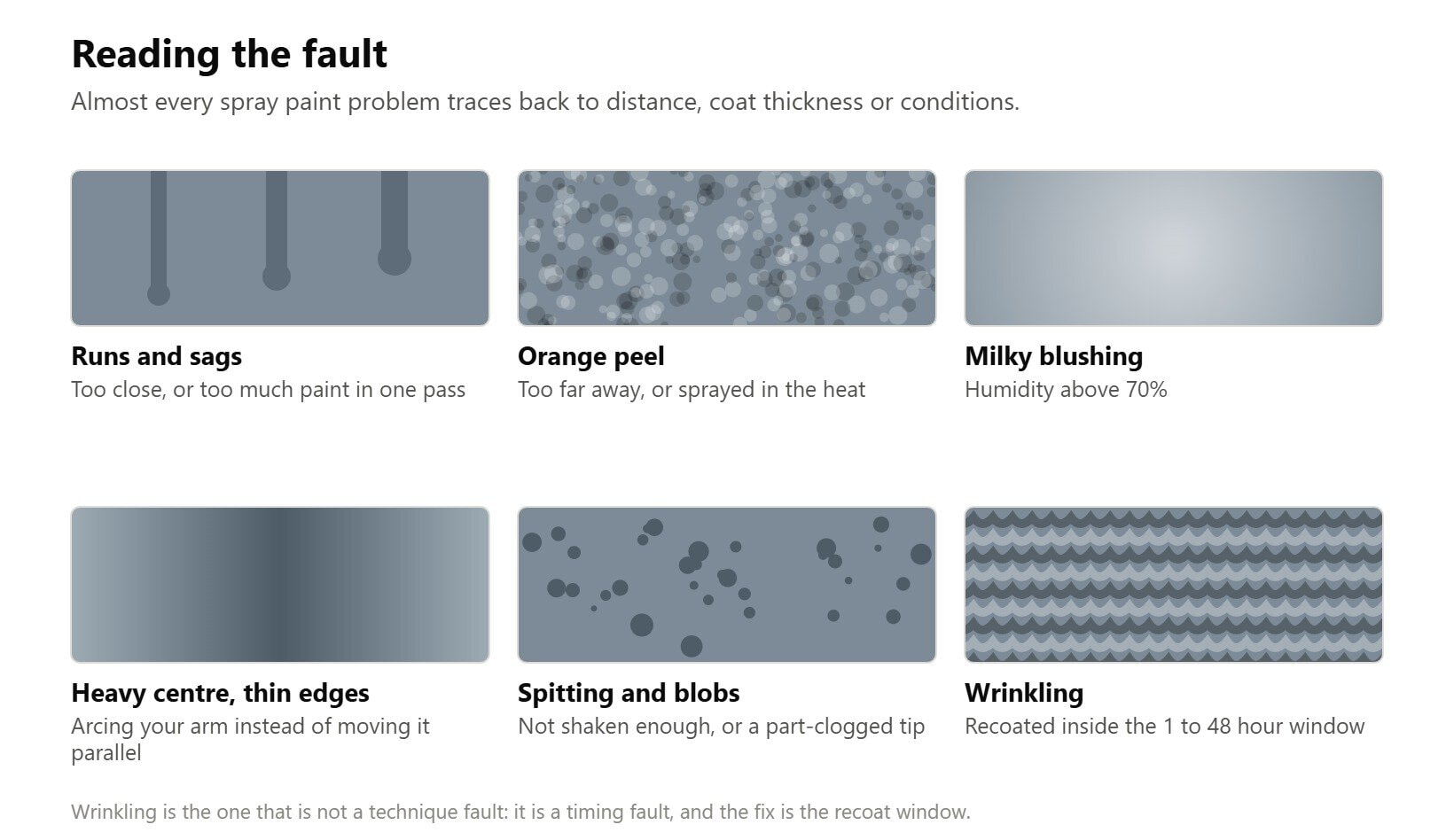
Work backwards from what you can see. Almost every fault traces to distance, coat thickness, or conditions.
| Fault | Cause | Fix |
|---|---|---|
| Wrinkling, a crumpled texture | Recoated inside the 2-47 hour dead zone, or coat far too heavy | Let it cure hard, sand back flat, respray in the window |
| Runs and sags | Too close, too much paint, or too cold | Back off to 10-16 inches, lighter coats |
| Gritty, sandy finish | Too far away, or too hot and dry | Move closer, spray out of direct sun |
| Milky or cloudy haze | Humidity too high, moisture trapped in the film | Wait for a drier day, respray |
| Heavy center, thin edges | Arcing your arm instead of moving it parallel | Keep the can the same distance across the pass |
| Spitting and blobs | Not shaken enough, or a partly clogged tip | Shake a full minute, clear the tip |
| Peels off when handled | No primer, poor degreasing, or wrong paint for the surface | Strip, prep properly, use a suitable product |
If the finish is sound but rubs off on your hands later, that is usually cure time rather than a fault, and our guide on keeping spray paint from rubbing off covers sealing it. For anything living outside, whether spray paint is waterproof is the question that decides if you need a clear coat over the top.
Safety, briefly but seriously
Spray outdoors or in a genuinely ventilated space, and wear a respirator rather than a dust mask. A dust mask filters particles; aerosol paint releases solvent vapor that passes straight through it.
Rust-Oleum’s enamel sprays use acetone, n-butyl acetate and aromatic hydrocarbons as solvents, with a flash point of 69°C. That means two things: the vapor needs organic-vapor filters, not a particulate mask, and it is flammable. No open flames, no pilot lights, no smoking, and do not spray in a small room with an appliance running. Our respirator guide covers the filter ratings.
Also worth knowing before you start: if you are sanding old paint off anything built before the 1980s, assume it may contain lead and do not dry-sand it.
For the clearing up afterwards: getting spray paint off skin, and removing the smell from wood if you sprayed something that has to come back indoors.
Frequently asked questions
What is the best way to spray paint?
Clean and degrease, scuff with 180-220 grit, prime if the surface is bare, shake the can a full minute, then spray from 10-16 inches in overlapping passes, keeping the can parallel and moving. Build two or three light coats a few minutes apart rather than one heavy coat, and work between 10 and 32°C with humidity under 70%.
Do I have to wait 48 hours for the second coat of spray paint?
Only if you missed the first window. Rust-Oleum calls for a recoat within 1 hour or after 48 hours. If you can get the second coat on inside an hour, do it then. If more than an hour has passed, waiting the full 48 is genuinely safer than recoating at, say, six hours, because the half-cured film underneath will wrinkle.
Is 3 hours enough for spray paint to dry?
Enough to be touch dry, usually not enough to recoat or handle. Rust-Oleum quotes tack free in 2-4 hours, handleable in 5-9 hours and fully dry in 24 hours, measured at 21-27°C and 50% humidity. Three hours is inside the worst possible recoat window, so do not put a second coat on at that point.
How many coats of spray paint is best?
Two or three light coats, applied a few minutes apart within the one-hour window. Light coats level out and cure properly; one heavy coat traps solvent, stays soft, and runs on vertical surfaces. If coverage still looks patchy after three, the issue is usually the primer or the color underneath rather than the number of coats.
Do I need to sand before spray painting?
Yes, on almost anything. A light scuff with 180-220 grit gives the paint a mechanical key, and on a glossy existing finish it is the difference between paint that stays on and paint that peels in sheets. You are not trying to remove the old finish, just take the shine off it. Wipe the dust away afterwards.
Is it okay to spray paint without primer?
On a sound, cleaned and scuffed painted surface, usually yes. On bare metal, bare wood or plastic, no. Many modern cans are sold as paint-and-primer in one, which works on previously finished surfaces but is not a substitute for a proper etching or plastic primer on difficult substrates like chrome or smooth polymer.
Will a fan help spray paint dry faster?
Gentle air movement helps solvent evaporate and is useful for ventilation, but it will not speed up curing much, because these paints harden by oxidizing rather than simply drying. A fan pointed straight at wet paint also throws dust into the finish. Better to raise the temperature slightly and be patient.
How long should you leave spray paint between coats?
Either a few minutes, or two days. Within the first hour the coats melt together, which is why the instruction is to apply light coats a few minutes apart. After 48 hours the film is hard enough to take another coat cleanly. The hours in between are the ones that cause wrinkling.
Do you add water to spray paint?
No. An aerosol is already mixed to the right viscosity and sealed under pressure, so there is nothing to thin and no way to do it. Thinning applies to paint you pour into a sprayer or a spray gun, which is a different job with different rules. If a can is spraying badly, the cause is shaking, temperature or a blocked tip.
Can you spray paint indoors?
Only in a well-ventilated space such as an open garage, never a closed room. The solvents are flammable and the vapor is harmful to breathe, so you need airflow, a respirator with organic-vapor filters, and no ignition sources nearby. An open garage door or a covered outdoor spot in dry weather is the practical answer.
What to remember
Three numbers decide whether a spray paint job works, and none of them are about technique. Spray between 10 and 32°C with humidity under 70%. Recoat within an hour or after 48 hours, never in between. And buy roughly one can per square meter per coat, then one more.
Get those three right and ordinary technique gives a good finish. That is the part of how to spray paint that actually decides the result; get them wrong and no amount of careful spraying will save it.
