Last Updated on October 6, 2026
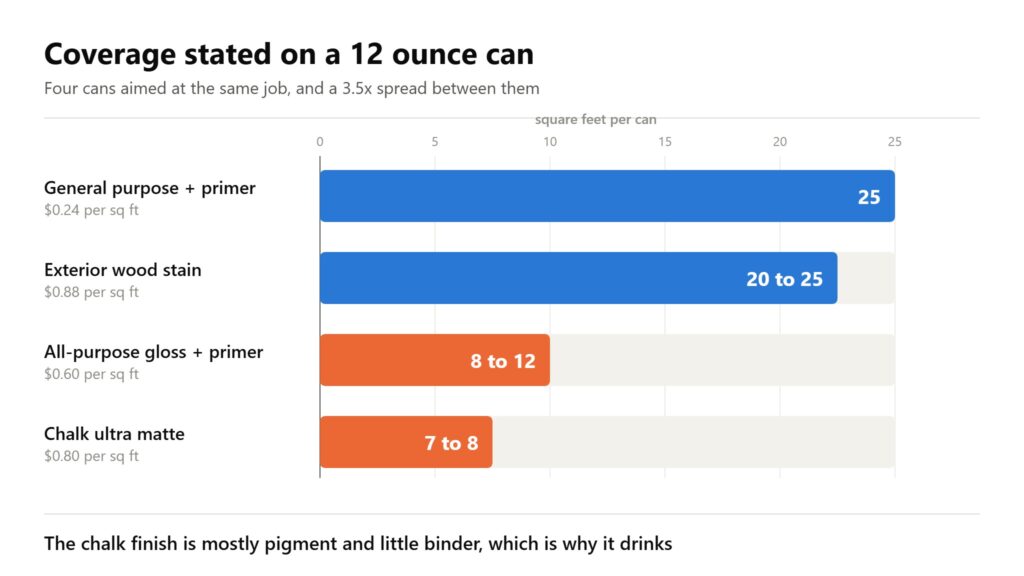
Every list of the best spray paint for wood furniture ranks the cans. None of them mentions the number printed on the back: four 12 ounce cans aimed at the same job, and the coverage runs from 7 square feet to 25.
That is a 3.5x spread for the identical amount of paint, and it decides what the project costs. What follows is the figure for each can, what it works out to on a real chair, and the three things about your wood that matter more than which can you pick.
How far one can really goes
| 12 oz can | Claimed coverage | Per sq ft at $5.99 |
|---|---|---|
| General purpose + primer | 25 sq ft | $0.24 |
| Semi-transparent wood stain | 20 to 25 sq ft | $0.88 |
| All-purpose gloss + primer | 8 to 12 sq ft | $0.60 |
| Chalk ultra matte | 7 to 8 sq ft | $0.80 |
Same size can, same aisle, 3.5x between the ends of the range. The chalk finish is the thirstiest because it is mostly pigment and very little binder, which is exactly what gives it that flat powdery look. The thin general-purpose lacquer goes furthest because there is less solid in it.
At $5.99 a can that works out to 24 cents a square foot for the thriftiest and 80 cents for the hungriest. You are not choosing between cans. You are choosing between 24 cents and 80 cents.
What that means for an actual chair
A plain wooden dining chair is roughly 11 square feet of surface once you count both faces of the seat, both faces of the back, four legs and the apron. Two coats makes it 22.
| Finish | Cans per chair | Four chairs | Cost |
|---|---|---|---|
| General purpose | 1 | 4 cans | $23.96 |
| All-purpose gloss | 3 | 9 cans | $53.91 |
| Chalk matte | 3 | 12 cans | $71.88 |
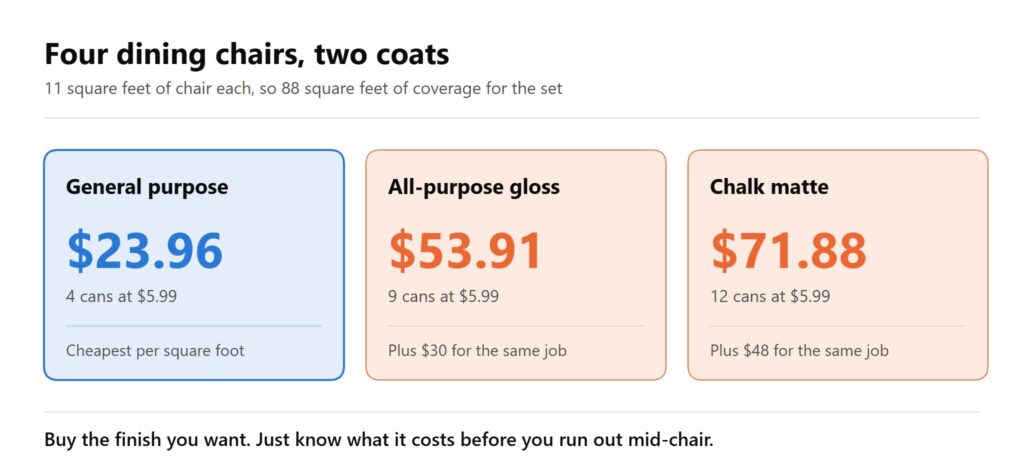
A set of four is where it bites. The same four chairs cost $24 in one can and $72 in another, and the $72 option is the one most furniture tutorials recommend because it looks good on camera.
Buy for the finish you want, by all means. Just buy enough of it, and know what the finish is costing you before you are three chairs in and out of paint.
Moisture is the one that peels
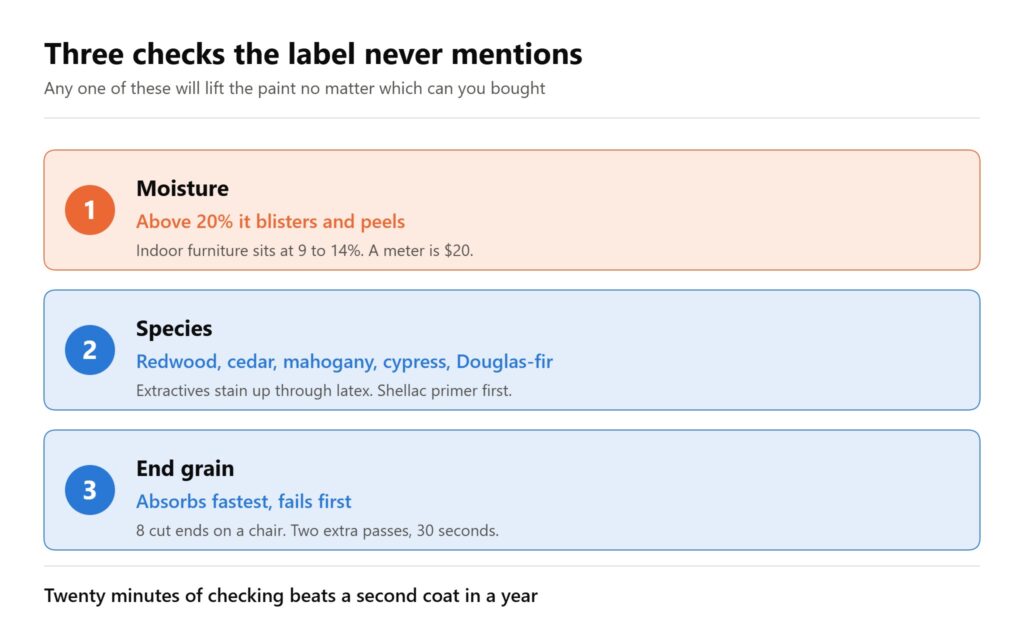
Three properties of the timber will sink the job regardless of which can you bought, and none of them is printed on anything. The first is water. Above 20 percent moisture content, blistering and peeling are likely. That is not a rule of thumb, it is the threshold, and it is why the patio chair you brought in after a wet week lifts in sheets a month later.
Indoor furniture sits somewhere between 9 and 14 percent, and 12 is the usual figure for most of the country. Anything that has lived outside, or in a shed, or came out of a garage in February, is a different proposition. A moisture meter is about $20 and it is the cheapest insurance in this entire article.
Give wet wood a week indoors before you touch it with paint.
Some species bleed straight through
| Wood | Bleeds through latex | What to do |
|---|---|---|
| Redwood | Yes, heavily | Shellac or oil primer |
| Western redcedar | Yes, heavily | Shellac or oil primer |
| Mahogany | Yes | Shellac or oil primer |
| Cypress | Yes | Shellac or oil primer |
| Douglas-fir | Yes | Shellac or oil primer |
| Pine | At the knots only | Spot-prime the knots |
| Poplar, birch, maple | No | Paint direct |
Redwood, western redcedar, mahogany and cypress carry water-soluble extractives that migrate up through a water-based coating and stain it brown from underneath, sometimes within days of painting. Douglas-fir does it too. On pine it is usually the knots rather than the whole board.
Latex will not hold them back. A shellac-base primer will, and one coat does it: 500 square feet from a gallon, dry to touch in 20 minutes, recoatable in 45.
With one exception that catches people out. On cedar and redwood, that 45 minute recoat becomes 24 hours before you paint over it. Those two are the heaviest bleeders and the primer needs the full day to lock them down. Rush it and the stain comes through the primer as well as the paint.
If you are painting any of those woods white or any pale color, prime. If you are painting them black, you can skip it and nobody will ever know.
End grain drinks, and fails first
End grain absorbs faster than face grain, and finishes generally fail there before anywhere else. Those are the cut ends: the bottoms of legs, the tops of posts, the ends of every rail.
It is a 30 second job. Hit the end grain, wait the 20 minutes to touch dry, hit it again, then paint the whole piece. On a chair that is 8 cut ends, four leg bottoms and four rail ends, and two extra passes over them will outlast everything else on the piece.
Do you need to prime bare wood?
For bare wood, yes, and the makers say so themselves on the can’s own literature rather than only in the primer aisle.
A paint-and-primer-in-one is a paint with slightly better adhesion, not a primer. On a surface that has already been sealed it is fine. On raw timber it sinks in, and that absorption is where a good share of the gap between 25 square feet and 8 goes.
The arithmetic favors sealing first. A gallon of shellac primer covers 500 square feet. A can of topcoat covers 25. Sealing is the cheapest coverage on the shelf, and it is the only thing that stops tannin.
Is spray painting wood a good idea at all?
For anything with spindles, slats, turned legs, louvres or carving, yes, and it is not close. A brush cannot get into a chair back without leaving runs where the bristles unload at the junctions.
For a flat panel, a tabletop, a door, a drawer front, no. A foam roller lays down a thicker film in one pass than a rattle can manages in three, and a door swallows 40 square feet of coverage over two coats, which is 2 cans of the thrifty stuff and 5 of the chalk.
The honest split is geometry. Complicated shape, spray it. Flat surface, roll it.
There is no spray paint that looks like wood
No such product exists, and the reason is physical rather than commercial. Grain is 2 tones sitting at 2 different depths. An aerosol lays down 1 tone at 1 depth, so the physics is against it before you pick a color.
What people are doing when you see it done well is a 2 step job. A base coat in the lighter tone, left the full 24 hours to dry hard, then a gel stain dragged over the top with a graining rocker or a dry brush while it is still open. The stain catches in the drag marks and reads as grain. It is a technique, not a purchase.
The closest thing on the shelf does the opposite job. An exterior stain aerosol thins the color enough that whatever grain is already under it still shows. That only helps if you started with timber. If the piece is actually plastic, that is a different job with a different can and a different set of rules.
Which can for which job
Spindles, chairs, anything intricate, on a budget: a general-purpose wood spray paint and primer at 25 square feet a can, which in practice means Krylon ColorMaxx. It is the cheapest per square foot by a distance and it atomizes finely enough to get into corners.
A flat matte furniture look: a chalk finish such as Rust-Oleum Chalked, at 7 to 8 square feet. Budget three times the cans and do not be surprised by it.
Outdoor timber you would rather tint than hide: Krylon exterior semi-transparent wood stain, 20 to 25 square feet, around $22 a can.
Bare redwood, cedar, mahogany or anything going pale: a shellac primer such as Zinsser B-I-N first, whatever you top it with.
Getting the coats right
Recoat within 1 hour, or wait until after 48. Both of the common lines print the same window. The window between is where the solvent in coat two softens a coat one that has skinned but not cured, and you get wrinkling.
Dry to touch is 20 minutes, dry to handle is an hour, fully dry is 24 hours. Fully dry is not fully hard. Give a chair a week before anyone sits on it in jeans.
Frequently asked questions
What spray paint is best for wood?
For most furniture, a general-purpose paint and primer in one, which covers around 25 square feet a can and gets into spindles. Chalk sprays look better matte but cover 7 to 8 square feet, so you need roughly three times as many. On redwood, cedar or mahogany the can matters less than putting a shellac primer under it.
Is it better to brush paint or spray paint wood furniture?
Neither wins outright, because the shape decides it. Spray reaches into spindles, slats and carving that a brush floods at the junctions. A roller wins on anything flat: one pass of a 4 inch foam roller puts down more film than 3 passes of aerosol, for a fraction of the money. A chair sprays, a tabletop rolls.
Do I need to prime wood before I spray paint it?
On bare wood, yes. Paint-and-primer-in-one is a paint with better adhesion, not a primer, and raw timber absorbs a large share of it. Sealing is also the cheap part: 500 square feet from a gallon of shellac primer against 25 from a can of topcoat. Skip it only on wood that is already painted and sound.
Is there a spray paint that looks like wood?
No. Grain is two tones at different depths and an aerosol applies one tone at one depth. Convincing faux wood is 2 layers: a base coat, then a gel stain dragged over it with a graining rocker while it is still wet. The nearest real product is an exterior stain aerosol at 20 to 25 square feet a can, and that only shows off grain that is already there.
What is the best paint color to mimic the look of wood?
A pale warm base in the tone of the sapwood, then a darker translucent layer dragged over it. Raw-oak looks start from a light wheat base, walnut from a mid tan. Of the 2 layers the second does the work, so the base only has to match the lightest tone in the grain, not the color of the finished piece.
Will spray paint stay on wood?
On dry, sound, primed timber it lasts years. It lifts for 3 reasons, none of them the can’s fault: moisture over 20 percent, which blisters the film; extractives from redwood, cedar or mahogany pushing up from below; and bare end grain, which gives way before any other part of the piece.
Final word
The can you pick swings the bill by $48 across 4 chairs, because the coverage on the label runs from 7 square feet to 25. Whether you checked the moisture, primed the cedar and hit the end grain first decides whether the paint is still there in 2 years. One of those is a shopping decision and the other is 20 minutes of work, and the 20 minutes matters more.

Does krylon sell the colormaster spray in a gloss black?
Yes, here you go- https://amzn.to/3ofBAD4
Hello! I’m trying to find out if the spray chalk paint would be safe to use on a baby’s highchair? Thank you, Linda
As long as it’s water based chalk paint, it’s fine