Last Updated on October 6, 2026
Every roundup of the best paint sprayer for furniture ranks the same way: by price. $63, $100, $150. None of them gives you the one number that decides whether a dresser dries smooth or pebbled, which is how long your finish takes to drain out of a viscosity cup.
Furniture is not a wall. A wall takes one heavy coat of latex through a 0.015 inch orifice. A chair takes three thin coats of something far runnier — stain, polyurethane, chalk paint, clear lacquer — and the gun has to be set for that liquid, not for the furniture. Set it for the wrong liquid and you get orange peel across the top, runs down the legs, or a pattern so starved it feels like sandpaper.
Two of the 14 sprayers below are rated by the company that built them for stain and not for paint. One tops out just under the published orifice floor for latex. That is the kind of thing a price ranking cannot tell you, so this list is grouped by what each unit can physically atomize. The short answer: measure your finish in a viscosity cup, and if it drains in 17 to 25 seconds you want a 1.3 mm air cap, or a 2.0 mm tip on a handheld.
There is no common measurement across sprayer types. Each architecture publishes its capability in whatever unit suits it, and none of them converts to the others on the label.
| Sprayer type | What the maker publishes | The furniture setting |
|---|---|---|
| Turbine HVLP | Air cap in mm, indexed to a cup runout time | 1.3 mm standard, 17 to 25 seconds |
| Corded handheld HVLP | Tip in mm plus a color-coded air cap | 1.5 mm for stain, 2.0 mm for paint |
| Handheld stain sprayer | A rating per material, no measurements at all | Stain only |
| Handheld airless | Orifice in thousandths of an inch | 0.014 to 0.015 inches |
| Gravity-feed gun on a compressor | Fluid tip in mm plus air demand in CFM | 1.0 to 1.4 mm, 10 to 25 CFM |
A 0.014 inch airless orifice is 0.356 mm. A 1.5 mm handheld tip is more than four times that diameter. Both are sold as fine finish, and both are correct, because the airless gun atomizes by forcing paint through a slot at 1,500 psi while the handheld atomizes by wrapping it in air at under 10. The number only means something inside one architecture.
That is also why cross-shopping a wall sprayer onto furniture goes wrong in both directions. The orifice that makes latex wall paint behave is too coarse for a clear topcoat, and the cap that lays a perfect topcoat will not pass unthinned latex at all. Handheld airless units sit between the two.
The seconds test
A Ford #4 viscosity cup is a small metal cup with a calibrated hole in the bottom. You fill it with your finish, pull it out, and time how long the stream takes to break. That drain time is the only figure that crosses between sprayer types, and it is the figure turbine makers index their air caps to. A viscosity cup costs about $10.
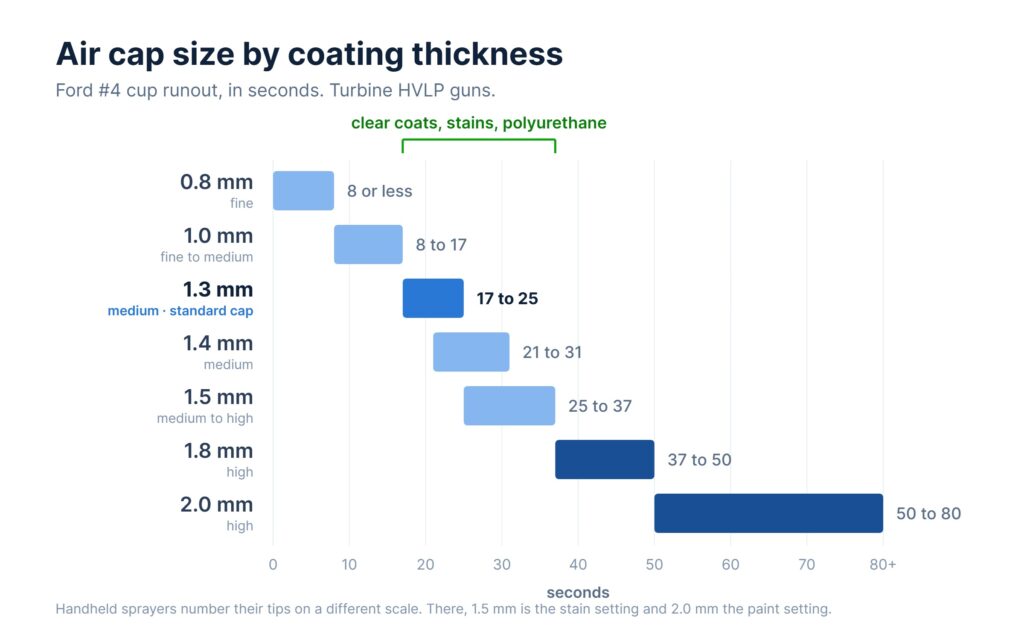
Read it from the left. Anything draining in 8 seconds or less — dye, ink, a thin shellac — wants a 0.8 mm cap and a fine output. 8 to 17 seconds takes 1.0 mm. The 17 to 25 second band is where clear lacquer, varnish and polyurethane land, and that band belongs to the 1.3 mm cap, which is why Fuji ships 1.3 mm as the standard set. Past 37 seconds you are into the 1.8 mm high-output caps built for primers and wall latex, and furniture territory has ended.
Thinning is how you move a coating into the band you want, and 5 to 15 percent is the usual range before a pattern comes good. Thinning latex moves it a long way; thinning an already-thin stain can push it past the fine end and give you runs. The ratios by paint and gun type are a separate exercise, and the cup is what tells you when to stop.
A high-volume low-pressure gun is capped at 10 psi at the air cap and pulls 10 to 25 CFM to get there. A low-volume low-pressure gun runs 10 to 30 psi on 5 to 18 CFM, and will atomize heavier and waterborne material than HVLP for that reason. Conventional air spray sits at 35 to 60 psi. Both low-pressure classes have to put at least 65 percent of what leaves the gun onto the workpiece, and that 65 percent figure is what people mean when they say low pressure makes less overspray. It is a compliance threshold, not a marketing line. The full air cap and runout reference maps every cap to a coating.
Corded handhelds use their own scale, published as a tip set rather than a cup time, and the mapping is explicit:
| Coating | Handheld tip | Spray pattern | Air cap |
|---|---|---|---|
| Sealers and varnish | 1.0 mm | 1 to 4 inches | Fine |
| Stains and polyurethane | 1.5 mm | 1 to 6 inches | Fine |
| Latex, chalk and milk paint | 2.0 mm | 1 to 6 inches | Fine |
| Latex, chalk and milk paint | 2.5 mm | 6 to 7 inches | Fine |
| Primer and latex | 3.5 mm | 8 to 10 inches | Wide |
| Primer and latex | 4.0 mm | 10 to 12 inches | Wide |
Note which column does the work. Every tip from 1.0 to 2.5 mm is listed for furniture and cabinets, and they all run the fine air cap. The wide cap only appears on the two tips meant for walls and fences. So on a handheld it is the air cap that decides whether a finish can be fine at all, and the tip that decides how much material arrives. Fit the wide cap to spray a dresser faster and the pattern class changes with it.
14 Best Paint Sprayer for Furniture Reviews, Grouped by Coating
Three picks first. Number two for a clear topcoat or varnish, number six for chalk and latex paint, number three for stain on bare wood.
1. HomeRight C800971 Paint Sprayer

A corded handheld that runs off household power, with no compressor and no turbine box to carry. The tip and cap pairing decides everything it can do: the fine cap with a stain-grade tip lays polyurethane cleanly, and the wide cap is for fences. Thin 5 to 15 percent, and point the pickup tube toward whatever you are spraying — backward for upward passes, forward for downward ones. Right for one dresser or a set of dining chairs.
2. Fuji 2202 Semi-Pro HVLP Sprayer

A 2-stage bypass turbine putting 5 psi through a 1.3 mm air cap, with a quart cup and 25 feet of hose. That cap is the furniture default: it covers finishes draining in 17 to 25 seconds, which is where clear lacquer, varnish and polyurethane sit. Clear lacquer also sprays well at 1.5 mm. Stain often wants the smaller 1.0 mm cap instead, depending on how thin it already is.
3. Wagner Spraytech 518050 Stain Sprayer

4 psi, an 800 ml cup rated for about 72 square feet, and a pattern that adjusts from half an inch to nine inches wide at up to 4.9 fluid ounces a minute. Check the material chart before ordering: wood stain and semi-transparent stain are both rated ideal, while solid stain and paint are listed as not recommended. For a stained oak table this is exactly the right tool. For a painted dresser it is the wrong one.
4. Graco 17M363 Cordless/Airless Paint Sprayer

Cordless airless, so there is no hose, no compressor and no cup to keep level — you can tip it to spray the underside of a chair. Airless atomizes by pressure alone, which is why it handles unthinned paint that a low-pressure handheld would spit. The trade is transfer: with no air cushion wrapping the fan, more material carries past the edges of the piece, so mask wider than feels necessary.
5. Wagner Spraytech 0529021 HVLP Paint Sprayer

The same low-pressure platform as the stain unit above, under a second part number. Its air cap rotates on the nozzle, giving a horizontal fan, a vertical fan or a round pattern. Turn it so the fan runs across your direction of travel, or every pass lands as a stripe. The round setting is for spindles and chair legs, where a flat fan wastes most of what it throws.
6. HomeRight Finish Paint Sprayer

This is the unit that ships with three tip sets — 1.5 mm, 2.0 mm and 4.0 mm — and arrives with the 2.0 mm fitted and the fine cap on. The 2.0 mm is the latex, chalk and milk paint setting, so out of the box it is configured to paint furniture rather than stain it. The 1.0 mm tip for sealers and varnish is not in the box, which matters if a clear topcoat is the plan.
7. REXBETTI HVLP Paint Sprayer

A four-nozzle handheld, which on paper spans everything from a thin stain to a heavy primer. Check which nozzle arrives fitted rather than assuming — the widest will flood a chair leg before you reach the bottom of it. Handhelds in this class stay under 10 psi at the cap, so anything draining slower than roughly 25 seconds needs thinning before it will break into a fan at all.
8. Wagner HVLP Home Décor Paint Sprayer

Built for small indoor pieces: picture frames, a shelf unit, one side table. The cup is small enough that a full dresser means refilling part way through a coat, which is where lap marks start. Load it once, spray one component, refill, move on. Chalk-type paints suit it because they already pass through a low-pressure cap without much thinning.
9. Graco Magnum 257025 Project Painter Plus

Piston airless: 2,800 psi, a maximum tip of 0.015 inches, 0.24 gallons a minute, and a 515 tip in the box that throws a 10-inch fan. That 0.015 orifice is the published floor for latex, so this one sprays wall paint from the can with nothing added. On furniture a 10-inch fan is more than the work needs — fit something narrower or you will chase runs along every edge.
10. AVID POWER Paint Sprayer
A budget handheld in the same architecture as most of this list: an electric fan motor, a gravity cup, interchangeable nozzles. What separates units at this price is not the motor but how cleanly the needle seats, because that is what stops the gun dribbling between passes and leaving a heavy spot at the start of each pull. Strain every batch through a filter and wash it out within minutes of finishing.
11. HVLP Electric Spray Gun by Paint Zoom
Sold as an all-rounder, which on furniture means running the material flow well below halfway. Low-pressure handhelds do their best work on finishes that are already runny — dye, shellac, thinned polyurethane. Push unthinned latex through one and the fan breaks into a spattered edge instead of a soft one, and no amount of knob adjustment recovers it.
12. Graco TrueCoat 360 DS Paint Sprayer
1,500 psi, a maximum tip of 0.014 inches, and 0.08 to 0.12 gallons a minute. Mind the gap in those numbers: the published orifice range for latex is 0.015 to 0.019 inches, so this one stops just short of it. For oil-based paint, where the range is 0.013 to 0.015, it fits comfortably. For thinned latex on a cabinet door it works. For latex straight from the can it is the wrong end of the scale.
13. Scuddles Paint Sprayer
Another corded handheld with a nozzle set and a flow dial. Judge these on two things only: whether the nozzle you actually need is in the box, and whether the cup still seals when the gun is tilted to reach under a tabletop. Wattage, cup size and cord length change the result far less than having the right orifice fitted.
14. TCP Global Complete Professional 9 Piece HVLP Spray Gun Set
The only entry here that reaches the fine end of the scale: a 1.0 mm detail gun, a 1.4 mm production gun and a 1.8 mm production gun in one case. The 1.0 mm covers sealers and varnish, the 1.4 mm covers clear coats and single-coat paint, and between them that is the furniture range. It needs a compressor though, and guns in this class ask for 10 to 25 CFM, which rules out most pancake tanks.
Three sprayers rated for less than the lists claim
Low-pressure stain sprayers are a fixture of furniture lists, and the Wagner material chart rates wood stain and semi-transparent stain as ideal while listing solid stain and paint as not recommended. Wagner adds that the unit is not designed for thick materials. If the plan is a painted dresser, that unit is outside its rating no matter how often it appears under a furniture heading.
The Graco handheld at number twelve tops out at a 0.014 inch tip. The orifice range Graco gives for latex is 0.015 to 0.019 inches. Those two figures come from the same company and do not meet. The piston unit at number nine, at 0.015 inches and 2,800 psi, clears the floor by exactly one thousandth.
And the HomeRight handheld that arrives with three tips arrives without the one for clear finishes. The 1.0 mm orange set covers sealers and varnish and is sold separately; the three in the box are 1.5, 2.0 and 4.0 mm. A buyer planning to spray a topcoat over chalk paint needs a second order before the first coat goes on.
Setting a gun up on a dresser

Fit the fine air cap, not the wide one. Then hold the gun perpendicular to the surface at 6 to 8 inches and overlap each pass by at least 50 percent. Spray at a steady speed without flexing your wrist, because a wrist arc changes the distance mid-pass and the film thickness with it. Furniture also has a pass order: back and underside first, then sides, then the top last so nothing drips onto a finished face.
Test on card before the piece. From here, 3 patterns cover everything that goes wrong, and each has 1 fix:
| What the pattern looks like | What is wrong | The fix |
|---|---|---|
| Clumpy, heavy texture | Too little air, too much material | Air flow up, material flow down |
| Runs and sags | Too much air and too much material | Both down, back off to 6 to 8 inches, move faster |
| Dry, patchy coverage | Too little air, too little material | Both up, move closer, slow down |
Frequently Asked Questions
What kind of paint can paint guns use?
Anything thin enough to atomize at the pressure the gun makes. A low-pressure handheld will take dye, shellac, stain, polyurethane, lacquer, and chalk or milk paint; latex usually needs 5 to 15 percent thinning first. Airless guns handle heavier material because they atomize by pressure rather than air volume, but they need an orifice of at least 0.015 inches before latex will break into a fan.
Which airless paint sprayer is better, Wagner or Graco?
Compare the three numbers rather than the badge: maximum tip size, maximum pressure and gallons per minute. A unit rated 0.015 inches at 2,800 psi and 0.24 gpm sprays unthinned latex. One rated 0.014 inches at 1,500 psi and 0.12 gpm does not, whoever built it. And the low-pressure Wagner and Graco handhelds are stain tools first — their own material charts say so.
Is spray paint ok for wood furniture?
Aerosol cans work on small pieces and hardware, but they lay a very thin film, so a dresser takes many coats and the cans empty quickly. The real limit is control: a can has one fixed fan and no flow adjustment, so corners and edges build faster than flat panels. A gun with an adjustable fan and a material dial puts the same film everywhere.
What is the best spray gun for painting cabinets?
Cabinet doors are flat panels in volume, so throughput and an even film matter more than fine detail. A 1.4 mm fluid tip on a gravity gun or a 2.0 mm tip on a handheld both suit cabinet paint, and both run the fine air cap. The sprayers sized for kitchen cabinets are a separate shortlist.
What are some good paint sprayers for furniture?
Choose by coating, not by piece. A clear topcoat or varnish wants a gun that offers 1.0 to 1.4 mm. Stain wants a dedicated low-pressure unit or a 1.5 mm handheld tip. Chalk or latex paint wants a 2.0 mm handheld tip, or a turbine running its 1.3 mm standard cap. The 14 above are ordered on that basis.
Is it worth getting a paint sprayer for cabinets?
On a full kitchen, yes. A brush leaves strokes on flat doors and a roller leaves stipple, and a clear topcoat magnifies both. On two or three doors the masking, the test card and the cleanup can take longer than brushing them would, and you still need somewhere to lay the doors flat while they cure.
Final words
Measure the finish before you buy the gun. A cup and a stopwatch give you the drain time, and the drain time gives you the tip. A finish that drains in 17 to 25 seconds takes a 1.3 mm cap, and that one line rules out most of these 14 before you have looked at a single price.
