Last Updated on October 6, 2026
A can of interior latex is formulated to go on unthinned. The sprayer beside it wants a 10 percent dilution before it will atomize anything. Neither instruction is wrong, and the reason they disagree is the whole subject: thinning is a decision about your equipment, not about your paint.
The short answer, for water: start at 5 percent, which is 6.4 fluid ounces per gallon or 1.6 per quart, and add a second 5 percent only if the spray pattern is still breaking. Ten percent, or 12.8 ounces per gallon, is the practical ceiling for wall latex, and a brush or roller wants none of it. The rest of this page is how to thin latex paint for each tool you might be holding, and what every ounce costs you in dry film. The broader sequence for other paint types sits in our guide to mixing paint for a spray gun.
First check whether the paint needs thinning at all
A professional-grade interior latex flat sprays through a .017 to .021 inch tip at 2,000 psi, unthinned. A consumer acrylic paint and primer from the same aisle sprays through a 0.015 to 0.019 inch tip at the same 2,000 psi, also unthinned. Neither one needs a drop of water.
Both of those products ship ready to spray. The catch is the phrase “at 2,000 psi” — a full-size airless pump pushing 34 percent solids paint through a .017 inch orifice atomizes it without any help. The trouble starts when the machine is smaller than the paint expects. Below a certain pump size even 100 percent acrylic latex needs thinning, and the first fix for material that will not move is to bring it up to room temperature rather than to add water.
That fixes the order of operations. Read what the paint is specified to spray through, work out what your machine can actually push, and add water only to close the gap between the two.
| What you are using | Thinning needed | What sets the limit |
|---|---|---|
| Airless, .017 to .021 in tip at 2,000 psi | None | Pump atomizes full-bodied latex unaided |
| Small airless or handheld, .013 to .015 in tip | 5 to 10 percent water | Orifice is narrower than the paint was formulated for |
| HVLP turbine or gravity cup gun | 10 percent, then 5 percent steps | Cup must drain inside the gun’s viscosity rating |
| Brush or roller | None | Flow problems are a conditioner job, not a water job |

How much water to add, in fluid ounces
Percentages are where most of the damage happens, because a US gallon is 128 fluid ounces and almost nobody runs that arithmetic standing over a bucket. Five percent is 6.4 ounces. Ten percent is 12.8 ounces. Fifteen percent is 19.2 ounces. A quart takes a quarter of each: 1.6, 3.2 and 4.8 ounces.
If you have read that 5 to 10 percent works out to 4 to 8 ounces per gallon, that figure is wrong by about half. Four to eight ounces of a gallon is 3 to 6 percent. The number was lifted from a paint conditioner’s label, where 4 to 8 ounces is the dose for a quart going through a cup gun, and then reprinted next to the word gallon.
The ratio, step by step
- Bring the paint to room temperature. Cold latex reads as thick paint and tempts you into thinning it does not need; the application window is 50 to 90 degrees Fahrenheit.
- Stir the full can for a minute with a flat stick, scraping the bottom corners. Solids settled under the surface read as thin paint right up until they clog a tip.
- Pour only what you plan to spray into a separate clean bucket. Thin the bucket, never the can, so you keep untouched paint to correct a mix that goes too far.
- Add water at 5 percent first, which is 6.4 ounces per gallon or 1.6 per quart, and stir for a full minute. Most latex that needed any help is spraying by this point.
- Test it. If the pattern still tails or spits, add another 5 percent and stir again. Stop at 10 percent unless the machine manual explicitly allows more.
- Strain the whole mix through a cone filter or a nylon stocking as you fill the hopper or cup.
Two habits keep that sequence honest. Add in steps, because water cannot be taken back out. And write the final mix on masking tape stuck to the bucket, because the second gallon has to match the first or the sheen shifts between walls.
What every ounce of water actually costs you
The usual warning is that thinning weakens the paint, which is close enough to be unhelpful. The number that decides it is printed on the back of the can: solids by volume.
Take the interior latex flat from earlier: 34 percent solids by volume, applied at 4.0 mils wet to leave 1.4 mils dry, covering 350 to 400 square feet per gallon. Solids are the part that stays on the wall. Everything else evaporates.
Add 12.8 ounces of water and you now have 1.1 gallons of liquid holding the same 0.34 gallons of solids, so the mix is 30.9 percent solids. Spray it at the same 4.0 mils wet and the coat dries to 1.24 mils instead of 1.4. That is 0.16 mils gone, and across two coats you have lost 0.32 mils of film — most of the thickness a third coat would have added.
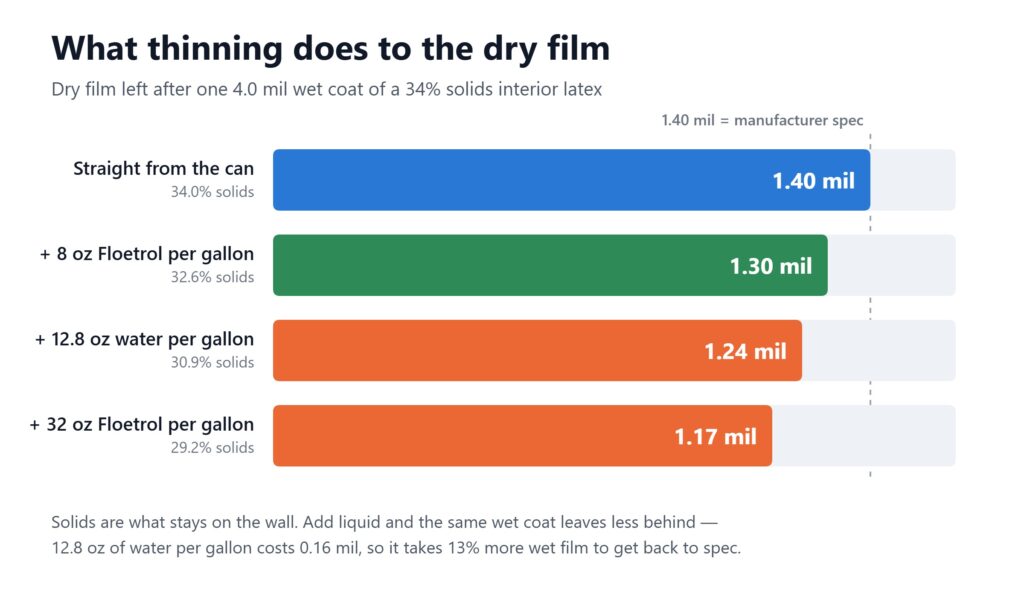
The useful way to read that chart is as a trade, not a penalty. Thinning does not destroy paint, because the solids are all still in the bucket. What it does is move the wet film thickness you need: to land on 1.4 mils dry out of a 30.9 percent mix you have to lay down 4.53 mils wet, which is 13 percent more material on the wall per pass.
So the honest cost of a 10 percent dilution is 13 percent more passes, and the usual failure is not thinning itself but thinning and then spraying exactly as before. That is where thin color over patched drywall, burnished sheen under a cloth, and the second full coat that was supposed to be unnecessary all come from.
| What is in the bucket | Solids by volume | Dry film from a 4.0 mil wet coat | Wet film needed for 1.4 mils dry |
|---|---|---|---|
| Paint straight from the can | 34.0 percent | 1.40 mils | 4.0 mils |
| Plus 8 oz conditioner per gallon | 32.6 percent | 1.30 mils | 4.3 mils |
| Plus 12.8 oz water per gallon | 30.9 percent | 1.24 mils | 4.53 mils |
| Plus 32 oz conditioner per gallon | 29.2 percent | 1.17 mils | 4.79 mils |
Water or a paint conditioner
Floetrol is the product almost everyone reaches for, and the last row of that table is why it deserves a closer look. It is dosed at up to 32 ounces per gallon through an airless sprayer. That is 25 percent by volume, two and a half times the water dilution people are nervous about, and because the conditioner is only 10 percent solids itself the mix ends up thinner in film than the 10 percent water version.
The conditioner is not a thinner. What it does is improve flow and leveling, stretch the open time, and cut wear on a spray gun. Those are different problems from a pump that cannot atomize.
| Job you are trying to do | Use | Rate |
|---|---|---|
| Pattern is tailing or spitting from a small pump | Water | 5 percent, then 10 percent |
| Brush and roller marks will not level out | Conditioner | 8 oz per gallon, 16 oz maximum |
| Edge drying before you can roll back into it | Conditioner | 8 oz per gallon |
| Cup gun will not atomize | Water first, conditioner second | 4 to 8 oz conditioner per quart |
| Stretching a gallon further | Neither | Solids are fixed; see the film table above |
The practical reading: water fixes viscosity, the conditioner fixes flow, and neither buys you coverage. If the paint is both too thick to pump and leaving brush marks, you are allowed both, but count the two together against the film figures rather than treating the conditioner as free.
Thinning latex for an airless sprayer
Start by looking at your tip, not your paint. Latex wants an orifice in the .015 to .021 inch range, and both of the paints above sit squarely inside it. If your machine tops out at .013 or .015, where most interior wall sprayers sit, you are at the thin end of what the paint was designed for, and that is the case where 5 to 10 percent water earns its place.
Pressure is the other half. Both products specify 2,000 psi. Consumer machines commonly run to 2,800 or 3,000, and a pattern that looks like it needs thinner very often just needs the pressure wound down until the fan edges stop feathering into overspray. Try that before you open the faucet, because it costs nothing.
- Fit the largest tip your machine supports within the .015 to .021 inch band. Tip ceilings by machine are listed in our latex paint sprayer comparison.
- Prime, then spray a test pass on cardboard at the pressure the paint sheet asks for.
- If the fan has heavy tails at the edges, raise pressure in small increments before adding water.
- If the fan is still broken at the top of the pressure range, add 5 percent water and retest.
- Hold the gun 12 inches off the surface, aim it straight rather than fanning it, and overlap each stroke by half. That overlap is how the extra 13 percent of wet film goes on without runs.
Thinning latex for an HVLP turbine or cup gun
This is the one tool where thinning is not optional, and it is also the only one that hands you a measurement instead of an opinion. HVLP guns carry a viscosity rating in seconds, and the cup in the box is how you read it. One turbine unit is rated at 160 seconds: fill the cup, lift it clear, and time how long the stream takes to empty. Under the rating, spray it as it is. Over the rating, it needs water.

From there the schedule is simple: start at 10 percent, measure again, and if it still runs long add another 5 percent. You do not need a measuring jug for it either, because 5 percent of the paint volume works out to about half a viscosity cup.
It also settles what to thin with, in one sentence: paint is thinned by adding the substance the paint is based upon, so water goes into water-based paint and mineral spirit into oil-based. For latex there is no third option.
Expect to go further here than with an airless. A turbine moves far less material per second than a 2,000 psi pump, so 10 to 15 percent is ordinary territory for a gravity-feed HVLP gun on wall paint, and a flat sheen tolerates it better than a gloss, which is part of why ceiling work forgives a heavier dilution than trim does. Straining matters more too: fill through a filtered funnel or a nylon stocking, because the fluid passage in a cup gun blocks on debris a pump would have swallowed.
Thinning latex for a brush or roller
Do not. Neither of those paints needs thinning, and a 3/8 to 3/4 inch nap roller puts far more wet film on the wall than 4 mils, so viscosity is never the constraint.
What people are chasing when they water down brush paint is open time, because the surface skins over before they can lay it off and leaves ridges. That is the conditioner’s job at 8 ounces per gallon, 16 ounces being the ceiling. Thinned paint is also harder on a brush, so the cleaning routine matters more once you start adding water. Water flattens brush marks as well, and it also makes color translucent over patching compound and puts you on the wall for a third coat.
What should never go into latex paint
Search this subject for ten minutes and you will be told to reach for mineral spirits, acetone, xylene, turpentine or rubbing alcohol. Every one of those belongs to oil-based and solvent-borne coatings. Latex is an acrylic latex paint carried in water, and a solvent that dissolves an oil binder will instead shock the latex paint, so the binder drops out as curds that no amount of stirring brings back.

There is a second reason, and it has nothing to do with chemistry. Interior latex has no flash point at all, and it cleans up with soap and warm water. Pour a flammable solvent into a product with no flash point and you have created one, in an open bucket, in a room you are about to fill with atomized mist. Acetone flashes at minus 4 degrees Fahrenheit and is rated Class IB; 70 percent isopropyl alcohol flashes at 64.9 degrees, which is below room temperature in most houses.
- Mineral spirits and paint thinner — correct for alkyd and oil enamel, and the thinner a brush gets cleaned in after oil work, which is a separate job with its own handling rules. In latex they separate the binder.
- Acetone — a lacquer solvent that boils at 133 degrees Fahrenheit against water at 212, so it leaves the film long before the film has leveled.
- Xylene and toluene — industrial reducers for epoxies and alkyds, and the two most hazardous things on this list to breathe indoors.
- Turpentine — a traditional oil-paint thinner. It will not mix into water-borne paint at all, though it still has a place when you are thinning oil-based paint for a spray gun.
- Rubbing alcohol — mixes with water, which is why it gets suggested, but it evaporates faster than water, drops the open time it was meant to extend, and is flammable at the concentration it would take to matter.
If a latex mix has already curdled, strain it and look at what comes through. Paint that still flows and ties back together after stirring can sometimes be rolled onto a garage floor or a shed, but it should not go back on a finished wall, and it should never go into a pump.
Strain it, then prove it on cardboard
Two steps separate a mix that works from one you find out about on a wall. Straining comes first, because the whole point of adding water was to get the paint through a narrow orifice and a skin fragment off the lid undoes that in one pass. A cone filter, a mesh paint strainer or a nylon stocking over the funnel all work.
Then test on something you can throw away. Spray a full pass on a scrap of cardboard or drywall held upright, not flat, so you can see whether the film sags. Put a drop cloth under it, because a test pass at 13 percent more wet film throws more overspray than you expect. Read three things off it:
- The edges of the fan. Heavy, dark tails at the top and bottom of the pattern mean the paint is not atomizing. On an airless try more pressure first, then 5 percent water.
- Spitting and sputtering. Usually a blocked filter or a loose tip rather than thick paint, so check both before you reach for the jug.
- Sag on the vertical. If it runs, you have gone too far. Add unthinned paint back from the can you deliberately left alone, and note how much that takes: walking a thinned gallon from 10 percent back down to 5 percent means adding roughly another full gallon of paint, because the 12.8 ounces of water you added is only 5 percent once 256 ounces of paint are sitting under it. That is the real argument for 5 percent first.
One pass on a vertical scrap tells you more than any ratio, which is the reason to keep the untouched portion of the gallon in reserve rather than thinning the whole can at once.
Frequently asked questions
Do professional painters water down paint?
Not as a technique. The contractor-grade products they buy are specified to spray unthinned, so there is nothing in the specification to fix. Where watering down happens it is to stretch a gallon, and the film arithmetic shows what that buys: the solids in the can are fixed, so the mix either covers the same area at a thinner film or the correct film over less area. What a working painter does adjust is pressure and tip size, because those change atomization without touching the solids.
What is the best thinning agent for latex paint?
Clean water at room temperature, added in 5 percent steps. Water is the carrier the binder is already suspended in, so more of it dilutes the mix without attacking anything in it. A conditioner is the better choice when the complaint is brush marks or edges drying too fast, but it is a flow additive, and at the rates it is dosed at it dilutes the dry film slightly more than water does.
Can you use acrylic latex paint in a sprayer?
Yes. The airless window for it is 2,000 psi through a tip between 0.015 and 0.021 inch. The real question is whether your machine reaches the top of that band. A handheld or entry-level unit capped at .013 or .015 is spraying at the thin edge of what the paint expects, and that is the situation 5 to 10 percent water is for.
Can Valspar paint be thinned?
It is not required and there is no published ratio, because the paint is formulated to spray unthinned at 36 percent solids through a 0.015 to 0.019 inch tip at 2,000 psi, covering 400 square feet per gallon at 4.0 mils wet. Through a cup gun it can be thinned the same way as any other acrylic latex: water, 5 percent at a time, until the cup drains inside the gun rating.
Can I use rubbing alcohol as a paint thinner?
No. Seventy percent isopropyl alcohol has a closed-cup flash point of 64.9 degrees Fahrenheit and is classified as a highly flammable liquid and vapor, so adding it to a paint with no flash point gives the bucket one at roughly room temperature. It also boils at 180.5 degrees against water at 212, so it leaves the film faster than the water it replaced and shortens the open time instead of helping it.
What household items can thin paint?
For latex, water and nothing else. The bottles under the sink that get suggested online, alcohol and acetone among them, are solvents for oil-based and lacquer finishes, and in an acrylic latex paint they shock the binder out as curds. If the complaint is flow rather than viscosity, a purpose-made latex conditioner at 8 ounces per gallon is the only other thing worth putting in the bucket.

in this article you start out with thinning latex paint with a picture of a can of naptha and a can of latex paint. some people dont like to read on because they are looking for a quick answer and see can of Naptha and a can of latex paint, oh! must be able to mix it. any way i mixed latex with a bunch of napta for a dog house. looked so bad we just lit it on fire, it burrned nicely!
Thanks for your information, fix it soon.