Last Updated on October 6, 2026
Choosing a latex paint sprayer is almost always framed as HVLP against airless, and that is the wrong axis. What decides whether a machine will spray latex is the size of the hole the paint has to go through, and the pressure behind it.
Latex wall paint needs a .015 inch orifice or bigger. At .013 you are at the top of the stain range and thinning stops being optional. At .011 and below latex will not pass at all, whatever you do to it. That single figure sorts every machine on this page.
The second figure is pressure. An HVLP turbine is capped at 10 psi at the air cap — that cap is the definition of HVLP — while a piston airless runs 2,000 to 3,000 psi. One of those can force full-bodied latex through a small nozzle and the other cannot.
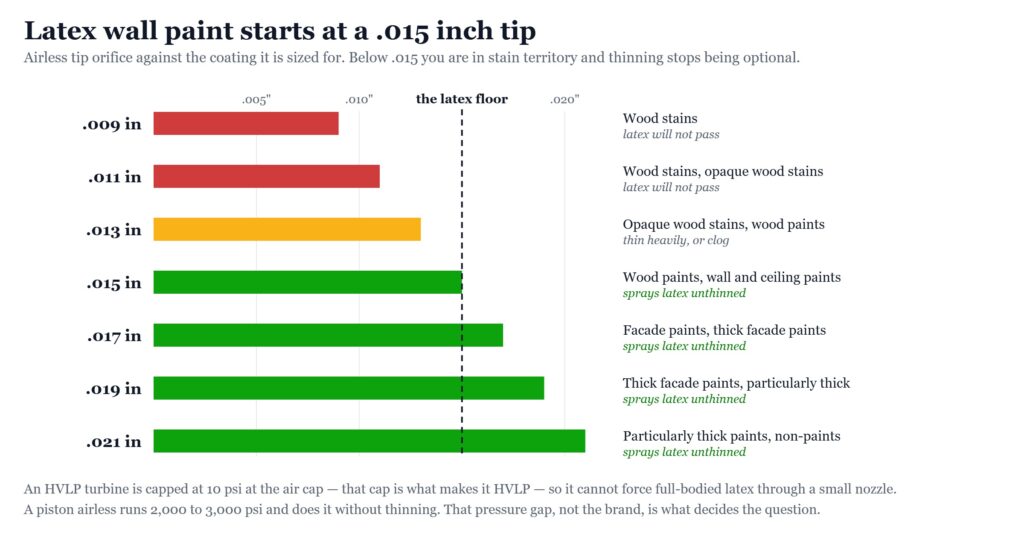
The three machine classes, and which one sprays latex straight from the can
| Machine | Pressure | Orifice | Latex unthinned? |
|---|---|---|---|
| Piston airless | 2,000–3,000 psi | .015–.021 in tips | Yes — thinning here costs film for nothing |
| High-efficiency airless (HEA) | Lower, same tips | .015 in and up | Yes, with up to 55% less overspray |
| Handheld or small airless | Varies | Often .013–.015 in | Usually needs 5 to 10% water |
| HVLP turbine | 10 psi at the cap | 1.0–2.0 mm nozzle | No — thin it, or use a flow enhancer |
| HVLP with a latex-rated nozzle | 10 psi at the cap | Wider nozzle set | Yes, on the models sold for it |
| Compressor gun, gravity feed | 20–50 psi at the inlet | 1.3–2.0 mm | No — built for thinner coatings |
Independent testing of turbine units found they handled unthinned lacquer and polyurethane without complaint, and that paint “was a different challenge, with some sprayers having to work noticeably harder”. The same testing adds the line that matters for buyers: latex viscosity rises with paint quality, so the better the paint you bought, the more likely a turbine will struggle with it.
That is the trap in the category. The premium latex you chose for coverage is the one your turbine will refuse, and the cheap contractor-grade latex sprays beautifully through it.
Nobody agrees how much water, and one of the common answers contradicts itself
Search for this and you will be handed four different quantities for one job. The figures circulating are half a cup per gallon, a quarter cup per gallon, an eighth of a cup per gallon, and “10 to 15 percent”.
A US gallon is 128 fluid ounces and a cup is 8, so those are not four opinions, they are four different orders of magnitude:
| The advice | In fluid ounces per gallon | As a percentage |
|---|---|---|
| 1/8 cup | 1 oz | 0.8% |
| 1/4 cup | 2 oz | 1.6% |
| 1/2 cup | 4 oz | 3.1% |
| 10% | 12.8 oz | 10% |
| 15% | 19.2 oz | 15% |
One widely repeated version manages to give two of these in the same breath — thin by 10 to 15 percent, it says, which is an eighth to a quarter of a cup per gallon. To actually reach 10 to 15 percent you need 1.6 to 2.4 cups. The quantity is 10 to 13 times smaller than the percentage sitting next to it.
Which is why the orifice matters more than the ratio. Get the tip right and most of this disappears: a .017 inch tip on a piston pump takes latex with nothing added. If you do need to thin, the measured ratios in fluid ounces are worked out properly, including what each ounce costs you in film thickness.
Seven sprayers, sorted by whether they will take latex as it comes
Ranking these one to seven would be dishonest, because they are not competing for the same job. Sorted by class, the choice makes itself.
Graco Magnum X7 — piston airless, sprays latex unthinned

This is the reference point for the class: a cart-mounted piston pump running up to 2,800 psi, shipping with a .015 inch tip and taking .017 for heavier coatings, drawing straight from a 1 or 5 gallon bucket. There is no thinning step. For a whole house or a fence it is the only class that makes sense, and the step up to a contractor pump is a question of duty cycle rather than capability.
Titan ControlMax — high-efficiency airless, less overspray
This line runs the same .015 inch tips at lower pressure, which is where the claimed reduction in overspray of up to 55% comes from. The 515 tip is a .015 inch orifice with a 10 inch fan. You give up a little speed and you get back a lot of masking time, which on interior work is usually the better trade.
Graco TrueCoat 360 — handheld airless, where thinning starts

It is a piston pump small enough to hold, and that is both the appeal and the limit. The pump is working near the edge with full-bodied latex, so this is the class where 5 to 10% water genuinely helps rather than just costing you film. Good for a door, a shed, a stair rail. Not for a ceiling.
HomeRight Finish Max — HVLP turbine, thin it first

This is a turbine unit, so it lives under the 10 psi cap. On lacquer, polyurethane and stain it is excellent. On premium latex it will labour, and the fix is either a flow enhancer, measured water, or a different machine. Nozzle sets in this class run 1.0 to 2.0 mm as standard.
The Wagner Flexio 590 is the exception worth knowing about — an HVLP-style latex paint sprayer whose wider nozzle is rated to spray latex without thinning. Same pressure ceiling, different hole — which is the point this whole page is making.
Astro 4008 and Neiko 31215A — compressor guns

Both are gravity-feed guns that need a compressor behind them. They atomize beautifully at 1.3 to 2.0 mm on automotive finishes, lacquers and enamels. Latex through them is a thinning exercise every time, and you are still limited by whatever compressor capacity you have.

Matching the machine to the job

Walls and ceilings, whole rooms, exteriors, fences: piston airless, .017 inch tip, nothing added. The pump is doing the work that thinning would otherwise have to do, and every ounce of water you skip stays on the wall as film.

Doors, trim, cabinets, furniture: an HVLP turbine or a cup gun gives you a finer finish and far less overspray in a room you cannot mask completely. Latex is the awkward coating here, which is why this class is happier with the finishes furniture work actually uses.

A multi-nozzle HVLP sits between the two. 4 nozzles cover roughly 1.0 to 2.6 mm, so 1 machine handles stain, lacquer and, at the widest setting, thinned latex. It is a compromise rather than a specialist, and that is a fair trade for a single tool in a small garage.
Whichever you buy, the clean-down routine decides whether it works next time. Dried latex in a .015 inch orifice — a hole 4 tenths of a millimetre across — is the single most common reason a sprayer gets described as broken.
Frequently asked questions
Can you use latex paint in a paint gun?
Yes, if the orifice is big enough. A piston airless with a .015 inch tip or larger takes latex straight from the can. A compressor gun at 1.3 to 2.0 mm, or a turbine capped at 10 psi, will need the paint thinned or a flow enhancer added. Anything narrower than that is a stain tip, and no amount of water rescues it.
What type of paint sprayer is best for latex paint?
Airless, for anything bigger than a door. It is the only class that generates enough pressure — 2,000 to 3,000 psi — to atomize full-bodied latex without thinning it first. High-efficiency airless is the refinement: same tips, lower pressure, up to 55% less overspray, which matters indoors.
What is a latex spray gun?
It is a marketing label rather than a category. What makes a gun capable with latex is a nozzle wide enough to pass it — .015 inch and up on an airless, or a wide-set nozzle on an HVLP rated for unthinned latex. Any gun with those will spray latex; any gun without them will not, whatever the box says.
Should I dilute latex paint for spraying?
Only if the machine needs it. On a full-size airless with a .015 to .021 inch tip, no — and thinning costs you film thickness in direct proportion to what you add. On a handheld or small airless, 5 to 10% water. On a turbine or cup gun, more, or a flow enhancer instead. Measure it: 10% of a gallon is 12.8 fluid ounces, not a quarter of a cup.
What are the downsides of using latex paint?
For spraying, the viscosity. Latex is thick enough to defeat anything under a .015 inch orifice, and it thickens further as quality rises. It also dries fast enough to skin over in the gun, so a stopped sprayer is a clogged sprayer within minutes. Against that, it cleans up with water and carries a fraction of the VOC of a solvent-based equivalent.
What is latex paint best used for?
Interior walls and ceilings, exterior siding, stucco, concrete and most trim. It is the default for everything a homeowner sprays, which is exactly why the orifice question comes up so often — the most commonly sprayed paint is also the most demanding one for a small machine.
The short version
Check the tip before the brand when you buy a latex paint gun. You need a .015 inch orifice at minimum, and a pump that can push paint through it — 2,000 to 3,000 psi on a piston airless against 10 psi at an HVLP cap.
Get that right and the thinning argument mostly evaporates. Get it wrong and no amount of water fixes it, because the paint was never going to fit through the hole.
