Last Updated on October 7, 2026
Search for an air compressor to run a paint sprayer and you will be shown units rated at 3 CFM, 5.3 CFM and 15 CFM, all measured at 90 psi, alongside advice to make sure your compressor matches or exceeds what your gun needs. Follow that instruction literally and you will buy the wrong compressor, because spray guns are rated at 30 to 50 psi and compressors are rated at 90. Those are two different numbers and they do not compare.
The short answer: one HVLP gun needs 10 to 15 CFM at 40 psi, continuously, and dropping your regulator from 90 psi to 40 buys about 15 percent more air rather than three times more. The Makita MAC700, a 2.6 gallon unit rated 3.3 CFM at 90 psi, delivers 3.8 at 40. That is a quarter of one gun.
Below are the 7 compressors this page has always listed, each rated against that requirement. Picking an air compressor paint sprayer combination is one subtraction, not a brand argument. None of them will feed a full-size HVLP gun without stopping, and the useful question is what each one can run instead.
Compressor ratings and gun ratings use different pressures
A compressor is sold on its output at 90 psi because that is the pressure most air tools want. An impact wrench, a nailer, a ratchet: all around 90. Spray guns are the exception. An HVLP gun takes 30 to 50 psi at the inlet and turns it into less than 10 psi at the air cap, which is what the high-volume, low-pressure name means.
Output does rise as outlet pressure falls, and the Makita figures show the actual size of that effect, because they are published at both pressures: 3.3 CFM at 90 psi becomes 3.8 CFM at 40 psi. Fifteen percent. Not a doubling, not a tripling. Anyone assuming a weak 90 psi rating will be fine at spray pressure is working from a factor that does not exist.
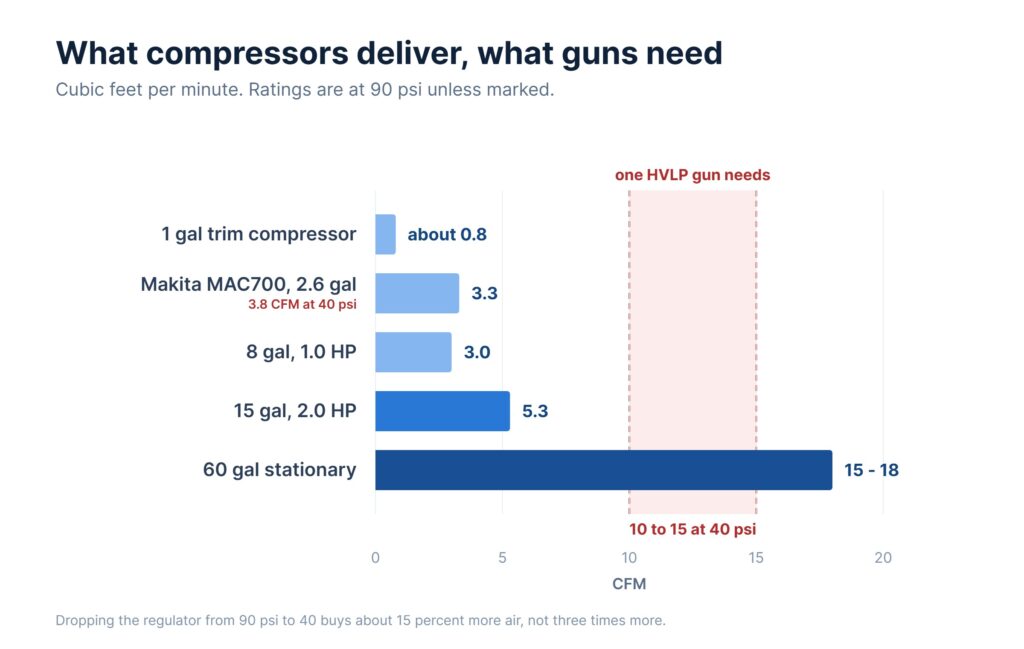
The requirement itself is settled. An HVLP gun wants 10 to 15 CFM at 40 psi for proper atomization, and some run to 18 at 40 to 60 psi. Low-pressure guns of the LVLP type sit lower at 5 to 18 CFM, and detail or touch-up guns can work on 3 to 6. On top of whichever figure applies, the practice is to supply 1 to 1.5 times the gun requirement, because a compressor running flat out all day is a compressor that overheats.
The tank is a buffer, not a supply
People buy tank gallons hoping to cover a weak pump. The tank only holds the difference between what the gun takes and what the pump makes, and you can work out exactly how long that lasts. A gallon is 0.1337 cubic feet. Multiply the tank volume in cubic feet by the pressure drop divided by 14.7 and you have the free air stored above your working pressure. Divide that by the shortfall and you have your run time.
Run with a 12 CFM gun and a 3 CFM pump, so a shortfall of 9 CFM, and a 110 psi tank bled down to 40:
| Tank | Free air above 40 psi | Spraying before the tank is empty |
|---|---|---|
| 1 gallon | 0.86 cu ft | about 6 seconds |
| 2.6 gallon | 2.1 cu ft | about 14 seconds |
| 3 gallon | 1.9 cu ft | about 13 seconds |
| 6 gallon | 6.0 cu ft | about 40 seconds |
| 20 gallon | 17.3 cu ft | about 2 minutes |
| 60 gallon | 73.6 cu ft | about 8 minutes |
After that the tank is out of the conversation and you are living on the pump. The gun does not care that there is a tank; it draws continuously for as long as you hold the trigger, and a door or a cabinet side takes longer than 14 seconds to coat. What you get instead is a pressure drop mid-pass, the fan collapsing to a narrow spatter, and a stripe down the work.
This is why the honest answer to whether a 3 gallon unit will run a paint sprayer is 13 seconds, and why 60 gallon stationary compressors exist in body shops. It is also why airless sprayers and turbine HVLP units are popular with people who do not own a serious compressor: both make their own air, and an airless unit skips compressed air entirely.
Matching a gun to the compressor you already own
Work it in this order and you will not waste money. Find your compressor’s CFM at 40 psi, not at 90, which means looking past the headline number on the box. Divide by 1.25 to leave headroom. Then buy a gun whose stated consumption at its rated inlet pressure fits under that figure.
| CFM at 40 psi | What it will run | What it will not |
|---|---|---|
| Under 2 | An airbrush, or a touch-up gun in short bursts | Any production spray gun |
| 2 to 4 | A detail or touch-up gun, small LVLP work | A full-size HVLP gun |
| 5 to 9 | A mid-range LVLP gun on panels and furniture | Continuous HVLP on walls |
| 10 to 15 | One full-size HVLP gun | Two guns, or an HVLP plus a blow gun |
| 18 and up | HVLP continuously, with headroom | — |
Two accessories are not optional. A water separator goes in the line, because compressed air carries moisture and moisture in a finish coat shows up as craters and blushing. And the hose has to be wide enough: a long run of quarter inch line throttles the air before it reaches the gun whatever the compressor is rated at. Thinning and viscosity is a separate variable that will not rescue an undersized compressor.
7 Best Air Compressor Paint Sprayer Picks, Rated Against The Requirement
No top pick for HVLP, because none of these reaches 10 CFM at 40 psi. For a detail or touch-up gun, number 2 is the real answer on specification. For an airbrush, number 7 is correctly sized. If you need to run a full-size HVLP gun, you are looking for a 60 gallon stationary unit or a turbine, and neither is on this page.
1. DeWalt D55140 Trim Compressor

A trim compressor, which is a one gallon tank built to drive a finish nailer. A nailer takes a short burst and then nothing for several seconds, so a tiny tank and a small pump are plenty. A spray gun takes air without pause. Keep this one for the trim carpentry it was designed for and for blowing dust off a surface before you spray it.
2. Makita MAC700 Air Compressor

The strongest unit on this page and the only one whose output is published at both pressures: 3.3 CFM at 90 psi and 3.8 at 40, from a 2.6 gallon tank and a 2 horsepower motor. Against a 10 to 15 CFM HVLP gun that is a quarter of the requirement. Against a detail or touch-up gun at 3 to 6 CFM it is a genuine match, and the cast iron pump and low noise are why it has lasted in workshops.
3. Campbell Hausfeld FP209499AV Air Compressor

A light portable in the same class as the trim units. Check the figure at 40 psi on the listing before you buy it for spraying, and expect it to sit in the airbrush to touch-up band rather than anywhere near a production gun. Where small portables earn their place in a paint job is the air blast that cleans a surface and the few seconds of air a touch-up needs.
4. Porter-Cable PCFP02003 Pancake Compressor

The pancake, which is the shape most people already own. The sibling Porter-Cable C2002 at 6 gallons is rated 2.6 CFM at 90 psi, so a 3.5 gallon version sits below that, and the arithmetic from the tank table applies: a few seconds of spraying and then you are waiting on the pump. It runs nailers and tires well and that is the honest scope.
5. Rolair JC10 Oil-Less Compressor

Quiet and well built, and quiet matters more than people expect when you are spraying indoors for an afternoon. It is still a small-tank, small-pump machine. Treat it as a touch-up and detail supply, or as the compressor you keep for everything that is not spraying while a bigger unit handles the gun.
6. Senco PC1010 Air Compressor
A one gallon brad nailer compressor, and the smallest practical pick here. It will hold up an airbrush and it will blow a surface clean. It is on this list because it keeps appearing on compressor roundups generally, not because it will spray. Buying it for a paint project is the mistake this whole page exists to prevent.
7. Master Airbrush Compressor
An airbrush compressor, which is a different category rather than a smaller version of the same thing. Airbrushes work at 15 to 30 psi and consume a fraction of a CFM, so a unit like this is correctly sized for models, cake work, nail art and fine illustration. For furniture, cabinets or walls it is the wrong tool by an order of magnitude.
Frequently Asked Questions
What size air compressor do I need for a paint sprayer?
Size it on CFM at your gun’s inlet pressure, not on gallons. A full-size HVLP gun wants 10 to 15 CFM at 40 psi and 1 to 1.5 times that for headroom, which in practice means a 20 gallon unit at the small end and a 60 gallon stationary for continuous work. A detail or touch-up gun at 3 to 6 CFM runs on a good 2.6 gallon portable.
What is the best air compressor machine for spray painting?
Whichever one delivers more CFM at 40 psi than your gun consumes, with a quarter left over. Among the units here that is the Makita at 3.8 CFM, for touch-up work. For a production gun the answer is a 60 gallon stationary in the 15 to 18 CFM class, and the honest version of that answer is that it costs several times what a portable does.
Can I use a paint sprayer with my air compressor?
Only if the numbers line up. Look up your compressor’s output at 40 psi, then look up your gun’s consumption at its rated inlet pressure, and compare those two. If the gun asks for more, the gun will work for a few seconds on tank air and then starve. The fix is a smaller gun rather than a bigger regulator setting.
What air compressor do I need for spray painting?
For walls and cabinets with an HVLP gun, one that holds 10 to 15 CFM at 40 psi all day. For panels with an LVLP gun, 5 to 9. For touch-ups, 2 to 4. For an airbrush, under 2. Those four bands cover almost every job, and the gun you intend to buy decides which one you are shopping in.
What type of air compressor is best for paint spraying?
A single-stage electric with a tank of 20 gallons or more, oil-lubricated if you want it quiet and long-lived, with a water separator in the line. Pancakes and trim units are the wrong type regardless of brand because the pump is sized for intermittent tools. Turbine HVLP systems sidestep the question by generating their own air.
Will a 3 gallon air compressor run a paint sprayer?
For about 13 seconds. A 3 gallon tank bled from 110 psi to 40 holds roughly 1.9 cubic feet of usable air, and a 12 CFM gun against a 3 CFM pump burns through that in a quarter of a minute. It will run an airbrush indefinitely and a touch-up gun in short bursts, and it will not coat a door.
Final word
There is one number that settles this and it is not printed on the front of the box. Find your compressor’s CFM at 40 psi, subtract 25 percent, and buy a gun that fits underneath. Everything else, gallons included, is a detail: 10 to 15 CFM runs an HVLP gun, 3 to 6 runs a touch-up gun, and under 2 runs an airbrush. The tank buys you 14 seconds and the pump has to do the rest.
