Last Updated on October 12, 2026
A handheld paint sprayer holds 32 ounces. At the rate these machines move paint, that is a little over two minutes of continuous trigger, and about 100 square feet of wall.
What gets printed instead is the weight of the empty tool, which is the one figure you never experience, because by the time you lift it there is a quarter gallon of paint on board.
In A Hurry, Check Out Our Top airless paint sprayers:
| IMAGE | PRODUCT | DETAILS | ||
|---|---|---|---|---|
|
Our Top Pick
 |
Our Top Pick
|
Krause & Becker Airless Sprayer |
|
Check Price |
|
Best Value
 |
Best Value
|
Graco Magnum X7 |
|
Check Price |
 |
Wagner 9175 Paint Sprayer |
|
Check Price | |
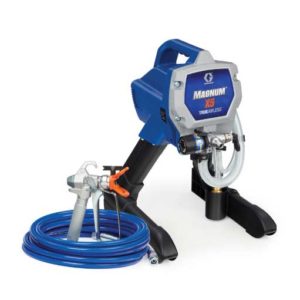 |
Graco Magnum X5 |
|
Check Price | |
 |
Graco Magnum 257025 |
|
Check Price |
What is actually in your hand
Interior latex weighs about 11.5 pounds a gallon. A full 32 ounce container is a quarter of that, so roughly 2.9 pounds of paint sitting on top of a tool that weighs 3.5 to 3.75 pounds empty.
| On the box | With a full container | |
|---|---|---|
| Weight | 3.75 lb | 6.6 lb |
| Held | At your side | Out in front, one hand, trigger down |
| For | Comparison tables | Every minute you are spraying |
6.6 pounds is not heavy. 6.6 pounds held at arm’s length, moving in a steady pass, for the 20 minutes it takes to do a run of cabinet doors, is a different measurement, and it is why these get put down halfway through in favor of a brush.
A budget handheld from the discount tool chains weighs 5.5 pounds empty, which lands the same tool at over 8 pounds loaded.
Two minutes of paint, and what that covers
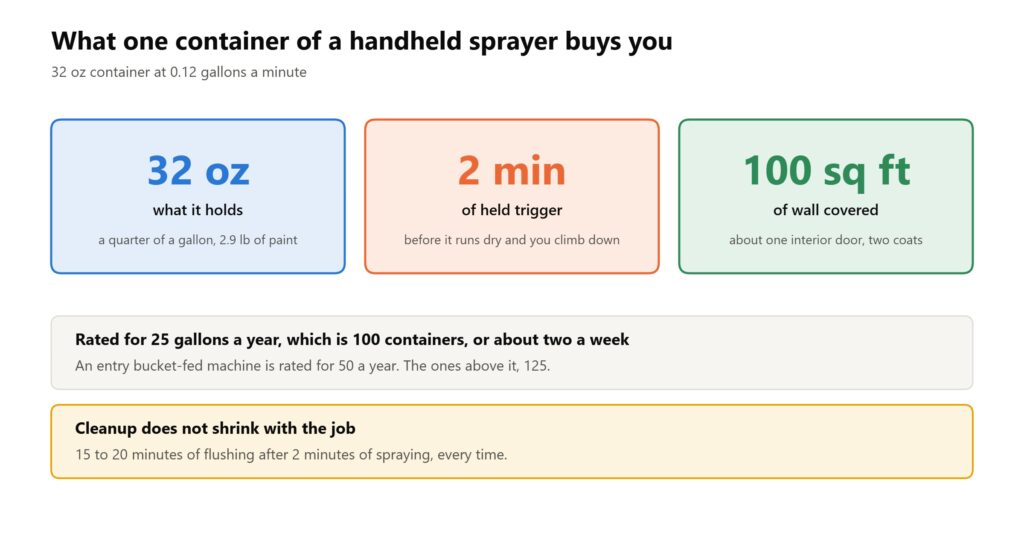
A handheld airless moves 0.12 gallons a minute. That is 15 ounces, so a 32 ounce container empties in a little over two minutes of held trigger.
Trigger time is not clock time — you are repositioning, checking, moving the ladder. But it sets the refill interval, and the refill is the part that costs you.
| Job | Surface | Containers at 100 sq ft each |
|---|---|---|
| One interior door, two coats | About 80 sq ft | 1 |
| Six cabinet doors, two coats | About 95 sq ft | 1 |
| A 12 by 15 ft ceiling, two coats | 360 sq ft | 4 |
| One bedroom’s walls, two coats | About 800 sq ft | 8 |
A quarter gallon covers around 100 square feet at the spread rate most interior paint gives. Up to a door or a set of drawer fronts, that is one fill and you are done. A room is eight, and eight refills means eight stops to unclip, pour, re-prime and find the wet edge again.
That is the line these tools sit on. Past about 150 square feet in one session, the time goes into refilling rather than spraying, and a machine that draws from the paint can instead wins on everything except the price.
The duty rating on the box
Each machine is built to move a set amount of paint in a year, and that figure varies by a factor of 5 across the range.
| Class | Paint per year it is rated for | What that is |
|---|---|---|
| Handheld | 25 gallons | Around two containers a week |
| Entry bucket-fed | 50 gallons | Double |
| Mid and upper bucket-fed | 125 gallons | Five times |
25 gallons a year is 100 containers. For furniture, doors, trim and the odd small room that is years of work. For someone repainting a whole house in one summer it is the entire budget inside a month, and the machine is being asked to do a job it was not rated for.
Cleanup does not scale with the job
The manual is blunt about it: clean the sprayer after every spray job, and store it filled with pump protectant or you will have problems the next time you spray.
None of that shortens because you only sprayed one door. The pump has to be flushed through, the tip and filters cleared, and the protective fluid drawn in before it goes back in the cabinet. That is a fixed 15 to 20 minutes against the 2 minutes of trigger time one container gives you.
That ratio is the honest case against these tools for small jobs, and the honest case for them on jobs with a lot of edges. On 1 flat door a foam roller takes 10 minutes and the cleanup is a rinse under a tap. On 6 louvered shutters a brush cannot reach the slats at all, and the 20 minute flush is the same either way.
They all stop at the same tip size
The tip is the hole the paint is forced through, named in thousandths of an inch. Interior latex wants .015 to .019.
| Machine | Largest tip it accepts | Pressure |
|---|---|---|
| Handheld airless | .015 in | 2,000 psi |
| Discount-chain handheld | .014 in | 2,000 psi |
| Entry bucket-fed | .015 in | 2,800 psi |
| Low-pressure bucket-fed | .015 in | 1,500 psi |
| Upper bucket-fed | .017 in | 3,000 psi |
Every consumer machine in that table stops at .015 except one. Latex starts at .015. So the tool is at the bottom of the range for the paint it will mostly be asked to spray, with nothing above to move to — and tips wear their holes open and their fans narrow as they spray, so the number only ever drifts the wrong way.
For stain, sealer and thin lacquer, which want .009 to .013, that ceiling never matters. It is latex and primer where it bites, and primer is most of what a handheld gets used for.
The overspray claim, and what is behind it
One range advertises up to 55 percent less overspray than standard airless. The claim holds, and the mechanism is not a secret: those machines run at 1,500 psi where a conventional consumer airless runs to 2,800 or 3,000.
Pressure is what atomizes the paint. Push it harder than the coating needs and you break it into a finer mist than will land, and the part that does not land is the cloud. Drop the pressure and the droplets get bigger, the spray gets softer and more of it stays on the wall.
Which means the same saving is available on a machine you already own. Turn the pressure down until the fan just stops throwing ragged tails at its edges, and stop there. The phrase on the box is a setting sold as a feature, and the two words doing the work in it are “up to”.
Where the discount-chain machines actually differ
A handheld airless from the discount tool chains lists 2,000 psi, 0.12 gallons a minute, a 32 ounce cup and a .014 tip. A handheld from the brand everyone recommends lists 2,000 psi, 0.12 gallons a minute, a 32 ounce container and a .015 tip.
On the numbers that decide how it sprays, they are the same machine. The difference is the warranty, which is 90 days on the discount version, and whether you can buy a replacement pump, tip or filter in two years without hunting.
For one project and then a cabinet, that is a reasonable trade. For a tool you expect to pick up every spring, the parts shelf is the whole argument, and it is not a performance question at all.
The sprayers
Three of the ten below are handheld. The other seven draw from a bucket, which changes what they are for rather than how well they spray, so the table says which is which before the reviews start.
| Machine | Format | Suits |
|---|---|---|
| Krause & Becker | Bucket-fed | Rooms and exteriors |
| Graco Magnum X7 | Bucket-fed | Whole house, longest hose |
| Wagner 9175 | Bucket-fed | Heaviest of the group |
| Graco Magnum X5 | Bucket-fed | Rooms, quarterly use |
| Graco Magnum Project Painter Plus | Bucket-fed | Occasional rooms |
| HomeRight Power Flo Pro | Bucket-fed | Fences and decks |
| Wagner Spraytech handheld | Handheld | Furniture and trim |
| Graco TrueCoat Pro II | Handheld | Doors, cabinets, spraying at any angle |
| Titan ControlMax 1900 Pro | Bucket-fed, low pressure | Interiors where overspray matters |
| REXBETI Ultimate-750 | Handheld | Small jobs, lowest cost |
If the job is furniture, doors, trim or anything with slats, read the handheld entries. If it is rooms or an exterior, the bucket-fed ones are the real answer and the handheld is a false economy you will feel at the fourth refill.
1. Krause & Becker Airless Paint Sprayer
This paint sprayer kit is manufactured by Krause & Becker. It is a lightweight spray paint gun that is long-lasting, has a built-in filter to capture particles of debris before they are capable of clogging your nozzle, and has a trigger lock so you can flush the system out or clean the sprayer easily.
This airless paint sprayer picks up the paint using a suction hose that is placed in the bucket the paint was purchased in. It has a 3000 PSI piston pump that provides high pressure when in operation so you get better coverage and spend less time painting.
The paint pick-up is crafted out of stainless steel so it will never rust or corrode. It’s is very easy to clean this paint sprayer and you do not have to worry about drying each segment completely.
It has a twist knob that you can use to control the pressure and thus control the amount of paint dispensed per minute, and it comes complete with a number 517 nozzle that can produce a twelve inch to sixteen-inch pattern width.
2. Graco Magnum X7 Airless Paint Sprayer
There is more detail than fits here in our full Graco Magnum X7 review.

Graco Magnum 262805 X7 paint sprayer is recommended for spraying as much as one hundred and twenty-five gallons of paint per year. That makes this sprayer an ideal selection for professional painters, and for homeowners alike. It is powered by a 0.625 engine.
You can spray un-thinned latex paint using this paint sprayer because of the stainless steel piston pump it picks the paint up with. There is not a paint container as the piston pump is connected to a hose that goes into the paint can and picks the paint up directly from the one gallon can or five-gallon bucket.
When it is time to clean up after the job is complete you hook a standard garden hose to the paint sprayer via a power flush adapter and allow the water pressure from the hose to help you do a fast cleaning of the equipment.
3. Wagner 9175 Airless Piston Pump Paint Sprayer
This Wagner piston pump sprayer will spray as much as thirty-five gallons of paint per minute. It is powered by a ¾ horsepower engine and has as much as 3000 PSI.
This paint sprayer comes with a heavy upright cart that makes positioning the sprayer easy to do. It also comes with a five-gallon plastic bucket. You also get a 50-foot long paint spray hose so you do not have to move the sprayer as often when you are working. It is capable of supporting up to a 0.19 spray tip.
It handles latex, oil-based paint, varnish, lacquer, stain and urethane without a change of setup.
The pump delivers on both the up and the down stroke, so the flow does not pulse between passes the way a single-acting pump does.
4. Graco Magnum X5 Stand Airless Paint Sprayer
Our separate Graco Magnum X5 review covers its pressure control and tip options in more detail.

The Graco 262800 allows you to spray paint that has not been watered down with precision. It has a fully adjustable pressure so you can spray thinned or thick paints with the same precision and get the same great results.
It has a suction hose that brings the paint out of the bucket it came in and forces it into the spray gun for distribution.
You can spray as much as one hundred and twenty-five gallons of paint per year using this sprayer. This sprayer can be connected to a hose that is up to 75 feet in length so it is great for exterior house painting and large jobs.
When you are painting you can reverse the tip on this spray gun if paint clogs begin to form. This keeps you from having to stop and change tips or stop and clean the tip you are using.
Cleaning up is made simpler by the power flush adapter that connects to a water hose and allows the water to flow through the gun removing all paint particles, dirt, and debris.
5. Graco Magnum Painter Plus Paint Sprayer
See also our full review of the Graco Magnum Project Painter Plus.

The Graco Magnum 257025 paint sprayer is capable of spraying latex paint that has not been watered down or thinned in any manner. That means that this sprayer will give you a thicker paint coating and allow you to shorten the amount of time it takes to complete the task.
It can support a hose that is as long as fifty feet. That will allow you to paint exterior surfaces or even a two-story home very easily. It pumps the paint directly from the paint bucket so you do not have to transfer paint from one container to another container.
You have complete control of the amount of pressure produced by this paint sprayer. There is also a RAC Switch tip that allows you to simply reverse the tip you are using if the tip were to become clogged with paint. You do not have to stop working so you finish quicker.
When it is time to clean the paint sprayer you will connect it to a regular water hose and flush all of the remaining paint and particles out of the system. The cleaning is very easy and there are plenty of storage compartments provided to store your extra tips, the spray gun, and the cord.
6. HomeRight Power Flo Pro Airless Paint Sprayer

The HomeRight Power Flo Pro 2800 C800879 airless paint spray gun is the ideal choice for exterior painting projects around your home (HomeRight Power Flo Pro is the best airless paint sprayer for home use) or business. It has a one half horsepower motor that provides you with a maximum of 2800 PSI so it is capable of spraying latex paints and thick paints without you adding water to them.
The 25-foot long hose allows you to easily reach any portion of the project you are working on, and it is a non-kink hose so you will not be stopping frequently to get the kinks out.
The paint is not poured into a container on the paint sprayer but is picked up by the sprayer pump straight from the container it was placed in by the manufacturer. You can use the small one gallon cans or you can use the five-gallon buckets of paint for larger jobs.
7. Wagner Spraytech Airless Paint Sprayer

The innovative suction tube on the Wagner Spraytech 0525032 allows you to paint a ceiling or a floor holding the paint sprayer at any angle you like because the paint is drawn into the cup without air being drawn with it. You do not have the sputtering that you have with other paint sprayers.
You can paint directly from a one-gallon paint can or a five-gallon paint bucket when you are doing large projects. It also has a one-quart paint cup that allows you to paint smaller projects with the same precision as the larger projects.
The piston and cylinder are tungsten steel, which is what lets it handle unthinned latex without scoring.
The electronic speed control can be set to one of two different speeds so you can paint the way you want to paint. This paint sprayer is capable of dispensing as much as 7.2 gallons of paint per hour.
8. Graco TrueCoat Pro II – Best Electric Airless Paint Sprayer
Our standalone Graco TrueCoat Pro II review goes further into its running costs and cleaning routine.

It is sized for jobs taking 4 to 8 quarts, which is 1 to 2 gallons, or a large room through to a small exterior.
You can spray the majority of all coatings like paints, sealers, stains, primers, and finish products, but you should never spray any material or product that has “flammable” on the label.
The suction tube is crafted from the latest technology and you can spray up and down or sideways and you will not have to fear losing prime. The device also uses liners in the 32-ounce cup so when the painting is done the cleaning is easy.
Graco 16N673 TrueCoat Pro II comes with an instructional DVD so you can see how to use it. It also comes with a storage case that allows you to keep it, and your tips, in one place, and keep them protected from dirt and dust
9. Titan Controlmax 1900 Pro High Efficiency Airless Sprayer

ControlMax is an excellent choice for individuals who wish to work like a pro on major painting tasks. The pump is made of stainless steel, which means it can last three times as long as its competitors.
It comes with an easy-to-replace fluid part that enhances the sprayer’s overall life. The innovative HEA technology in Titan ControlMax 1900 PRO’s best airless paint sprayers for home use helps reduce 55 percent overspray by increasing soft spray control.
The additional wheels make it easy to maneuver and cover larger areas. Moreover, the 0.70 horsepower pump can disperse up to 0.4 gallons of paint per minute. The sprayer also boasts of an advanced HEA technology that only adds to its appeal.
The Titan ControlMax 1900 PRO is a portable cart design and comes fully equipped with wheels and a 50-foot hose for easy operation. It can easily move around in large projects and even reach higher altitudes on ladders.
10. The REX BETI Ultimate-750 Paint Sprayer

For paint sprayers that step up to the plate and get the job done, the Rexbeti 750 Ultimate spray painter stands out.
The smaller nozzles are for sealers and chalk paint, the larger ones for primer and latex, so the tip changes with the coating rather than the job.
A pattern knob switches between a circular, horizontal and vertical fan, which is how you follow a narrow rail without overspraying the wall behind it.
Even if it’s just a small hand-held gun, the sprayer’s high-powered capabilities and flawless finish will amaze you. With a capacity of up to 750 watts, the REX BETI 750 paint sprayer can create accurate spray lines with a smooth and neat finish.
The unusually high paint capacity (up to 34 fl oz (1,000 ml)) demonstrates the sprayer’s exceptional capabilities. Use it for various applications – chairs and tables, fences, shelves, roofs, walls, and other projects around your home.
Frequently Asked Questions
Are handheld paint sprayers worth it?
Handheld sprayers are worth it for work with a lot of edges, and a poor trade on anything flat. A 32 ounce container gives about two minutes of trigger and roughly 100 square feet, and the cleanup afterwards is the same whether you sprayed one door or twenty. On louvers, spindles, shutters and radiators that trade is clearly worth making, because a brush cannot reach. On a flat door, a foam roller is finished before the sprayer is rinsed.
What is the best paint sprayer gun for home use?
For a house, a bucket-fed airless rather than a handheld, because it draws straight from the can and the duty rating is double or five times higher. Handhelds are rated for about 25 gallons a year against 50 for an entry bucket-fed machine and 125 for the ones above it. Buy the handheld for furniture and trim, the bucket-fed for rooms.
What is the best hand held sprayer?
The best handheld sprayer is the one with parts you can still buy in two years, because the spraying numbers barely move between them. The machines in this class all sit at 2,000 psi, 0.12 gallons a minute and a 32 ounce container, so the separation is the warranty, the availability of replacement tips and filters, and whether the container system lets you spray at an angle without losing prime.
What is the best paint sprayer for a beginner?
A handheld, on something small, with the pressure turned down. It costs least, needs no thinning, and the 32 ounce container limits how much paint a mistake can waste. Start on the back of a cabinet door, keep the tip about a foot off the surface, and overlap each pass by half before going near anything that shows.
Are Harbor Freight airless paint sprayers any good?
On the specification they match the name brands: 2,000 psi, 0.12 gallons a minute, a 32 ounce cup and a .014 tip against .015. What differs is the 90 day warranty and how easily you can get a pump or a filter later. For one project they are a sensible buy; for a tool you want running in five years, the parts supply is the thing you are paying extra for elsewhere.
Is Graco or Wagner better?
Graco and Wagner build to the same numbers at this size, so neither is better outright and the pick comes down to the container system. Graco handhelds use disposable liner bags that let you spray upside down without losing prime, which suits ceilings and the undersides of furniture. Wagner leans on turbine units where the motor sits on the floor and only the gun is in your hand, which suits long sessions. Decide by which of those two problems you have.
Final word
A handheld holds 32 ounces, moves 0.12 gallons a minute and is rated for 25 gallons a year. Those three numbers decide everything else: two minutes of trigger per fill, about 100 square feet, and roughly two fills a week before you are outside what the tool was built for.
Inside that, on work with edges a brush cannot reach, nothing else comes close for the money. Outside it, every refill is time you would not have spent on a machine that drinks from the can, and the tool that looked cheap is the one costing you the afternoon.
