Last Updated on October 6, 2026
Most roundups answer this as though plastic were one material. It is not. Plastic spray paint is rated for polypropylene, polystyrene, PVC, fiberglass and vinyl; the polyethylene in #2 and #4 items may not hold paint at all; and certain polycarbonate plastics should never be painted. So the best spray paint for plastic depends on a number stamped into the back of the thing you are about to paint.
Of the seven resin codes, three take plastic spray paint directly, two carry an adhesion warning, one is not on the rated list at all, and one should not be painted. Find that number first. After that there are three cans worth owning, and one timing rule that wrecks more plastic paint jobs than the wrong brand ever has.
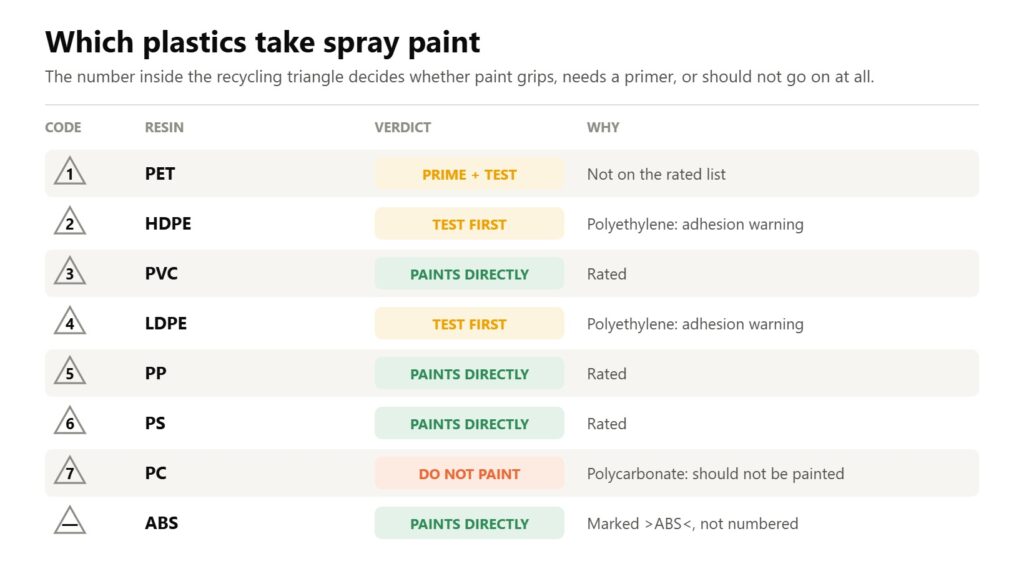
Find the resin code before you buy anything
Turn the item over. Most molded plastic carries a recycling triangle with a number from 1 to 7, and that number is the resin. It decides whether paint grips, whether a primer has to go down first, and in one case whether you should be painting the item at all.
| Code | Resin | Where you meet it | Verdict |
|---|---|---|---|
| 1 | PET | Drink bottles, clamshell packaging | Not on the rated list. Prime it and test a hidden patch. |
| 2 | HDPE | Milk jugs, detergent bottles, storage totes | Polyethylene. Adhesion may be compromised, so test first. |
| 3 | PVC | Pipe, exterior trim, some patio furniture | Rated. Takes plastic spray paint directly. |
| 4 | LDPE | Squeeze bottles, lids, flexible tubs | Polyethylene again, and the same warning applies. |
| 5 | PP | Chair shells, planters, tote lids, car trim | Rated. Takes plastic spray paint directly. |
| 6 | PS | Hobby kits, cabinet trim, disposables | Rated. Takes plastic spray paint directly. |
| 7 | Other, including polycarbonate | Clear panels, lenses, some bottles | Polycarbonate should not be painted. Check with the maker. |
ABS, which is what most electronics housings, toy bricks and interior car trim are made from, is usually stamped >ABS< rather than given a number, and it takes paint as readily as the rated resins do. An item with no marking at all is a candidate for the hidden-patch test rather than a guess.
The three cans worth owning
Three products cover every job the resin table allows, and they are separated by coverage and color range rather than by how well they stick.
Krylon Fusion All-In-One needs no primer and covers 25 square feet per 12-ounce can. Dry to the touch in 20 minutes, ready to handle in an hour, and happiest between 55 and 75°F with humidity under 60%. Its surface list is the generic one — metal, wood, plastic, laminate, masonry, glass — with no resin named, which is why the triangle check matters more with this can, not less.
Rust-Oleum Specialty Paint for Plastic also skips the primer, and it names the resins it is built for: polypropylene, polystyrene, resin, PVC, fiberglass and vinyl. The trade-off is reach. It covers 8 to 10 square feet per can, about a third of that, and comes in eleven colors rather than dozens.
The matching Plastic Primer is the route to any color the first two do not make, and the safer route on a doubtful resin. It takes an oil-based topcoat after one hour and a latex one after four. One instruction on it is easy to get wrong: a single thin coat, never a heavy one and never several.
| Fusion All-In-One | Paint for Plastic | Plastic Primer | |
|---|---|---|---|
| Primer needed | No | No | It is the primer |
| Coverage per 12 oz can | 25 sq ft | 8–10 sq ft | 8–10 sq ft |
| Resins named | None | PP, PS, resin, PVC, fiberglass, vinyl | PP, PS, resin, PVC, fiberglass, vinyl |
| Dry to touch | 20 min | 30 min | 30 min |
| Ready to handle | 1 hr | 1–2 hr | 1 hr |
| Recoat window | Within 6 hr, or after 24 | Before 1 hr, or after 48 | Topcoat after 1 hr oil, 4 hr latex |
| Working conditions | 55–75°F, under 60% RH | 50–90°F, under 65% RH | 50–90°F, under 85% RH |
| Colors | Dozens | 11 | White only |

The recoat window is where these jobs actually fail
Both cans open a window for the second coat, close it, then open it again, and the gap in between is where a second coat does damage. Paint for Plastic wants the next coat before one hour or after 48. Fusion All-In-One wants it within six hours or after 24. Spray at hour three on the first, or hour twelve on the second, and the solvent in the fresh coat softens a film that has skinned over but not cured. That is what wrinkling and lifting are.
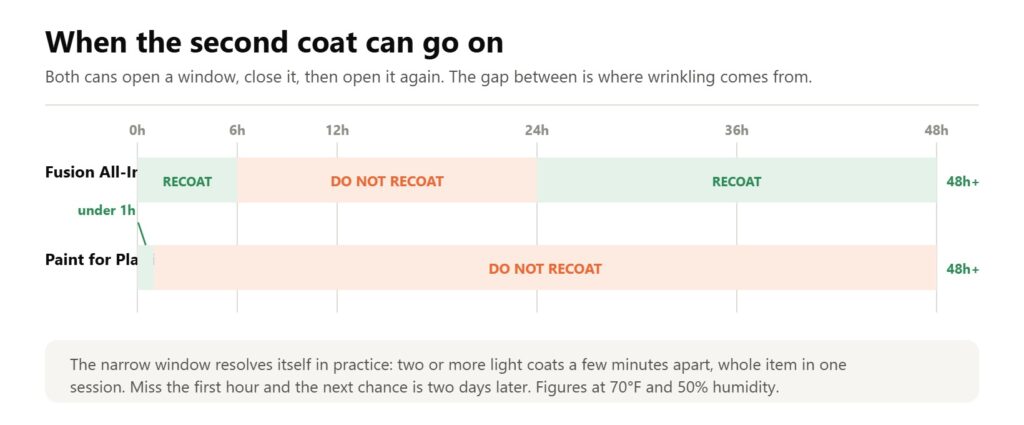
The narrower window resolves itself in practice: two or more light coats, a few minutes apart, doing the whole item in one session. Miss the hour and the next opportunity is two days later.
Every figure here assumes 70°F and 50% relative humidity, and cooler conditions stretch all of them, so a chilly garage changes the arithmetic.
What “5X stronger adhesion” actually claims
Read the asterisk and it means five times stronger than the same brand’s own general purpose paints. It is a comparison with the other cans on the same shelf, not with a rival, and it is not an adhesion figure for any particular resin.
Fusion All-In-One holds 3.9 out of 5 across 419 reviews, 74% of responding reviewers would recommend it, and 80 of those ratings are a single star. That is the profile of a product that works well on the resins it suits and disappoints about a fifth of buyers, which is roughly what the resin table predicts.
The prep step most guides skip
New plastic wants one thing before paint: a thorough wipe-down with paint thinner, not detergent. New molded plastic carries mold-release agent from the factory, and a solvent wipe is what takes it off.
Plastic that has been outdoors reverses the order. Wash it with a commercial detergent, rinse with fresh water, dry with a clean cloth, and treat mildew with a bleach solution first. Lightly sand anything glossy. Weathered plastic also goes chalky, and that powder has to come off or the paint bonds to the powder instead of the item.
Conditions matter as much as technique. Fusion All-In-One wants 55 to 75°F and humidity under 60%; Paint for Plastic allows 50 to 90°F and under 65%; the primer tolerates up to 85%. Then hold the can 10 to 16 inches out, keep it moving, overlap each pass, and build it in light coats.
It is dry in a day and adhered in a week
Maximum adhesion comes at five to seven days. Fully dry in 24 hours is a different measurement, and it is the one people act on.
That week is what decides whether the job holds. Do not stack painted chairs, do not bolt trim back on under tension, and keep planters out of the rain until it is up. If paint has come off things you painted before, the reasons spray paint rubs off usually sit in this window rather than in the can.
Nothing here belongs on a surface that will exceed 200°F, which rules out engine bays, lamp housings and heater vents. And no aerosol in this category is made for leather or faux leather, despite leather and vinyl dyes turning up regularly in plastic spray paint roundups — including an earlier version of this one.
If you need paint off rather than on, that is a different process: see how to remove paint from plastic. For drying times across paint types, how long spray paint takes to dry covers the general case, and whether you can skip primer goes further on the surfaces where you cannot.
Frequently asked questions
Does spray paint for plastic really work?
On the resins in the table above, yes, and with no primer needed. The failures cluster in three places: polyethylene, where adhesion may be compromised whatever the can promises; the recoat dead zone in the middle of the window; and the five to seven days before maximum adhesion, when the item looks finished and is not.
What paint permanently stays on plastic?
No aerosol coating is permanent, and the honest version of the answer is a bonded film that outlasts the item’s useful life. You get that from a paint rated for your resin, applied in light coats inside the recoat window, over a surface wiped with paint thinner if it is new or washed and lightly sanded if it is not, then left alone for a week. A no-peel guarantee with a refund against the product number is as close as either brand comes to a written durability commitment.
Will any spray paint stick to plastic?
No, and the resin is the reason. Polyethylene totes and milk jugs carry an explicit adhesion warning, and polycarbonate should not be painted at all. A general-purpose can on a #5 chair shell will often hold; the same can on a #2 storage tote frequently will not.
Is Krylon or Rustoleum better for plastic?
Neither wins outright, and the comparison table above holds the figures. The decision rule is simpler than the brand argument: if you can read a resin code, Rust-Oleum states in writing whether it is rated for that resin and sells a dedicated primer for the ones it is not. If the item carries no marking, or the area is large, Fusion All-In-One goes further per can and comes in far more colors — test a hidden patch first. The 3.9-out-of-5 rating across 419 reviews suggests the complaints track resin mismatch rather than brand quality.
