Last Updated on October 6, 2026
Spray paint is touch dry in 20 minutes to 4 hours, ready to handle in 1 to 9 hours, and fully dry in 24 hours. The spread is that wide because it depends on the paint’s chemistry, not the surface. Full cure, where the film reaches its real hardness, takes several days longer.
Search this question and you will get a different answer from every result. Ten minutes. Thirty minutes. Two hours. Twenty-four hours. Google’s own AI summary currently says spray paint is touch dry in 10 to 30 minutes, while citing a source that says 24 to 36 hours and another that says 1 to 2 hours.
They are not all wrong. They are answering different questions without saying so, and the biggest variable is not the surface you are painting. It is what is in the can.
The short answer, by stage
“Dry” is four different things. Most arguments about drying time are really people talking about different stages. Those stages are formally defined, and wall paint runs through the same seven of them on a far longer clock.
| Stage | Typical timing | What it means |
|---|---|---|
| Surface dry | 5 to 20 minutes | The solvent has flashed off the top. Dust will not stick. Everything underneath is still wet. |
| Touch dry | 20 minutes to 4 hours | A light touch leaves no paint on your finger. Pressure still marks it. |
| Ready to handle | 1 to 9 hours | You can pick the item up and turn it over without leaving fingerprints. |
| Fully dry | 24 hours | The film is dry through. It is not yet at full hardness. |
| Fully cured | 2 to 7 days, longer on plastic | The chemical reaction has finished. Now it resists scratching, solvents and cleaning. |
If someone tells you spray paint dries in 20 minutes, they mean touch dry. If someone tells you it takes a week, they mean cured. Both are right.
Why every source gives you a different number
Because the chemistry in the can changes the answer by a factor of ten, and almost nobody says which paint they are talking about.
Here are two aerosols from the same manufacturer, sold on the same shelf, with their stated figures side by side (the Stops Rust Enamel sheet is here):
| Stops Rust Enamel | Painter’s Touch 2X | |
|---|---|---|
| Resin | Oil-modified alkyd | Acrylic-modified alkyd |
| Touch dry | 2 to 4 hours | 20 minutes |
| Ready to handle | 5 to 9 hours | 1 hour |
| Fully dry | 24 hours | 24 hours |
| Recoat | Within 1 hour or after 48 hours | Within 1 hour or after 48 hours |
Same brand. Same size can. Six to twelve times the difference in touch-dry time. The rust-preventive enamel is an oil-modified alkyd, which hardens by reacting with oxygen in the air, and that reaction is slow. The general-purpose paint is acrylic-modified, and a large part of its drying is solvent simply evaporating, which is fast. If you are not sure which you have, our guide to whether Rust-Oleum spray paint is oil based explains how to tell from the label.

Krylon sits close to the fast one: most of their spray paints are dry to the touch in 20 to 25 minutes and ready to handle in an hour.
So the widely repeated “10 to 30 minutes” is a real number from real products. It is just badly wrong if the can in your hand is a rust-preventive enamel, which is the one most people reach for when painting metal.
The practical rule: read the back of your own can before you plan the job around a number you found online. If it says oil-based or rust-preventive, assume hours. If it says acrylic, fast-dry, or paint-and-primer, assume minutes.
How long does each type of spray paint take to dry?
Lacquer is touch dry in 20 minutes and fully dry in 30. Acrylic is touch dry in about 20 minutes but needs 24 hours to be fully dry. Enamel takes 2 to 4 hours just to reach touch dry. Three chemistries, three completely different clocks, and the front of the can rarely tells you which one you are holding.
| Type | Touch dry | Recoat | Fully dry |
|---|---|---|---|
| Lacquer | 20 minutes | Anytime | 30 minutes |
| Acrylic, acrylic-modified | 20 minutes | Within 1 hour, or after 48 hours | 24 hours |
| Enamel, oil-modified alkyd | 2 to 4 hours | Within 1 hour, or after 48 hours | 24 hours |
The row that gives the game away is lacquer’s recoat time. Rust-Oleum’s lacquer line gives anytime — no window, no waiting period — because lacquer solvent softens the coat underneath and the two layers merge into one. Acrylic and enamel do the opposite. Their second coat lands on a film that is already skinning over, which is why both sheets give you an hour and then tell you to wait two days.
So the question has no single answer even before you pick a surface. A lacquer can is finished before an enamel can is safe to touch. If the label says lacquer, halve every figure you have read elsewhere; if it says enamel, rust-preventative or oil-based, double them. One caveat on that lacquer row: there is no separate cure time stated at all, so for anything that will be handled hard, use the cure guidance further down rather than the 30-minute figure.
Every published dry time assumes lab conditions
The figures on the can are measured at about 21°C and 50% relative humidity. Rust-Oleum attaches a one-line warning that most people never see: allow more time at cooler temperatures.
That single sentence explains most “why is my paint still tacky” problems. A garage in November is not 21°C, and a damp British fall is not 50% humidity. The number on the can is not a promise about your conditions. It is a measurement taken in someone else’s.
The manufacturers also disagree about what conditions are acceptable at all:
- Rust-Oleum Stops Rust: use between 10 and 32°C, humidity below 70%
- Rust-Oleum Painter’s Touch 2X: use between 10 and 32°C, humidity below 65%
- Krylon: use between 13 and 24°C, humidity below 60%

Krylon’s window is noticeably tighter at the top end. If you are spraying on a hot day with a Krylon can, you are already outside what the manufacturer recommends at 25°C.
As a rough working guide, every 10°C below the mid-twenties roughly doubles the time you should allow. Below about 10°C, many aerosols will not form a proper film at all, and the result stays soft for days rather than simply drying slowly. Our guide to how to spray paint covers the full temperature and humidity range and what goes wrong outside it.
How long does spray paint take to dry on each surface?
Less than you would think, with one real exception. The paint film dries at the rate its chemistry dictates. What the surface changes is how much paint sits on top of it, how much heat it holds, and how long the finish takes to become genuinely tough.
| Surface | Touch dry | Safe to handle | Why it differs |
|---|---|---|---|
| Metal | 20 min to 4 hrs | 1 to 9 hrs | Non-porous and conducts heat, so nothing soaks in. Usually the fastest surface. Rust-preventive enamels are the slow exception. |
| Plastic | 20 to 60 min | 1 to 4 hrs | Dries fast but bonds slowly. See the warning below. |
| Wood | 1 to 2 hrs | 2 to 6 hrs | Porous. The first coat sinks in, so it needs more paint and more time. |
| Glass | 30 min to 2 hrs | 2 to 8 hrs | Zero absorbency, but adhesion is poor, so the film stays fragile longer than it feels. |
| Rubber | 1 to 2 hrs | 4 to 24 hrs | Flexes, so the film needs to be fully cured before the item is bent or stretched. |
| Cardboard and paper | 10 to 30 min | 30 to 60 min | Very absorbent, so it feels dry quickly. Warping from the solvent is the real risk. |
| Concrete | 30 min to 2 hrs | 2 to 4 hrs | Porous and cold. Holds moisture, which slows everything down. |
| Fabric | 30 min to 1 hr | 4 to 24 hrs | Feels dry fast, but wait a full day before it is handled or worn. |
| Wheels and rims | 20 min to 4 hrs | 24 hrs minimum | Heat and brake dust. Give it the full cure before driving. |
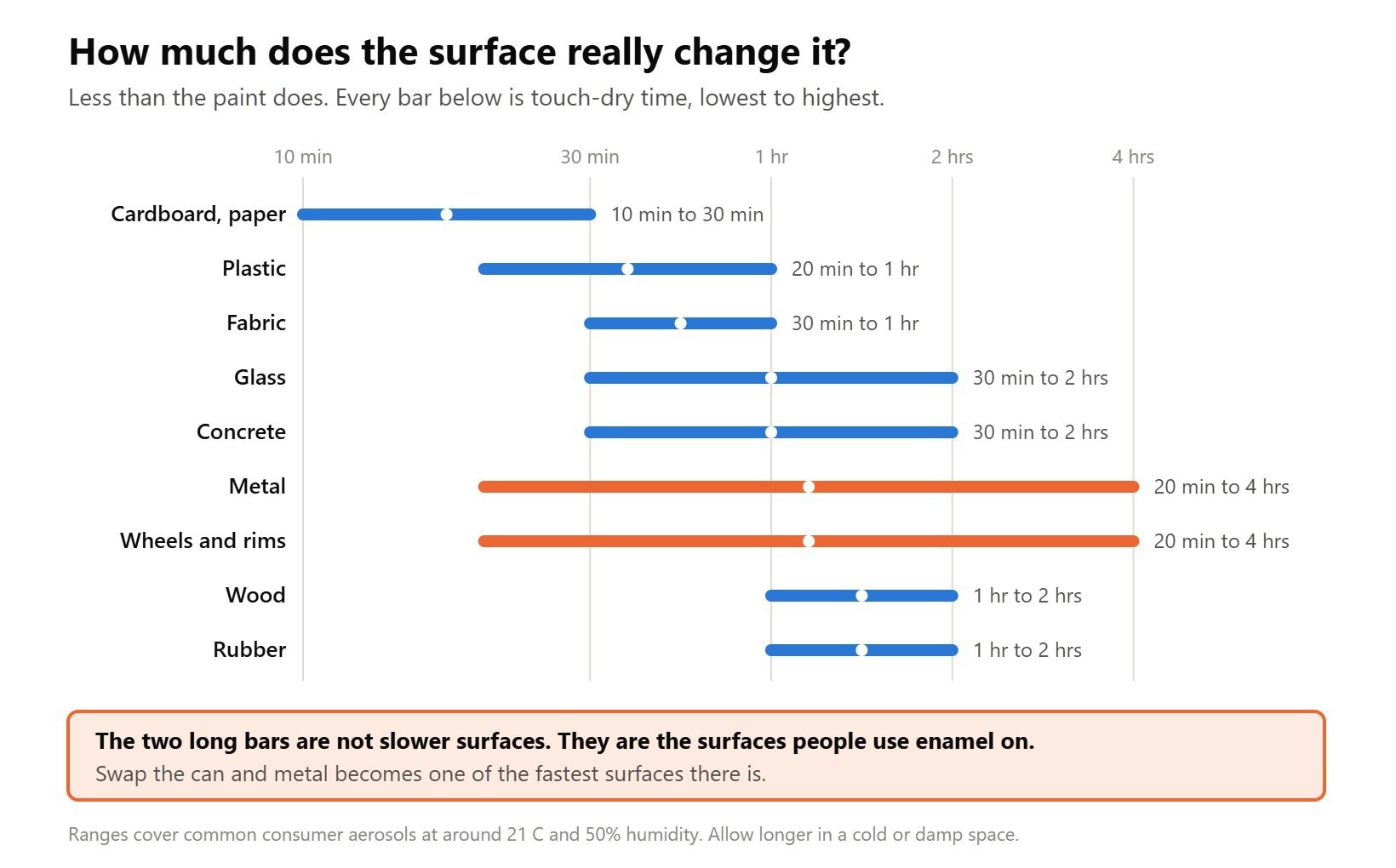
Ranges are wide because the paint matters more than the surface. Use the lower end for acrylic and fast-dry cans, the upper end for oil-based and rust-preventive enamels.
Plastic is the one that catches people out
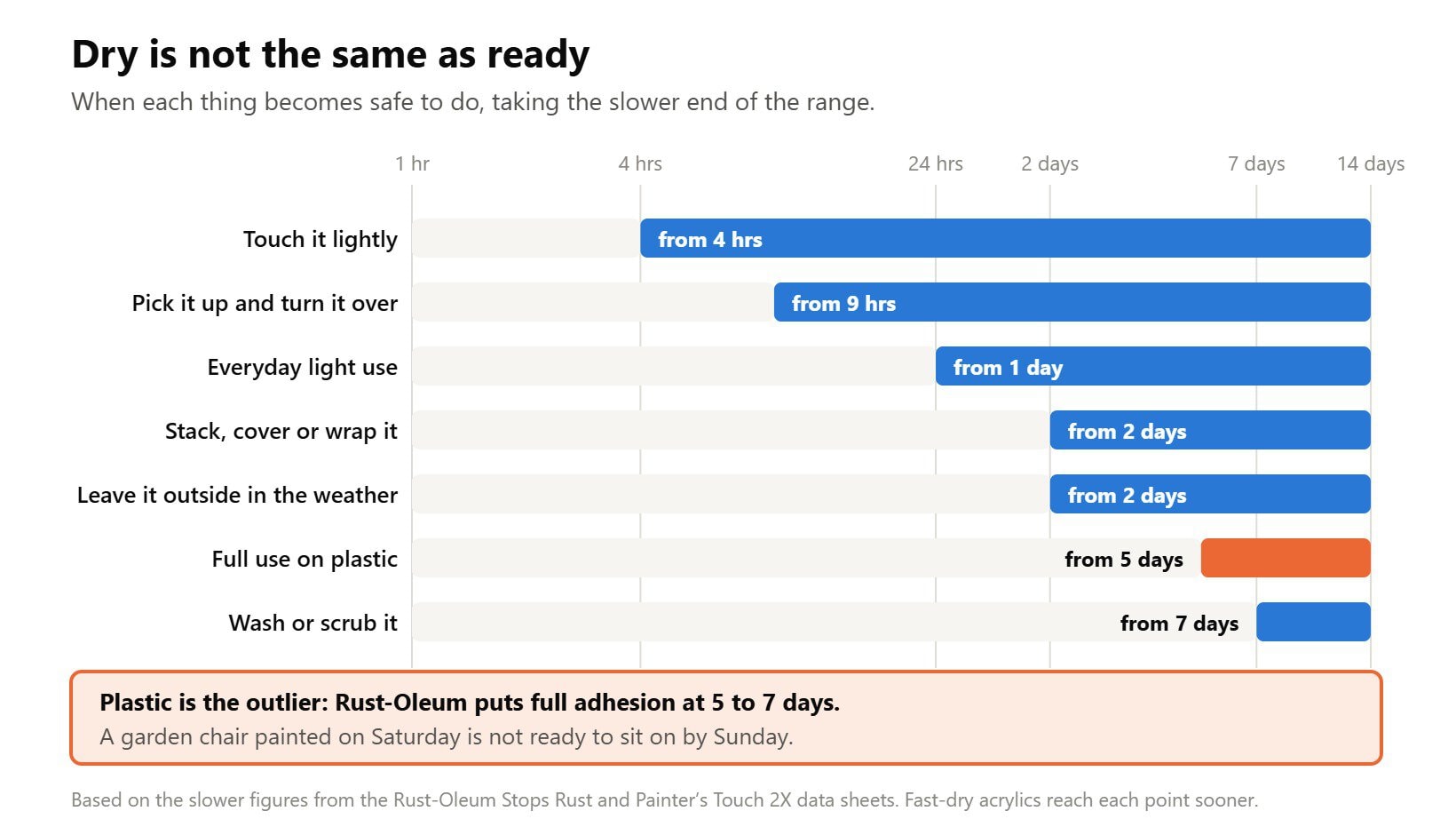
Plastic feels dry quickly and stays weak for a week. Rust-Oleum carries a note on Painter’s Touch that appears almost nowhere else: on plastic maximum paint adhesion and durability is achieved in 5-7 days.
Getting it back off is a different problem again, and a harsher one: most paint removers attack plastic itself. We cover which solvents are safe on which plastic in removing paint from plastic.
So the honest answer for plastic is two answers. Touch dry in under an hour. Properly tough in five to seven days. If you paint a plastic garden chair on Saturday and sit on it on Sunday, the finish has not failed because the paint was bad. It failed because it was four days early.
This is also why plastic needs the right product in the first place, which we cover in our guide to spray paints for plastic.
What is the difference between dry time and cure time?
Dry means the solvent has left. Cure means the chemical reaction that hardens the film has finished. Dry takes hours. Cure takes days, and on plastic up to a week.
A dry finish will take a fingerprint, mark under a fingernail, and soften if you clean it. A cured finish resists all three. Everything that goes wrong days after a job looked finished, such as marks appearing under objects placed on it, or the paint lifting when it gets wet, is a curing problem rather than a drying one.
Practical consequences worth planning around:
- Do not stack, wrap or cover a painted item until it has cured, even if it feels dry. Anything resting on it will leave a permanent print.
- Do not wash or wipe a painted surface for at least a week. If it is already rubbing off on your hands, that is an uncured film rather than a bad one.
- Do not put a painted item outside in rain during the first day or two, however dry it feels. Our guide on whether spray paint is waterproof covers what happens when it gets wet too soon.
- Do not refit hardware, hinges or screws through a fresh finish before it has hardened.
When can you apply the second coat?
Within the hour, or after 48 hours. Not in between. This is the single most useful timing rule on this page, and it is not the same thing as the dry time.
Both products carry the same instruction: apply a second coat or clear coat within 1 hour or after 48 hours. Inside the first hour the coats melt into a single film. After 48 hours the first coat has hardened enough to take another cleanly. In between, the surface has skinned over while the paint underneath is still soft, and the solvent in the new coat dissolves that half-set film from above. That is what wrinkling is.
Note that “fully dry in 24 hours” sits right in the middle of the forbidden window. Waiting until the paint is dry before recoating is exactly the wrong move. Our full spray painting guide goes through the recoat window in detail, and spraying over existing spray paint covers the case where the old coat is already hard.
Fast-dry ranges differ here. Krylon’s Fusion and COLORmaxx lines are designed to be recoated after about a minute. Check the can rather than assuming the Rust-Oleum rule applies to everything.
Will spray paint dry faster in the sun?
It will feel dry faster and cure worse. Direct sun heats the surface of the film so the top skins over before the solvent underneath has escaped, which traps it. You get a finish that is hard on top, soft below, and prone to blistering and orange peel.
Warmth helps. Direct sunlight on the workpiece does not. The distinction matters: a sheltered spot at 22°C will dry better than full sun at 30°C, even though the sunny spot feels quicker.
The same logic rules out a heat gun or a hairdryer held close. Gentle warm air moving through the room is useful. Concentrated heat on wet paint skins it.
What actually makes spray paint dry faster
Thin coats and moving air, in that order. Nothing else makes much difference, and several popular tricks make things worse.
- Spray thinner coats. Drying time rises sharply with film thickness, because the solvent at the bottom has further to travel. Two light coats dry faster than one heavy one, and the finish is better.
- Move the air, gently. A fan across the room, not pointed at the item, carries solvent vapor away and speeds evaporation. Aimed at wet paint it just deposits dust in the finish.
- Raise the room temperature. Warm the space and the object before you start, and keep it warm while it dries. Bringing a cold item into a warm room and spraying immediately causes condensation under the paint.
- Drop the humidity. A dehumidifier in a garage genuinely helps in damp weather.
- Choose a faster paint. If speed is the priority, an acrylic or fast-dry can will beat a rust-preventive enamel by hours. Skipping primer does not speed things up either, as our guide on spray painting without primer explains.
What does not work: direct sun, hairdryers held close, heat guns, and putting the item in an oven or linen closet. All of them skin the surface and trap solvent.
Is it safe to be in the room while it dries?
Not while it is wet, and not for several hours afterwards. Aerosol paint releases solvent vapor as it dries, which is what you can smell, and the smell is the warning rather than the harm passing.
Spray outdoors or in an open garage. Keep windows open and air moving while the item dries, not just while you spray. Do not sleep in a room where solvent-based paint is drying, and keep children and pets out until the smell has gone completely. If the item is small enough to move, put it somewhere ventilated and unoccupied to dry rather than leaving it in a living space.
A lingering solvent smell days later means the paint has not finished curing, usually because it went on too thick or the room is too cold or damp. Our guide to removing spray paint smell from wood covers what to do when a painted item has to come back indoors.
Frequently asked questions
How long should I let spray paint dry before touching it?
Twenty minutes for a fast-dry acrylic, up to four hours for a rust-preventive enamel. Check the can rather than the clock. Even once it is touch dry, pressure will still mark it, so leave it another few hours before you pick the item up and turn it over.
How long does Rust-Oleum spray paint take to dry?
It depends which Rust-Oleum. Painter’s Touch 2X is touch dry in 20 minutes and handleable in 1 hour. Stops Rust Enamel takes 2 to 4 hours to touch dry and 5 to 9 hours to handle. Both are fully dry in 24 hours and both recoat within 1 hour or after 48 hours.
Can spray paint dry in 20 minutes?
Yes, if it is an acrylic or fast-dry formula sprayed in thin coats at room temperature. That 20 minutes is touch dry only. The paint is still soft underneath, will mark under pressure, and is days away from being properly cured.
Why is my spray paint still tacky after 24 hours?
Almost always one of three things: the coat went on too thick, the temperature is below about 15°C, or the humidity is high. An oil-based enamel in a cold garage can stay tacky for several days. Warm the space and move the air. If it is still soft after a week, it was applied too heavily and needs sanding back.
How long does spray paint take to dry on plastic?
Touch dry in 20 to 60 minutes, but full adhesion on plastic takes 5 to 7 days. Plastic is the surface where dry and cured are furthest apart, so anything that will be handled, sat on or stacked needs the full week.
How long does spray paint take to dry on metal?
Twenty minutes to 4 hours to touch dry, depending entirely on the paint. Metal itself is the easiest surface, being non-porous, but rust-preventive enamels are the slowest-drying aerosols you can buy, and they are exactly what most people use on metal.
Does spray paint dry faster in the cold?
No, considerably slower. Manufacturers specify a minimum of about 10°C, and Krylon recommends nothing below 13°C. Below that, the film may never harden properly no matter how long you leave it, which is different from simply taking longer.
How long before I can put a second coat on?
Within an hour, or after 48 hours. The hours in between are the ones that cause wrinkling, because the surface has skinned over while the paint underneath is still soft. Fast-dry ranges such as Krylon Fusion are designed to be recoated within about a minute, so check your own can.
How long until I can use the item?
Twenty-four hours for light use, a week before anything gets scrubbed, stacked, sat on or left out in the weather. On plastic, wait the full 5 to 7 days. Rushing this stage is the commonest reason a finish that looked perfect gets marked in its first week.
Can I speed it up with a hairdryer?
Not held close. Concentrated heat skins the surface and traps solvent underneath, giving you blistering and a finish that stays soft. Warm air moving through the room is fine and genuinely helps. Heat aimed at wet paint does not.
Is it safe to sleep in a room that has been spray painted?
Not the same night. The EPA’s painting guidance for residents is to keep windows wide open for two to three days afterwards and to avoid freshly painted rooms over that period, keeping young children and anyone with breathing problems out of them. Aerosol paint carries more solvent per square foot than wall paint, so treat two to three days as the floor rather than the ceiling. Better still, spray outdoors or in an open garage, let the item dry there, and only bring it inside once the smell has gone.
What to remember
There is no single drying time, and anyone who gives you one without asking what is in your can is guessing. Two aerosols from the same manufacturer differ by a factor of six.
Three things to hold on to. Read your own can, because the chemistry decides. Treat the printed figure as a best case measured at 21°C and 50% humidity. And remember that dry is not cured: touch dry in an hour, usable in a day, properly tough in a week, and on plastic a week is the minimum.
