Last Updated on October 6, 2026
The best spray paint for metal depends on one thing almost nobody checks first: whether the metal is galvanized. Get that wrong and the paint peels within a year whichever can you bought.
Spray enamel does protect metal from rust and corrosion, and it does dry faster and lay flatter than brushing — the reasons it is the usual choice for a metal paint project. What it will not do is stick to every metal, and the exception is the one most people meet outdoors. That is where this guide starts.
Check one thing before you buy: is the metal galvanized?
Galvanized steel is zinc-coated, and zinc is what most metal enamel will not stick to. It is also what a great deal of outdoor metal is made of — gutters, chain-link, fence posts, ductwork, trash cans, shed panels, and the frames under a lot of patio furniture. The test is visual: galvanizing leaves a dull gray surface, often with a crystalline spangle pattern like frost on a window.
This matters because the two products most often named as the best spray paint for metal both carry the same line in their own instructions: not for use on galvanized metal. That applies to Stops Rust Custom Spray 5-in-1 and to Professional High Performance Enamel. Neither is a bad product. They are simply not rated for the surface a lot of people are about to spray.
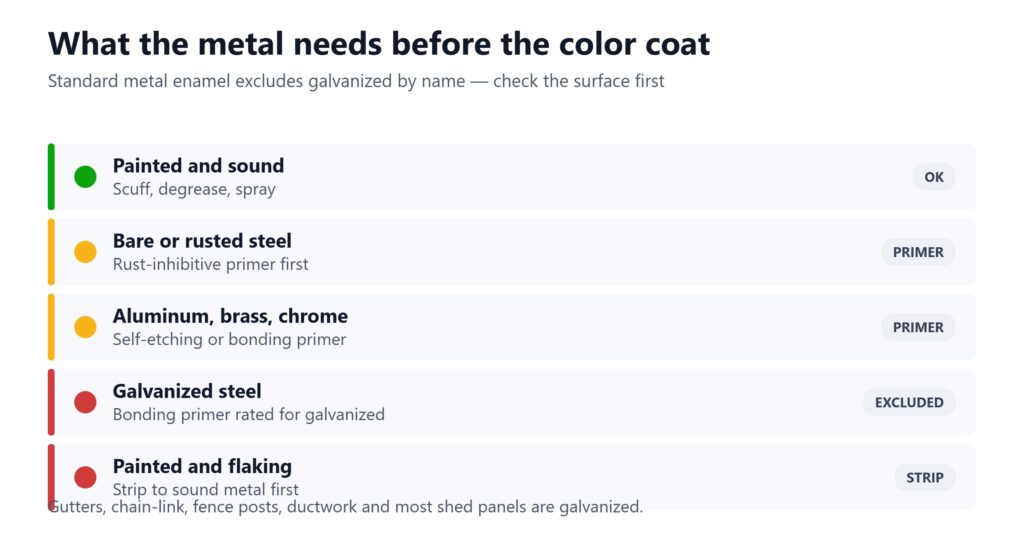
| If the metal is | What it needs | Why |
|---|---|---|
| Bare or rusted steel, iron | Rust-inhibitive primer, then enamel | Primer is specified for bare metal, not optional |
| Galvanized steel | A bonding primer rated for galvanized, then enamel | The enamels exclude it by name |
| Aluminum, brass, chrome | Self-etching or bonding primer, then enamel | Non-ferrous; nothing to rust, everything to peel off |
| Already painted and sound | Scuff, degrease, enamel direct | The existing film is the substrate |
| Already painted and flaking | Strip back to sound metal first | New paint bonds to the old film, not the metal |
For the galvanized case the fix is a bonding primer that names galvanized steel on the can — a bonding primer that lists galvanized steel and two-part epoxies among the surfaces it grips. It is a two-can job rather than a one-can job, and that is the whole of the difference between a finish that lasts and one that sheets off in a year.
Top 5 Metal Spray Paint Comparison Table
| IMAGE | PRODUCT | DETAILS | ||
|---|---|---|---|---|
|
Best Overall
 |
Best Overall
|
Krylon Color Master |
|
Check Price |
|
Best by Usages
 |
Best by Usages
|
Rust oleum Universal Metallic |
|
Check Price |
 |
|
Krylon Diversified Brands K08970000 |
|
Check Price |
 |
|
Rust-Oleum Stops Rust Metallic |
|
Check Price |
 |
|
Rust-Oleum 7251830 Stops Rust Metallic |
|
Check Price |
Top 7 Best Spray Paints for Metal Reviews, Stainless Steel
1. Krylon Color Master Paint Spray Reviews

This metal comes in several finishes, including Gloss, Stain, Metallic, Matte, Flat, Semi-Flat, Semi-Gloss and Primer.
Rated for interior and exterior use, touch dry in 10 minutes, and it seals against sun, wind, rain and humidity.
2. Rust oleum Universal Metallic Spray Paint Reviews
This Rust-Oleum product has a unique spray system that allows you to position the can upside down, on its side, or in any position without interfering with the dispensing of the paint. This allows you to easily reach all of the intricate designs of your metal pieces.
The spray tip needs two fingers rather than one, which is slower to start but far easier on the hand over a full can.
It can be used on a wide variety of surfaces, including metal. Wicker, and plastic.
3. Krylon Diversified Brands K08970000 Spray Paint Reviews

It needs no sanding or priming before it goes on, which is the practical reason to reach for it over a primer-and-enamel pair.
A push-button tip instead of a trigger, which cuts finger fatigue on anything bigger than a single chair frame.
You can choose from finishes as flat, satin, hammered, gloss, and metallic.
4. Rust-Oleum Stops Rust Metallic Spray Paint Reviews
It is an oil based formula so it can provide a greater amount of rust prevention and protection. It sticks to the metal easily and is resistant to fading, abrasion, and chipping.
Touch dry in 20 minutes or less, and one can covers 15 square feet.
5. Rust-Oleum 7251830 Stops Rust Metallic Spray Paint Reviews
It has an oil base so it covers the metal in a thicker coating. One can cover 15 square feet with a durable protective seal.
Real metal flake in the paint, which is what gives the finish its glitter rather than a flat metallic tint, and it is touch dry in minutes.
6. Krylon K08800007 ‘Dual’ Superbond Spray Paint

This Krylon paint eliminates the need for you to use a primer on the metal before you apply your top coat. The primer that creates the protective seal and makes the topcoat look smoother is already combined in the paint so you get both effects out of one product.
You can choose a gloss, satin, or flat finish in a variety of popular colors.
It is excellent for use on metal yard décor, tables, house trim, aluminum, concrete, plaster, wicker, glass and more.
7. Krylon K09196000 Spray Paint Reviews

A paint and primer in one, so the primer coat and the color coat go on from the same can — fewer passes, and no waiting on a primer to cure between them.
It is sold in gloss, metallic, satin, matte, semi-gloss and semi-flat, plus a matching primer.
The recoat window is the one number that ruins the job
Both enamel lines print the same instruction: apply a second coat within 1 hour or after 48 hours. The hours in between are the failure zone. An alkyd film skins over while the solvent underneath is still leaving, and a second coat laid into that half-set skin softens it and lifts it. The result is the wrinkled, alligatored surface people blame on cheap paint.
Almost nobody waits 48 hours, and almost everybody comes back at three or four hours because the first coat feels dry. It feels dry because the surface is dry. The film is not.
| Product | Dry to touch | Dry to handle | Recoat window |
|---|---|---|---|
| Stops Rust Custom Spray 5-in-1 | 2 to 4 hours | 5 to 9 hours | Before 1 hour or after 48 |
| Professional High Performance Enamel | 15 minutes | 1 to 2 hours | Within 1 hour or after 48 |
| Krylon Fusion All-In-One | 20 minutes | 1 hour | Not stated as a window |
Read the first two rows again. They are the same manufacturer and the touch-dry figures are 15 minutes against 2 to 4 hours — a difference of eight to sixteen times. Ranking by brand name tells you nothing useful here. The dry times in that table assume 70 to 80 degrees Fahrenheit at 50 percent humidity, and both enamels want air and surface between 50 and 90 degrees with humidity under 85 percent.
Why the coverage figures do not compare
Every roundup on this subject puts coverage in a single column, and the numbers are not measured the same way.
| Product | Stated coverage | What the figure assumes |
|---|---|---|
| Stops Rust Custom Spray 5-in-1 | 6 to 10 sq ft per can | 15% material loss, 1.0 to 2.0 mils dry film |
| Krylon Fusion All-In-One | 25 sq ft per can | No loss figure, no film thickness stated |
One is a practical figure with overspray already deducted and a film thickness attached. The other is a headline number with neither. The apparent gap of two and a half to four times is partly real and partly an artifact of how each brand chose to measure, and there is no way to resolve it from the outside. The useful habit is to buy on the lower number and keep a second can.
How to spray metal so it lasts

- Degrease before you sand, not after. Sanding a greasy surface drives the contamination into the scratches you just made. Wipe with a solvent first, then abrade, then wipe again.
- Take rust back to sound metal. Primer that claims to work over rust means tight surface rust, not scale you can flake off with a thumbnail. Anything that lifts, comes off.
- Prime if the metal is bare. A primer is specified for bare metal rather than offered as an upgrade — a red one for sound rusted or clean steel, a gray one for clean steel.
- Work between 50 and 90 degrees Fahrenheit, under 85 percent humidity. Those are the stated limits for both enamel lines. A cold garage door in November is outside them.
- Hold the can 10 to 12 inches out and keep it moving. A can held still builds the heavy wet film that runs; the fix for thin coverage is another pass, not a slower one.
- Then obey the recoat window. Second coat inside the hour, or leave it two full days. This is the step that decides whether the finish survives.
- Let it harden before it goes back into service. Fully dry is 24 hours on the professional enamel. Handling at five hours is what puts fingerprints into a finish that otherwise went on perfectly.
The one thing that cannot be fixed afterwards is a surface the paint was never rated for. Everything else on that list is recoverable; spraying enamel straight onto galvanized is not. Our guide to the right paint project preparation covers the general case.
Frequently asked questions
Is Rust-Oleum or Krylon better for metal?
Wrong question, and the dry-time table above shows why: the spread inside one of those ranges is wider than the gap between the two names — 15 minutes to touch dry against 2 to 4 hours, from the same manufacturer. The distinction that decides it is priming. Krylon Fusion is sold as needing no sanding or priming and is built to bond on its own; the Rust-Oleum enamels specify a primer on bare metal and reward you with better corrosion protection for the extra step. Pick on surface and prep, not on the badge.
Can I just spray paint over metal?
Over sound existing paint, yes — scuff it, degrease it and spray. Over bare steel, no, not if you want it to last: a rust-inhibitive primer is specified rather than suggested, and the enamel wants 50 to 90 degrees Fahrenheit and humidity under 85 percent to cure properly over it. Over galvanized, no, not with a standard metal enamel, because both main enamel lines exclude galvanized by name and need a bonding primer underneath instead.
What is the best permanent spray paint for metal?
Nothing sprayed from a can is permanent, and the useful question is what fails first. On ferrous metal it is corrosion creeping under the film, which is what a rust-inhibitive primer delays. On aluminum, brass and galvanized it is adhesion, which is what a bonding or self-etching primer delays. The finish coat is the part everyone chooses and the least important of the three. Expect 24 hours before the film is fully dry and a two weeks before it has any real hardness.
Can I spray paint metal without primer?
On already-painted metal in sound condition, yes. On bare metal, the instructions are explicit that a primer is recommended for bare wood and metal and adds corrosion protection and adhesion. The exception is a self-priming product such as Krylon Fusion All-In-One, which is sold on the basis that no sanding or priming is needed and is touch dry in 20 minutes against 2 to 4 hours for the oil-based enamels — that claim is the product’s whole purpose, and it is why the two are not interchangeable.
What kind of spray paint will stick to metal?
An oil-modified alkyd enamel sticks to clean ferrous metal, and the common metal enamels are all modified alkyds. What changes the answer is the surface underneath: on zinc, aluminum or chrome the enamel needs a bonding or etching primer to hold on, and on a greasy or flaking surface nothing holds at all, whatever the 5X adhesion claim on the can says. The paint is rarely the variable.
Can I just paint over old paint on metal?
If the old film is sound, yes — degrease, scuff to a dull finish and spray, treating the old paint as the substrate. If it is flaking, blistering or lifting at the edges, no: the new coat bonds to the old film rather than the metal, so it fails exactly where the old one was already failing. Strip back to sound material first, which is a different job with its own tools. The giveaway is the edge: if you can lift a flake with a thumbnail, the whole coat is going to come off eventually.
Final Word
The can matters less than the three decisions made before it: whether the surface is galvanized, whether bare metal gets a primer, and whether the second coat lands inside the hour or after 48. Get those right and almost any metal enamel holds. Get the first one wrong and none of them will.
Spray paints are easier to use because they come in a can that is their container and their dispenser. You do not have to buy brushes and rollers to apply these products. You might have to buy sandpaper and a wire brush to remove old paint, rust deposits, or dirt and grime from the object.
Always use spray paint in a well-ventilated area, and for your own safety, you should wear a respirator mask, and protective eyewear while painting.
Metal is also where recoat timing bites hardest, because enamel on bare steel needs a full cure before it is handled. Our guide to how to spray paint covers the one-hour and 48-hour recoat windows, and the temperature range these paints need to form a proper film.
Metal is the fastest surface to paint but rust-preventive enamels are the slowest-drying aerosols you can buy, which catches people out. Our guide to spray paint drying times has the figures for each type.

It is very useful! Thanks! I have a few things in my house that I could renovate this way.