Anti-climb paint is a petroleum-jelly-based coating that never dries. It is brushed in a 0.5 mm band along the top of a wall, fence, drainpipe or parapet, above 5 ft 11 in, and it stays greasy for about 3 years. Anyone who grabs it loses their grip and walks away marked with a stain that is difficult to wash out.
Developed by Camrex Paints in the early 1960s, it is a British product sold almost entirely by British suppliers, and most of the advice you will find quotes British rules. Two figures in that advice are wrong by a factor of 4 and a factor of 5, and a third detail — an 86°F ceiling — rules the product out across much of the United States.
Anti-climb paint at a glance
| Property | Figure |
|---|---|
| Base | Petroleum jelly, 60–100% |
| Solvent | Hydrocarbons C9–C11, 5–10% |
| Dry time | None. No touch-dry, hard-dry or full-hardness figure exists |
| Film thickness | 0.5 mm wet, 0.5 mm dry (0.02 in) |
| Coverage | 1–2 m² per kg, or roughly 5–10 sq ft per pound |
| Minimum height | Above 5 ft 11 in (1.8 m), away from daily legitimate use |
| Temperature ceiling | Areas not normally above 86°F (30°C) |
| Colors | Black, red, gray, green |
| Pack sizes | 1.8 lb, 4.4 lb, 8.8 lb (0.8 kg, 2 kg, 4 kg) |
| VOC | 112 g/l |
| Hazard classification | Flammable liquid, category 3. Health and environmental hazards: not classified |
| Service life | About 3 years before recoating |
Does anti-climb paint ever dry?
No, and that is not a quirk — it is the entire mechanism. There is no touch-dry figure, no hard-dry figure and no full-hardness figure, because none exists. No cure, no recoat interval, no overcoating time: nothing is happening chemically after it goes on. Three years later it is still wet.
Ordinary paint dries because the binder oxidizes or the water flashes off and the film knits together. This product is 60 to 100% petroleum jelly on a non-drying oil base, so the film never forms. At 3 years it is the same grease it was on day one, just thinner where rain and dust have worked on it.
The surface can fool you. A skin forms on top and the 0.5 mm band reads as semi-matt gloss from 6 ft away. Press it and your thumb goes straight through into the soft layer underneath. That gap between how it looks and how it behaves is doing most of the work — a climber commits their weight before they discover anything is wrong.
Each batch also carries a hidden identifier, so a smear recovered from clothing can be matched back to the surface it came from.
What is actually in it
Sixty to one hundred percent petroleum jelly, thinned with five to ten percent light hydrocarbon solvent and pigmented black, red, gray or green. That is the whole formula.
Knowing that answers several questions at once. It explains why white spirit takes it off and water does not — it is insoluble in water. It explains the flammability: the solvent gives it a flash point around 117°F (47°C), which is why it ships as a Class 3 flammable liquid under UN 1263 and should not be stored next to anything hot.
It also explains the one genuine skin effect. The solvent is a degreaser, so repeated contact dries skin out and can crack it. Beyond that it carries no health hazard classification and no environmental hazard classification at all, and the solvent is readily biodegradable — 80% in 28 days.
Three things the usual advice gets wrong
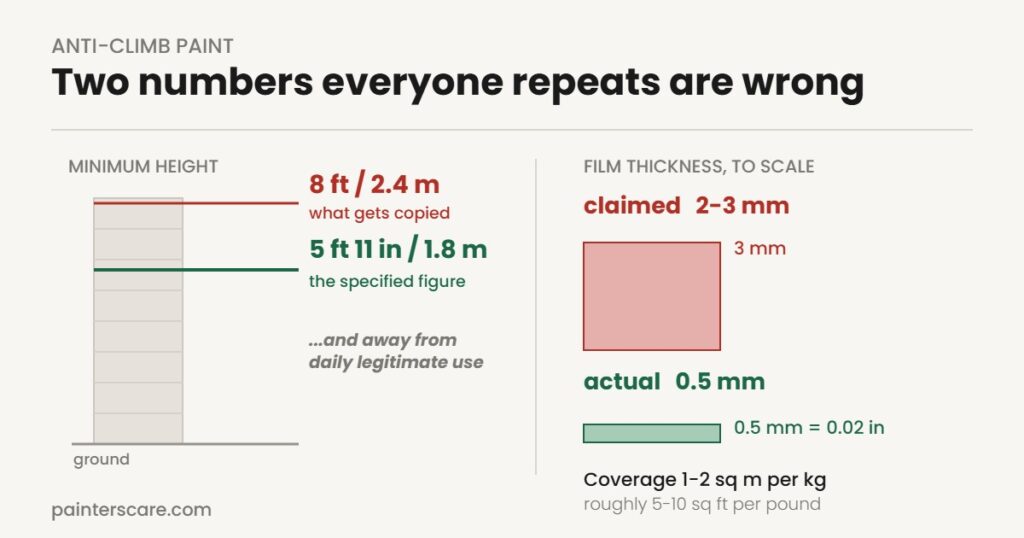
The height is 5 ft 11 in, not 8 ft
Search for this product and nearly every result repeats the same figure: apply above 8 feet, or 2.4 meters. It gets copied from page to page and now turns up in Google’s own summary.
The specified condition is different. Apply at heights over 1.8 meters — 5 ft 11 in — and away from daily legitimate use.
The second half of that sentence is the part worth keeping. Height is a proxy for the thing that actually matters, which is whether anyone with a legitimate reason to be there can reach it. A gate top at 6 ft 6 in that nobody touches is fine. A pipe at 9 ft that a meter reader braces against twice a year is not, however high it is. Measure the reach, not just the wall.
The film is half a millimeter, not two to three
You will see it described as a 2–3 mm coating. The specified build is 0.5 mm wet and 0.5 mm dry — about twenty thousandths of an inch, roughly a credit card’s thickness divided by two.
This matters when you are buying. Coverage is quoted at 1–2 m² per kilo at that thickness, which works out at about 5–10 sq ft per pound. Treat a 100 ft fence run in a 12-inch band and you are covering 100 sq ft, so you need 10–20 lb of material — two or three of the largest tubs. Budget from the real spread rate and you will not end up with half a job and an empty container.
It is not classified as toxic
Common advice warns against using it near animals, livestock or water because of toxicity. The hazard classification says otherwise: flammable liquid category 3, and nothing else. Health hazards, not classified. Environmental hazards, not classified.
There is still a sound reason to keep it out of ponds and streams, just not that one. The chronic no-effect concentration for rainbow trout is 0.131 mg/l over 28 days, which is low enough that a slug of it washing into a small body of water is a real problem. Keep it away from water because concentrated run-off is harmful, not because the coating itself is poisonous to the touch.
Is anti-climb paint legal in the United States?
There is no federal rule on it and no state bans it by name. The question people are really asking is whether it counts as a booby trap, because that is a felony in a lot of places.
California’s definition is a useful test, since it is tighter than most and written down plainly. Penal Code 16310 defines a booby trap as a concealed or camouflaged device designed to cause great bodily injury when triggered by an unsuspecting person — the listed examples are trip-wired guns and explosives, sharpened stakes, and lines or wire with hooks. Under Penal Code 20110, placing one is a felony carrying 2, 3 or 5 years.
Properly used, anti-climb paint fails that definition on both halves. It is not concealed, because warning signs are part of the specified installation. And it is not designed to cause great bodily injury — it is designed to make a surface too slippery to hold, which is a deterrent rather than a weapon.
Used badly, the picture changes. Unsigned paint, at a height someone can reach from standing, on a surface people have a legitimate reason to touch, is no longer a deterrent that announces itself. Now you are closer to the general principle that runs through American premises law: you cannot set up a mechanism to do to a trespasser what you could not lawfully do to them in person, and the fact that someone was trespassing does not by itself clear you of a fall they take on your property.
So the practical answer is that legality turns almost entirely on execution:
- Signs at every approach, readable from the ground, before the paint goes on
- Above reach from any surface a person can legitimately stand on — including a ledge, a dumpster or a parked trailer
- Never on handrails, gate latches, door furniture, meter boxes or anything a delivery driver, utility worker or firefighter has to touch
- Never where a child could reach it, and never on a boundary a school or playground shares
- Check your city ordinances as well as state law — some have their own rules on fence treatments
This is general information rather than legal advice. Rules vary by state and by city, and if the wall in question borders a public sidewalk it is worth twenty minutes with a local attorney before you open the tub.
Where to buy anti-climb paint in the US
This is the honest part: you mostly cannot, not easily.
Search the big American retailers for anti-climb paint and what comes back is anti-climb spikes — galvanized steel strips that bolt to a fence top. Home Depot stocks the spikes. It does not stock the paint. The same is true of the general-merchandise listings; the term has been colonized by the hardware.
The paint itself — Coo-Var Vandalene is the product most US buyers eventually find — is made in Hull, in the north of England, and sold through British trade suppliers. Importing it is awkward for a specific reason rather than a vague one: it is a Class 3 flammable liquid, UN 1263, packing group III. That classification restricts air freight and adds dangerous-goods handling to any shipment, which is why the few US listings that do appear tend to be expensive, intermittent, or quietly fulfilled from overseas.
If you find a US seller, check the container carries a batch code and full hazard labeling. Petroleum jelly and solvent is an easy formula to imitate badly, and a knock-off that slumps at 90°F is worse than nothing.
The temperature limit that rules out much of the country
Here is the detail that almost never appears in advice written for an American audience. The specification is explicit: use only where temperatures do not normally exceed 86°F (30°C).
Eighty-six degrees is an ordinary summer afternoon across most of the United States. A dark-colored grease on a south-facing wall in direct sun runs considerably hotter than the air around it — a black surface in full sun can sit 40 to 50 degrees above ambient. At that point the coating slumps, runs down the wall, drips onto whatever is below and stops being a 0.5 mm band at a controlled height.
That is a mess and a liability at the same time, because grease that has migrated down a wall is no longer where your warning sign says it is.
Practical consequences: this product suits the Pacific Northwest, coastal northern California, New England and the upper Midwest outside high summer. In Phoenix, Houston, Atlanta or anywhere with a long hot season, pick a north elevation and a light color, or use a mechanical deterrent instead. Put a drop cloth down whatever the forecast says — a canvas drop cloth catches the inevitable drips, and this is not a material you want on a driveway.
How to apply it
- Put the signs up first. Every approach, legible from ground level. If the paint goes on before the signs, there is a window where you have an unmarked hazard on your wall.
- Clean the surface. It must be dry and free of grease, oil and dust. Anything loose underneath comes away later and takes the band with it.
- Seal or prime. Porous masonry and wood need sealing first or the oil soaks in and the band thins out. Bare metal needs priming — the coating offers no corrosion protection of its own, so an oil-based primer does that job before the grease goes on.
- Roughen anything smooth. Coarse abrasive paper or a wire brush. Grease on glazed tile or smooth gloss will slide off as a sheet.
- Brush or glove it on. A stiff brush or a gloved hand, 0.5 mm, in a continuous band. Do not thin it.
- Wear nitrile. Gloves at least 0.31 mm thick, plus eye protection. Skip the latex — the solvent goes through it.
- Clean up with white spirit or turpentine substitute. Water will not touch it. Our guide to using paint thinner properly covers disposal, which matters here because the waste is classified as hazardous.
There is no second coat and no recoat interval. One band, done, and you revisit it in about three years.
Getting it off skin and clothing
On skin, rinse with water, then wash with soap. It is a degreaser, so it will leave your hands dry and the discoloration can take 2 to 3 days to fade, but it is not an injury.
Clothing is a different story and largely a lost cause. The coating is formulated to resist washing and a range of solvents, which is the whole point of the identification feature. Scrape off what you can with a blunt edge, treat the rest with white spirit before anything goes near water, and expect a shadow to remain. Do not put a contaminated garment through a machine with anything else.
What to use instead
Given the heat limit, the import problem and the liability exposure, most American sites are better served by something else:
- Anti-climb spikes. Widely stocked, bolt on in an afternoon, no temperature ceiling, visible by design. The common failure is fitting them low enough to be a hazard rather than a deterrent.
- Roller barriers. Free-spinning cups along a fence top that rotate under load. Expensive, and the standard choice where a fall would be serious or where children are nearby.
- Trellis toppers. A light wooden extension, usually 12 to 18 in, that will not take a climber’s weight. It fails under them without injuring them, which is a far better liability position than anything slippery.
- Lighting and cameras. Dull, and consistently more effective per dollar than physical deterrents on residential property.
If the wall is metal and you are going to be up a ladder with a brush anyway, it is worth asking whether the fence needs refinishing rather than greasing — a coat of spray paint made for metal plus a spike strip solves the same problem for less money and no ongoing exposure.
Frequently asked questions
What does anti-climb paint do?
It makes a surface too slippery to grip, and marks whoever touches it. It does not injure, trap or alarm — the grip failure and the stain are the entire effect.
Is there a clear anti-climb paint?
No. Vandalene comes in black, red, gray and green only, and no mainstream brand offers a clear grade. A clear version would defeat the purpose anyway, since visible color is part of how the deterrent announces itself.
What colors does anti-climb paint come in?
Black, red, gray and green. Black is the usual choice on dark brick and ironwork. In a hot climate the lighter shades run cooler and slump less.
How do you get anti-climb paint off clothes?
Realistically, you do not. Scrape the bulk off, treat the residue with white spirit before it meets water, and accept a mark. It is made to resist washing.
Can you make your own anti-climb paint?
You can mix petroleum jelly with a solvent and get something slippery. What you will not get is the controlled 0.5 mm film, a tested flash point, the hidden identifier or any hazard labeling — and without that last one you have nothing to show anyone if a person is hurt. The paperwork is most of what you are buying.
Does Home Depot sell anti-climb paint?
No. Searching for it there returns anti-climb spikes, which are a different product. The paint is a British trade item and is not carried by the large US home-improvement chains.
Do I legally have to put up signs?
The manufacturer specifies notification signs as part of correct use, and in practice the signs are what keep the installation on the right side of the booby-trap definition. Treat them as mandatory regardless of what your local ordinance says.
