Last Updated on October 6, 2026
The most effective homemade paint remover is a washing soda paste: four tablespoons of washing soda and one of plain flour stirred into a cup of hot water, brushed on thick and left for 30 minutes. It will lift old oil-based paint. It will barely mark modern acrylic, and any alkali left behind in the wood will make your new paint fail.
That last sentence is the part every recipe on the internet leaves out, and it is the reason most homemade stripping jobs look fine on the day and peel within a year.
So this guide gives you the DIY paint remover recipes with real quantities and real dwell times, tells you honestly what each one will and will not shift, and then covers the finishing step that decides whether the repaint holds.
Homemade paint remover: the short version
- Work out what you are stripping and what is on it. Old oil paint, modern acrylic and varnish all respond differently.
- Pick by that answer: alkali paste for oil paint on softwood, a hot soak for metal hardware, heat for thick build-up, and a bought stripper for anything modern.
- Put on rubber gloves and eye protection, then mix and apply thickly. A thin smear dries out and stops working.
- Cover it with plastic wrap or a plastic bag to stop it drying.
- Leave it 30 minutes, then test one corner with a plastic scraper.
- Scrape with the grain, never across it.
- Rinse thoroughly, then wipe over with a weak vinegar solution to neutralize any alkali.
- Let it dry for at least 24 hours, sand the raised grain flat, then prime.
Steps 7 and 8 are not optional tidying. They are the job.
Two questions decide which recipe to use
Nothing else matters until these are answered, because the same paste that strips a Victorian baseboard will sit on a modern satinwood door doing nothing at all.
What is underneath? Softwood, hardwood, steel, aluminum, plastic and glass all set different limits. Alkali darkens oak. It eats aluminum. Heat melts plastic.
Is the paint oil-based or water-based? Soak a cotton pad in denatured alcohol or denatured alcohol, hold it against the paint for a minute, then rub. If the paint goes soft or colors the pad, it is water-based — latex paint, acrylic or latex. If nothing happens, it is oil-based, and alkali is the thing that attacks it.
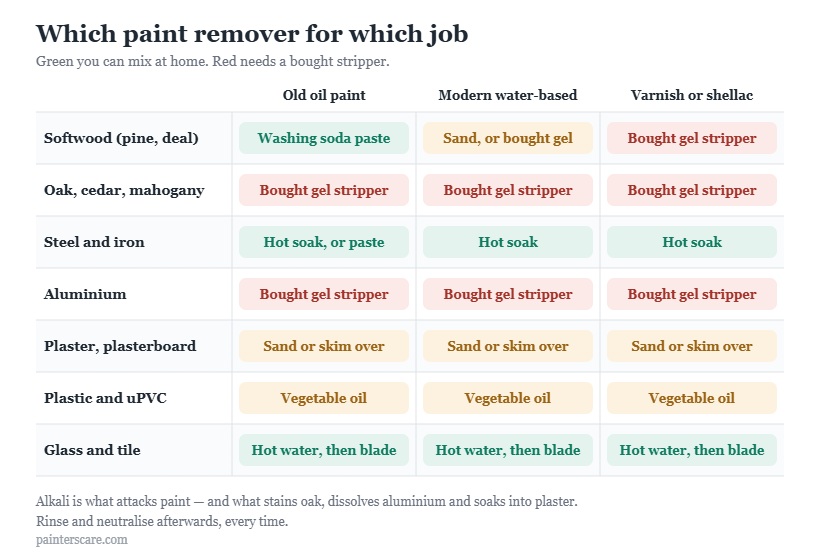
| What you have | Use | Expect |
|---|---|---|
| Old oil paint on pine or deal | Washing soda paste | Works, in two or three applications |
| Old oil paint on oak, cedar or mahogany | Bought solvent stripper | Alkali stains these woods almost black |
| Painted steel hardware, hinges, handles | Hot water soak | Very effective, almost no effort |
| Painted aluminum | Bought solvent stripper | Alkali dissolves aluminum and releases hydrogen |
| Modern acrylic or satinwood, one or two coats | Bought stripper, or sanding | Homemade alkali does very little |
| Thick build-up, four coats or more | Heat, then scraping | Fastest route by a wide margin |
| Paint spots and splashes on glass or tile | Hot soapy water, then a blade | No chemistry needed |
| Paint on plastic | Vegetable oil, patience | Most solvents melt the plastic |
The recipes, ranked by what they will actually shift
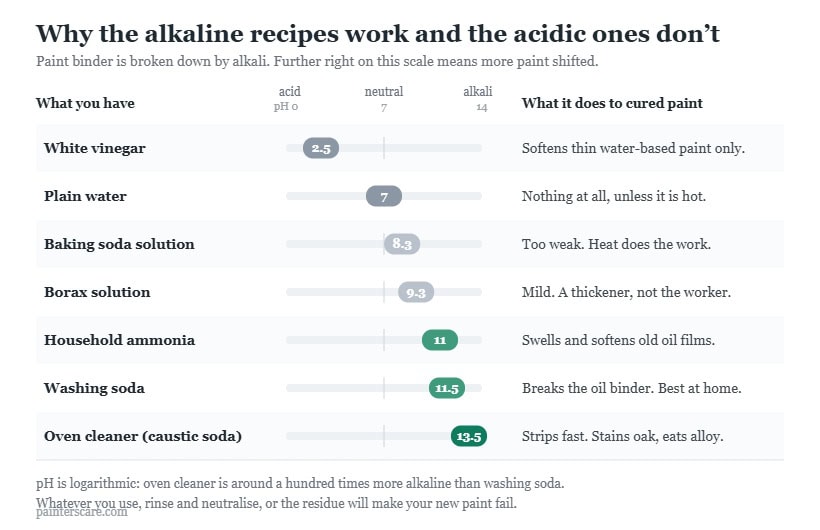
One pattern runs through every DIY paint stripper here: the alkaline mixtures work and the acidic ones mostly do not. Paint films are held together by a binder that alkali breaks down and acid largely ignores, which is why washing soda outperforms vinegar by a distance.
Washing soda paste: the strongest homemade paint stripper you can mix
Four tablespoons of washing soda, one tablespoon of plain flour, one cup of hot water. Stir the soda into the water first, then add the flour and keep stirring until it is the consistency of double cream. Brush it on thick, cover with plastic wrap, and leave for 30 minutes.
Washing soda is sodium carbonate. It attacks the oil binder in old paint and turns it into a soft soap you can scrape off. The flour is only there to stop the mixture running off vertical surfaces.
Be realistic about its strength. A washing soda solution sits at around pH 11.5. The caustic soda in commercial alkali strippers is pH 13 or higher, and because pH is a logarithmic scale that is between a hundred and a thousand times more alkaline. On three coats of 1930s oil paint, the paste works. On a modern water-based satinwood, it will not.
Good on: old oil-based paint and distemper, on softwood, brick and steel. Bad on: oak and other tannin-rich timber, aluminum, plaster, anything modern.
Borax, washing soda and ammonia: the recipe everyone copies
One cup of borax, one cup of washing soda and one cup of household ammonia stirred into two cups of room-temperature water. This is the mixture repeated on almost every page about eco-friendly paint removal.
It does work, and it is worth understanding why: the ammonia is doing most of the lifting. Ammonia swells and softens old oil films and dried latex paint, and the two powders raise the alkalinity and thicken the mix. It is not a gentle recipe just because the ingredients come from the supermarket.
Three hard rules with this one.
- Never add bleach, and never use it on a surface you have just bleached. Ammonia and bleach together produce chloramine gas, which can put you in hospital.
- Outdoors or by an open window. Ammonia fumes are punishing in a small room, and a cartridge respirator rated for ammonia is not a bad idea.
- Not on aluminum. An alkaline solution dissolves aluminum and gives off hydrogen as it does so.
Hot vinegar: the weakest option, and the most oversold
Heat half a cup of white vinegar until it is hot but not boiling, sponge it onto the paint, leave it 15 minutes, and scrape.
Household vinegar is about five per cent acetic acid, and acid is simply not the right tool for a paint film. What it does do is soften thin, single-coat water-based paint, and loosen dried latex splashes. What it will not do is strip a painted door, however many videos suggest otherwise.
Use it for paint spots, small areas and light overspray. We went through the metal case in detail in our guide to whether vinegar removes paint from metal, and the short answer there is the same: some, slowly, and only if the paint is already failing.
The hot water soak: the one that genuinely beats shop-bought
For painted steel hardware — hinges, handles, lock plates, brackets, radiator valves — this is better than any stripper, costs nothing, and needs no scrubbing.
- Put the hardware in an old slow stove or a pan you will never cook in again.
- Cover with water, add a squirt of dish soap and a tablespoon of washing soda.
- Hold it just below a simmer for two to six hours. A slow stove on low overnight is ideal.
- Lift each piece out with tongs. The paint should come away in sheets under a stiff brush.
- Rinse, dry immediately and thoroughly, then oil or wax bare steel so it does not flash-rust.
Heat and time are doing the work; the soda just speeds it up. Two cautions: never put aluminum in an alkaline soak, and never use a pan that will go back in the kitchen. If the hardware is brass under the paint, keep the soak gentler and check it hourly, because prolonged alkali dulls the surface.
Vegetable oil and dish soap: softening, not stripping
Rub vegetable oil generously over the paint, leave it an hour, and push at it with a plastic scraper. Clean up with hot soapy water.
This is not really a paint remover. It is a way of softening paint on a surface that nothing else can safely touch, which in practice means plastic. Oil will not harm plastic the way acetone and alcohol will, and it is the first thing to try on a painted plastic fitting or a splashed uPVC frame.
What household items will not strip paint
Worth naming these, because between them they account for most of the wasted Saturdays.
| The claim | The reality |
|---|---|
| Dish soap removes paint | It removes wet paint and grease. Cured paint is unaffected — a surfactant has nothing to attack. |
| WD-40 removes old paint | It lifts fresh overspray and transfer marks off hard surfaces. It will not shift a cured film, and it leaves an oily residue you must degrease before repainting. |
| Cola strips paint | Weak phosphoric acid. It has a mild effect on light rust and none worth measuring on paint. |
| Baking soda scrubs paint off | As a dry abrasive it is far too soft. Boiling water with soda in it is the method that works, and the heat is the active part. |
| Rubbing alcohol strips latex | It softens fresh or thin latex. On a properly cured latex paint it does very little, and it flashes off in seconds. |
| Oven cleaner strips paint | This one does work, because it is caustic soda in a can. Treat it as the harshest option here, not a household shortcut, and keep it away from oak and aluminum. |
If a method belongs in the left column, the honest answer is that you need a purpose-made stripper, heat, or an abrasive.
The step everyone skips, and why the new paint fails
Every homemade recipe above except the vinegar and the oil is alkaline. Alkali soaks into timber and stays there. If you scrape, wipe over with a dry cloth and prime the next morning, the residue is still in the wood, and it will break down the new paint from underneath.
The National Park Service is blunt about this in its guidance on exterior paint problems on historic woodwork: a caustic residue makes the wood feel slippery, and if it is not neutralized with a mild acid solution or at least thoroughly rinsed, the residue will cause new paint to fail.
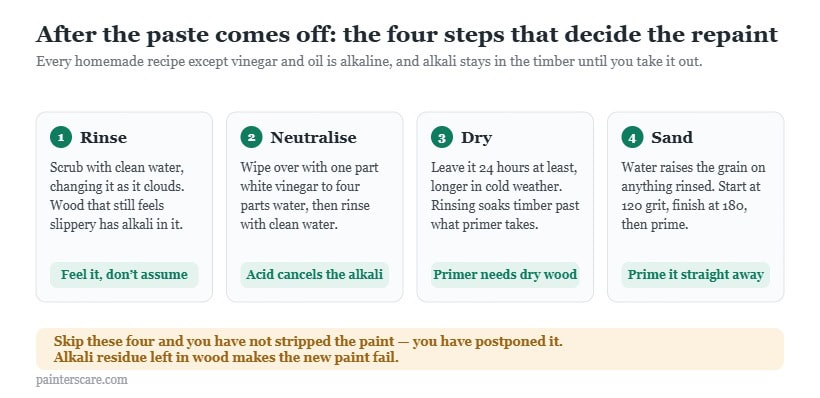
- Rinse with clean water and a scrubbing brush. Change the water when it turns cloudy. Run your fingers over the damp wood — if it still feels soapy or slippery, there is alkali left.
- Neutralize. One part white vinegar to four parts water, wiped over the whole surface, then one more rinse with clean water.
- Dry for at least 24 hours, longer in cold weather. Water-based stripping raises the moisture content of the timber well above what primer will tolerate.
- Sand the raised grain. Any water-rinsed stripping lifts the grain more than a solvent stripper does. Start at 120 grit and finish at 180.
Skip these and you have not stripped the paint. You have postponed it.
When a homemade remover is the wrong tool
Five situations where mixing your own costs more than it saves.
- Anything painted before 1978 in the US, or 1992 in the UK. Assume lead. The NPS works on the basis that houses built before 1950 carry one or more layers of lead paint, and US federal rules on lead-safe renovation prohibit open-flame burning, ban power sanding without HEPA extraction, and permit heat guns only below 1,100°F because lead vaporizes above that. Wet methods and careful scraping, or a licensed contractor, not a dry sander.
- Oak, cedar, mahogany and other tannin-rich timber. Alkali reacts with the tannin and stains the wood gray to near-black. It goes deeper than a sander will reach.
- Aluminum. Alkaline solutions dissolve it and release flammable hydrogen gas. This includes oven cleaner and the ammonia recipe.
- Large areas. A homemade paste over a whole staircase is days of work, several rinses and a lot of raised grain. Heat is quicker. Our guide to heat guns for paint removal covers the machine side, and the discs for angle grinders if the substrate is metal or masonry.
- Modern coatings. Two-pack finishes, floor lacquer, powder coating and modern acrylics are designed to resist exactly the sort of mild chemistry you can mix at home.
What to buy instead, and why the shelf looks different now
Part of the reason DIY paint remover recipes became popular is that the products people remember are no longer sold. Methylene chloride used to be the active ingredient in almost every fast-acting stripper. The US Environmental Protection Agency prohibited it in consumer paint removers from 22 November 2019 after a series of deaths, then in 2024 extended the prohibition to most industrial and commercial paint-stripping uses. The European Union restricted it for consumer and most professional use back in 2010.
What replaced it works differently, and the difference is dwell time. The old solvents blistered paint in minutes. The current generation needs hours.
| Type | Typical dwell | Best for |
|---|---|---|
| Soy or citrus gel (benzyl alcohol, methyl soyate) | 30 minutes to 24 hours | Furniture, indoor woodwork, layered paint |
| Dibasic ester (DBE) based | 2 to 8 hours | Varnish, shellac, thinner coatings |
| Caustic poultice or paste | Several hours to overnight | Many layers of oil paint, masonry, metal |
| Peel-off laminate systems | Overnight to 48 hours | Lead paint, intricate moldings, no dust |
Whichever you use, the mistake is the same one people make with the homemade versions: applying it too thinly. A thin coat dries out and stops working. Lay it on like cake icing, cover it, and leave it alone for the full time on the can.
If you are stripping wood specifically, our fuller guide to removing paint from wood takes each method in order of how much of the surface it risks, and using paint thinner properly covers the solvent side and the disposal rules.
Homemade mixes are only ever part of the picture. Matching the removal method to the surface covers what actually works on each material, and which shop-bought option is worth it.
Frequently asked questions
What household items can strip paint?
Washing soda, household ammonia, borax, hot water and oven cleaner are the five that genuinely work, and all five work by being alkaline. Vinegar and vegetable oil soften paint rather than strip it. Dish soap, WD-40 and cola do not remove cured paint at all, whatever the video shows.
Will Dawn dish soap remove paint?
Only while the paint is still wet. Dish soap is a surfactant: it lifts grease and loose pigment, and it is genuinely useful for washing latex paint out of brushes or off skin. Once paint has cured into a film there is nothing for it to act on, so it will not strip a painted surface.
Does WD-40 remove old paint?
No. It will lift fresh overspray, paint transfer and scuff marks from glass, tile and vehicle panels, because those sit on the surface rather than bonded into it. On an old cured film it does nothing, and it leaves an oil residue that must be degreased off before any new paint will key.
What is a good substitute for paint remover?
Heat is the closest substitute, and often faster than chemistry. A heat gun or electric heat plate softens thick paint so it peels away with a scraper, with no rinsing and no raised grain. An electric heat plate runs at 500 to 800°F, below the temperature at which lead paint starts to vaporize. For metal hardware, a hot soak replaces stripper entirely.
Will vinegar remove paint from wood?
Only thin or already failing water-based paint. Hot vinegar applied for 15 minutes will soften a single coat of latex paint enough to scrape, and it is useful on splashes and drips. It will not strip a painted door or baseboard, and repeated wetting will raise the grain and can darken some timbers.
Does baking soda remove paint?
Not as a dry scrub — it is far too soft an abrasive to cut a paint film. Baking soda in boiling water does remove paint from metal hardware, but the heat and the water are doing most of the work. Washing soda in the same soak is considerably more effective, because it is a stronger alkali.
What is the best homemade paint remover for metal?
A hot soak, for anything small enough to submerge. Water, a squirt of dish soap and a tablespoon of washing soda held just below a simmer for two to six hours will lift paint off steel hardware in sheets. For metal too large to soak, a washing soda paste left under plastic wrap for an hour is the next best thing. Never soak aluminum in an alkaline solution.
Is there a homemade paint remover for glass?
Glass needs no chemistry. Soak the paint with hot soapy water for a few minutes, then take it off with a new razor blade held almost flat to the surface, keeping the glass wet as you go. A dry blade scratches. This handles both fresh splashes and old paint that has been on the pane for years.
Can I make a paint remover for walls?
Not really, and it is the wrong approach. Plaster and drywall absorb whatever you put on them, so an alkaline paste soaks in, cannot be rinsed out, and ruins the surface for repainting. Latex paint on a wall is either sanded, skimmed over, or left in place and painted. Wallpaper paste and distemper are the exceptions, and warm water with a little dish soap handles both.
How long should homemade paint remover sit?
Thirty minutes is the working minimum for an alkaline paste, and an hour is better on thick paint. The limit is not time but drying: once the paste dries out it stops working completely, so cover it with plastic wrap or a plastic sheet and it will stay active for several hours. Test one small corner before scraping the whole piece.
Is homemade paint stripper safer than shop-bought?
Not automatically. Household ammonia and oven cleaner are hazardous chemicals sold in supermarkets, caustic solutions can cause permanent eye damage, and ammonia mixed with bleach produces a toxic gas. A modern soy or citrus gel stripper is genuinely less dangerous to handle than a strong homemade alkali. Homemade is cheaper and avoids solvent fumes — those are the real advantages.
Will a homemade remover take paint off plastic?
Vegetable oil is the only one to try. Alkaline pastes can haze or craze plastic, and solvents such as acetone and denatured alcohol dissolve it or strip the color out of it. Rub oil in, leave it an hour, and work at the paint with a plastic scraper. Test on a hidden area first, because plastics vary enormously.
What to remember
Answer the two questions first: what the surface is, and whether the paint is oil or water-based. Alkali is the only homemade chemistry that really attacks paint, so washing soda paste and the hot soak are the two recipes worth your time. Keep alkali away from oak, aluminum and plaster. Apply everything thickly and keep it covered. And treat the rinse, the vinegar wipe and the 24 hours of drying as part of the job rather than the clean-up, because that is what decides whether the paint you put on next actually stays there.
