Last Updated on October 11, 2026
The short answer: heat gun paint removal works by softening the paint rather than dissolving it. Hold it two to three inches from the surface, keep it moving, wait for the paint to blister, and follow immediately behind with a scraper. Most paint lifts between 400°F and 600°F (200–315°C), which is the low-to-middle setting on a typical gun, not the high one.
It is the fastest way to strip layered paint off woodwork, and it produces no chemical mess. It is also the method with the two real hazards – scorched wood and, on older houses, lead fume. Both are avoidable, and both come down to temperature.
How to remove paint with a heat gun
- Set up properly. Ventilate the room, lay a drop sheet you do not mind scorching, and have a metal tin or tray to put the hot gun and the scrapings in. Wear gloves and eye protection.
- Start on the low setting. You can always go up. Starting high is what burns the wood and, on old paint, what turns a nuisance into a health risk.
- Hold it 2 to 3 inches off the surface and keep it moving. Small sweeps over an area about the size of your hand. A gun parked in one spot scorches the wood underneath in seconds.
- Wait for the blister. The paint wrinkles, lifts and goes soft. That is the cue – not a color change, not smoke.
- Scrape immediately, behind the heat. Work the scraper at a shallow angle, pushing away from your other hand. Paint that cools goes hard again in seconds, so heat and scrape move together as one motion.
- Collect the scrapings as you go. Hot paint flakes smolder. Into the metal tin, not onto the drop sheet.
- Finish with abrasive. A heat gun gets you back to bare wood but leaves residue in the grain and around moldings. A light sand finishes it.
- Set a timer and come back to it before you leave for the day. Smoldering debris is the commonest cause of fires after this kind of job, and it is slow – it does not announce itself while you are still in the room.

What temperature removes paint?
Paint softens well below the top end of what a heat gun can produce. The useful range is narrower than most people assume.
| Temperature | What happens |
|---|---|
| Below 400°F / 200°C | Paint warms but does not release. You are just drying it out |
| 400–600°F / 200–315°C | The working range. Paint blisters and lifts cleanly |
| 600–900°F / 315–480°C | Faster, but the wood starts to scorch and the paint can char onto the surface |
| Above 1,100°F / 593°C | Scorching is close to certain, and on lead paint this is above the legal limit in the US |
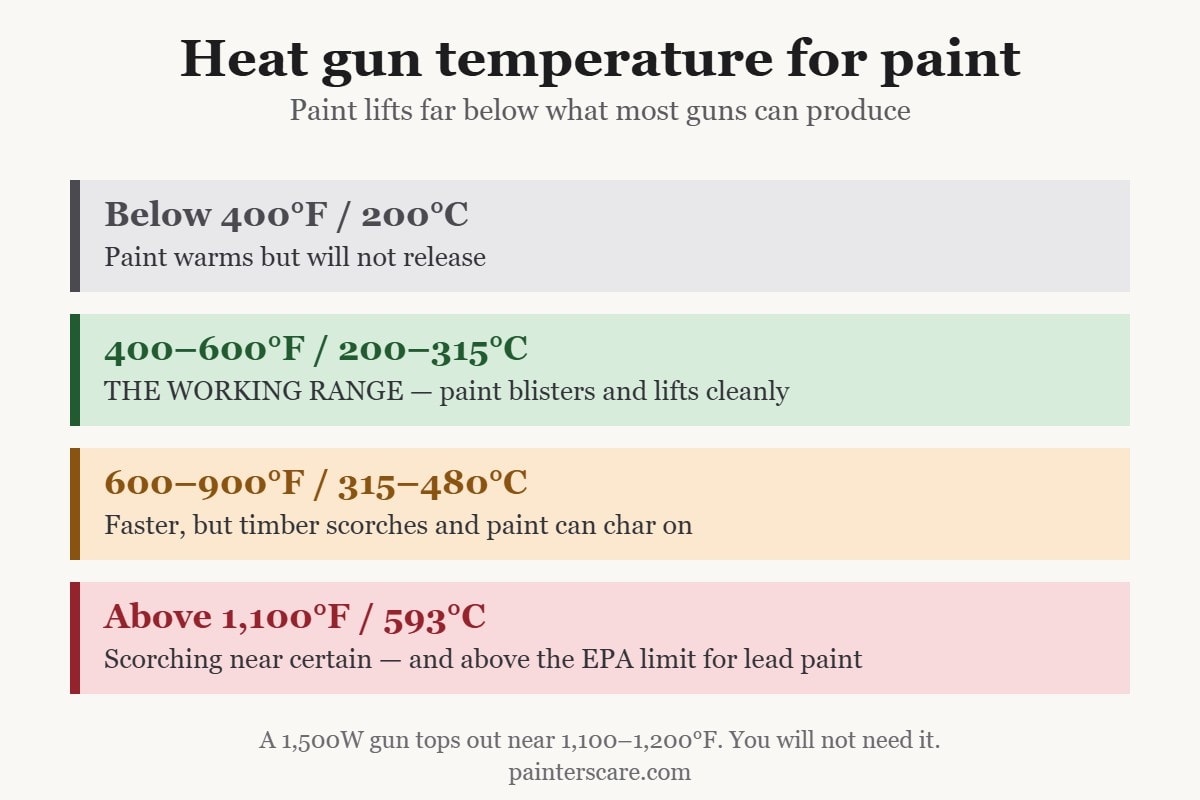
A 1,500W gun typically tops out around 1,100–1,200°F on its high setting, which is well past useful for paint and into the range where you are damaging what you are trying to save. Wattage buys you recovery speed and airflow, not a requirement to use the top setting.
Old paint: the lead problem, and the 1,100°F rule
This is the part most heat gun guides skate over, and it is the one with a number attached to it.
Heating lead paint vaporizes the lead. The fume is invisible, it is inhaled, and it settles as dust that stays in the room long after you have finished. The US Environmental Protection Agency’s Renovation, Repair and Painting rule puts a hard limit on it: operating a heat gun on lead-based paint is permitted only at temperatures below 1,100°F, and open-flame burning of lead paint is prohibited outright (EPA, Lead Safety for Renovation, Repair and Painting). HUD goes a step further and prohibits any heat gun use that chars the paint, even below that limit.
The awkward part is that plenty of consumer heat guns reach 1,100–1,200°F on high. So on exactly the houses where a heat gun is most useful – old ones, with six layers of paint on the baseboards – the high setting is the one you cannot use.
Assume lead if the paint predates the late 1970s. The EPA’s cut-off is 1978; in the UK, lead was being phased out of household paint through the 1960s and 70s and was not fully banned for domestic use until 1992. A cheap swab test from a DIY shop settles it in a minute.
If it is lead:
- Stay on the low setting, under 1,100°F, and never let the paint char or smoke.
- Wear a P100 or FFP3 respirator, not a dust mask. A surgical or nuisance mask does nothing against lead fume.
- Seal the room off, and keep children and pregnant women out of it entirely.
- Collect every scraping. Wet-wipe and HEPA-vacuum afterwards – ordinary vacuuming redistributes the dust.
- For a whole house, or any large area, get a certified contractor rather than doing it yourself.
Chemical stripper is often the better answer on lead paint precisely because it does not aerosolize anything. Our guide to paint strippers for wood, metal and concrete covers the options.
Heat gun or chemical stripper?
| Heat gun | Infrared remover | Chemical stripper | |
|---|---|---|---|
| Working temperature | 400–1,200°F | 230–320°F | Ambient |
| Typical cost | $10–$115 | $520–$870 | Per can, repeatedly |
| Speed on thick layers | Fast | Fast – fewer passes | Slow – dwell time then scrape |
| Mess | Dry scrapings | Dry scrapings | Sludge, needs neutralizing and disposal |
| Detailed moldings | Awkward – hard to heat evenly | Flat surfaces only | Better – gets into the profile |
| Lead paint | Risky, capped at 1,100°F | Stays far below the cap | Safer – nothing goes airborne |
| Near glass | Cracks it | Safer, but still heat | Fine with care |
| Running cost | Electricity | Electricity | Buying stripper repeatedly |
The middle column is the one most guides leave out. An infrared remover warms the paint to 230–320°F and heats the wood underneath rather than the air above it, so the film lifts in sheets instead of bubbling. The temperature matters more than the speed does: it sits several hundred degrees below the 1,100°F ceiling, which is why restoration crews reach for one on pre-1978 houses where a heat gun is legally awkward. It is not a free pass — heating old paint still releases vapor and particles that can contain lead, so the same containment and respirator apply. The catch is price: $520 to $870 against $10 to $115 for a heat gun, which only pays back across a whole house rather than one door.
In practice most people doing a period house use both: heat gun on the flat runs of baseboards, door casing and doors, stripper on the moldings and the window beads.
Which surfaces it works on
Wood – what a heat gun is for. Layered gloss on baseboards, doors and door casing comes off in ribbons.
Metal – yes, and often faster than wood because the metal conducts heat away from the paint film rather than burning. Radiators, railings, gates. The caveat is that metal holds heat for a long time afterwards, so it stays dangerous to touch well after you have moved on.
Masonry, brick and concrete – poor. The surface soaks up the heat and the paint is keyed into the texture. Chemical stripper or an angle grinder disc is the realistic route.
Never on vinyl or plastic frames, which deform long before the paint lifts; on or near glass, which cracks from the thermal shock; or on a wall where you cannot see what is behind it. Old lath, dry framing and loose insulation in a cavity can all catch from conducted heat without anything visible on your side.
Which heat gun for paint removal: 7 reviewed
| IMAGE | PRODUCT | DETAILS | ||
|---|---|---|---|---|
|
Our Top Pick
 |
Our Top Pick
|
Pit Bull CHIGH0014UL |
|
Check Price |
|
Best Budget
 |
Best Budget
|
Wagner Spraytech 0503008 |
|
Check Price |
 |
|
PORTER-CABLE PC1500HG |
|
Check Price |
 |
|
DEWALT D26960K |
|
Check Price |
 |
|
|
Check Price | |
 |
|
Wagner Spraytech Furno 300 |
|
Check Price |
1. Pit Bull CHIGH0014UL 1200W Electric Heat Gun
Paint and varnish can be difficult to remove once it has been in place for a long period of time. Using the Pit Bull electric heat gun and paint stripper will allow you to loosen the paint and varnish so that you can easily remove it with a wire brush.
Decals on windows, doors, and other products can often be a lot of trouble to get off. This heat gun will allow you to apply enough heat to loosen the adhesive holding the decal in place without applying so much heat that it damages the surface it is stuck to.
2. Wagner Spraytech Wagner 0503008 HT1000
This heat gun has two heat settings so you can cause paints, decals, adhesives, and varnishes to loosen their grip without causing heat-related damage to the surface you are working on.
The temperature switch that changes the heat setting from 750 degrees to 1000 degrees is conveniently placed on the handle.
You may not have thought of all of the times that a heat gun would come in handy around your home. It is great for removing paint and decals but these appliances also help you to thaw water pipes that are frozen, apply shrink wrap, loose floor tiles that you want to replace, and more.
3. PORTER-CABLE PC1500HG 1500
When using a heat gun to loosen paint and varnish you want to be careful to not apply to much heat to the surface so that you do not damage the painted item. This heat gun has a variable temperature control dial that lets you choose how much heat you are going to apply.
One of the best features of this heat gun is the hand’s free stand that allows the heat gun to be applying heat to one area while you are working in another area.
The six-foot-long electrical cord ensures that you will be able to find a convenient receptacle for your heat gun needs.
4. DEWALT D26960K Heavy Duty Heat Gun
This heat gun has a temperature adjustment that is displayed on an LCD screen so that you can make adjustments in fifty-degree increments.
The kickstand that supports the heat gun when you are not holding it, is conveniently built into the gun so you always have it easily accessible.
It has an ergonomic grip built into the handle so you can use it for longer periods of time without suffering hand pain or cramping. I weigh less than two and a half pounds so you will be able to use it for hours.
When you are ready to store the tool there is a convenient ring built into it that allows you to hang it up in your tool area.
5. Cartman Heat Gun, 1500W Hot Air Gun
The Cartman heat gun has a 750 degree and a 1000 degree heat setting so you can choose the exact amount of heat you need. It is useful in removing paint, varnishes, decals, flooring tile adhesive and more.
With this heat gun, you can also do things like loosen up rusted bolts and nuts, thaw frozen pipes, apply shrink wrap, bending flexible plastic pipe, and even stripping the paint off of things as delicate as furniture.
The heat gun plugs into ordinary household outlets so it is easy to provide the power you need to operate this tool.
The Cartman heat gun also has two fan speeds that allow you to project the heat to the exact place where you need it to be concentrated. It has a hands free stand so you do not have to hold it while it is in operation.
6. Wagner Spraytech Furno 300
The Wagner Furno 300 has an integrated stand that allows for hands-free operations. There are sidebars on the heat gun that prevent the heated nozzle of the gun from coming into contact with the surface you are applying heat to.
The heat gun has dual temperatures so you can use more or less heat according to what you are removing or loosening up.
This heat gun will be handy for loosening adhesives on the back of flooring tiles, cell phone glass, and stickers and decals. It also helps you to loosen old paint and varnish so you can create a smooth surface to paint.
7. Mini Heat Gun, Compact Hot Air Gun

This mini heat gun is small in size but big in power and performance. You can use it to loosen the adhesive on the backs of floor tiles when stripping paint and varnish when applying shrink wrap when embossing when you need to bend laminates and plastics, and for thawing frozen pipes around the house.
It only weighs 10.8 ounces so you can hold this tool in your hand for hours without feeling muscle strain. Be careful though the nozzle on this little powerhouse can reach a working temperature of 200 degrees in a matter of seconds.
What to look for when buying one
When you have decided to purchase a heat gun then you have to consider the differences in those appliances, so you can choose the appliance you will use the most often around your shop or home. Some of the main considerations you should ponder are:
Temperature Settings
You want to get a heat gun that is capable of providing enough heat to help you do the work you need to do. The guns are available in strengths to reach temperatures as low as 200 degrees and as high as 1000 degrees.
Nozzles
These guns come with different nozzles that allow you to direct the heat to the proper places you need it. Many of the heat guns come with several nozzles.
Hands-free Operations
If you will be using the gun to do large projects you will want to find one that offers hands free operations. The hands free is created by a stand that you can place the heat gun on while you are working on other things. If you choose a hands free applicable gun to try to find one that also has protective bars that keep the gun from heating on the side and touching your surface area or your hands.
Power Supply
You can purchase heat guns that are electric and you can purchase some guns that are powered by batteries. The electric power source guns are generally stronger and provide more heat. If you get an electric heat gun make sure that the cord is long enough to easily reach normal outlets. Six foot is an average cord length.
Accessories
Some heat guns come with accessories like storage boxes or rings on the heat gun that allows it to be easily hung up in your workshop. You will also find some heat guns that have ergonomic handles to make it easier for you to hold the gun for longer periods of time.
What goes wrong
Scorched wood
Almost always the gun sitting still, or the high setting used from the start. If you are stripping back to bare wood for a clear finish, a scorch mark is permanent and sanding it out changes the profile. Low setting, constant movement.
Paint that chars instead of lifting
Too hot. Charred paint bonds to the surface and then has to be sanded or stripped off, which is slower than doing it properly the first time. Drop the temperature a setting and give each pass 2 or 3 seconds longer.
Cracked glass
Heating a painted glazing bar puts the heat straight into the pane beside it. Use a heat shield attachment, or switch to stripper for the last inch.
Fires that start after you leave
Scrapings smolder. So does dust in a cavity that took conducted heat through a wall. Bag the debris in metal, and go back and check the area an hour later.
Melted plastic
Vinyl window frames, plastic vents, cable raceway. All deform at temperatures well below what paint needs.
Heat is one of four ways to shift paint, and it suits some surfaces far better than others. Matching the method to the surface compares all four.
One surface to keep it away from: drywall. Heat scorches the paper face long before the paint blisters, and our guide to removing paint from walls covers what to do there instead.
Frequently asked questions
Is a heat gun a good way to remove paint?
For layered paint on wood or metal it is the fastest method available to a DIYer, and the only one that leaves no chemical residue to neutralize afterwards. It is the wrong tool on masonry, within about 6 inches of glass, and on anything painted before 1978 unless you can keep the gun under 1,100°F. A $20 dual-setting gun strips a door as well as a $115 one; the extra money buys recovery speed and airflow, not a better result.
At what temperature does a heat gun remove paint?
Between 400°F and 600°F. Below 400°F the film softens but will not release from the surface, and much above 600°F you start scorching the wood underneath. Most dual-setting guns put low somewhere in the 400 to 750°F band and high above 1,000°F, which makes low the working setting and high a short-burst tool for stubborn spots rather than the one you run all day.
Which heat gun is best for removing paint?
Any dual-setting gun that will hold a temperature under 1,100°F. Prices run from about $10 for a single-setting handheld to $115 for one with an LCD readout, and for paint stripping that readout is the one feature worth paying up for, because it is the difference between knowing you are under the lead limit and guessing at it. Variable or digital control beats two fixed settings. Wattage mostly buys recovery speed between passes.
What is the quickest way to remove old paint?
On flat wood carrying several layers, a heat gun and a sharp scraper — roughly an hour for a door front against most of a day with an orbital sander. On detailed moldings a chemical stripper wins outright, because heat cannot reach evenly into a profile. On pre-1978 paint the quickest safe route is usually stripper or infrared, since the 1,100°F ceiling takes the heat gun’s main advantage away.
Will a heat gun remove paint from metal?
It does, and the thing to plan for is not getting the paint off but what the metal does afterwards. A railing or a radiator holds heat for several minutes once the gun comes away, long after it has stopped looking hot, so most burns on metalwork happen during the scraping rather than the heating. Thin sheet is the other limit: light-gauge steel can distort above roughly 600°F, which sits inside the band you need for the paint, so keep the gun moving and work in short passes.
Will a heat gun remove paint from plaster?
Poorly, and it is worth knowing why before you try. Plaster does not conduct heat away the way metal does, so the surface climbs through the 400 to 600°F working band while the paint film barely moves, and you scorch or craze the skim before the paint lifts. Old plaster also holds moisture, which flashes to steam and blows the face off. A steam stripper works at 212°F and uses that moisture rather than fighting it.
Will a heat gun remove paint from brick?
No. Brick is porous, so the paint is keyed down into the face rather than sitting on top of it. A heat gun working at 400 to 600°F softens only the film on the surface and cannot reach what is inside the pores, so you end up with a scorched, patchy face and most of the paint still there. Masonry wants a poultice-type stripper left on for hours, which draws paint back out of the pores instead of baking it in.
Can you use a heat gun to remove paint from a car?
Not on bodywork. Factory automotive finish is only about 4 to 6 mils thick in total, a fraction of the ten-plus layers a heat gun suits, and everything around it moves first: filler softens, plastic trim deforms, and heat conducts along the panel into paint you wanted to keep. Use a stripper rated for automotive use, or abrasive. The exception is a stuck badge or trim adhesive, which is what a heat gun on a car is actually for.
Final Word
A heat gun is a wonderful tool to have around your house or shop. The best heat gun for homeowners is one that has a dual temperature control or a variable temperature control so you can use it in a wider variety number of applications.
These guns can help you thaw out water pipes in the winter so no more doing without running water, they can loosen adhesives from stickers and decals, they can help you bend plastic pipe, and more. Every home should have at least one of these appliances.
