Last Updated on October 9, 2026
For removing paint with an angle grinder, use a silicon carbide non-woven strip disc — also sold as a clean and strip disc, poly strip disc or stripping wheel — rather than a flap disc or a wire wheel. Black suits thin paint on aluminum and fiberglass, blue is the general-purpose choice, and purple handles thick coatings and rust on steel. Check the bore size before you buy — not every disc fits a standard grinder.
That last point catches more people than the color does. The highest-profile paint stripping disc on Amazon has a threaded mount that will not go on an ordinary 4½-inch grinder spindle, and nothing in the listing title says so.
So this guide covers what the colors mean, which disc suits which surface, the two numbers that decide whether a disc will physically fit and safely spin, and roughly how many discs a real job eats through.
Paint stripping discs: the short version
- Buy a non-woven strip disc, sometimes sold as a clean and strip disc or poly strip wheel.
- Match the color to the job: black for light work and soft materials, blue for general use, purple for thick coatings and heavy rust.
- Check the bore. A standard 4½-inch grinder needs a 4½-inch disc with a 7/8-inch center hole.
- Check the maximum RPM marked on the disc against your grinder’s no-load speed.
- Fit the guard. Wear a face shield, not just glasses.
- Hold the disc flat against the surface and use almost no pressure.
- Keep it moving. Heat builds fast and thin steel panels warp.
- Stay off sharp edges and proud welds — they tear the web and end the disc early.
Buy a multi-pack. Whatever the marketing says, these discs wear out quickly, and running out halfway through a panel is the usual outcome of buying one.
What the disc colors actually mean
Non-woven strip discs are color-coded by how aggressive they are. Black is the gentlest, purple the harshest, blue in between. The color tells you the grade, not the brand.

| Color | Duty | Use it on | Keep it away from |
|---|---|---|---|
| Black | Light | Thin paint, surface rust, fiberglass, aluminum and soft alloys | Thick multi-layer coatings — it glazes over and stops cutting |
| Blue | Medium | General paint and rust on steel. The one to buy if you only buy one | Nothing in particular, it is the compromise grade |
| Purple | Heavy | Thick coatings, mill scale, rust taken back to bare steel | Thin sheet, aluminum, fiberglass — it bites into the substrate |
| Green, orange, red | Brand-specific | Whatever that manufacturer’s chart says | Assuming they line up with another brand’s scale |
One honest caveat that most pages skip: this color code is a convention, not a standard. There is no published specification forcing black to mean light duty. Most makers of silicon carbide non-woven discs follow it, but the extra colors are brand inventions, and even the big names break the pattern — 3M’s green XT Pro disc uses aluminum oxide rather than silicon carbide, which makes it a different animal from its purple one.
If you are buying an unfamiliar brand, read the grit and mineral in the specification rather than trusting the color.
Which disc for what you are stripping
The surface underneath matters more than the paint on top, because the disc that shifts paint fastest is also the one most likely to damage what is beneath it.
| What you are stripping | Disc | Watch for |
|---|---|---|
| Steel chassis, gates, railings, thick plate | Purple strip disc | Nothing much. This is what purple is for |
| Car body panels and thin sheet steel | Blue strip disc | Heat. Keep moving or the panel warps |
| Aluminum and soft alloys | Black strip disc | Anything coarser cuts into the metal itself |
| Fiberglass and GRP | Black strip disc | The dust. Respirator, not a paper mask |
| Painted wood, decking, doors | Black strip disc | Flap discs and sanding discs gouge wood in seconds |
| Concrete, render, brick | Diamond cup wheel | Strip discs glaze over on masonry almost immediately |
| Anything painted before 1978 | None — stop | Assume lead. See the section further down |
The wood case surprises people. A strip disc works on painted timber precisely because it does not cut wood fiber — the open nylon web wipes the coating off and leaves the grain alone. Put a 60-grit flap disc on the same door and you will be filling the dishes you just carved into it. Our fuller guide to removing paint from wood ranks every method by how much of the surface it risks.
Strip disc, flap disc, wire wheel or diamond cup?
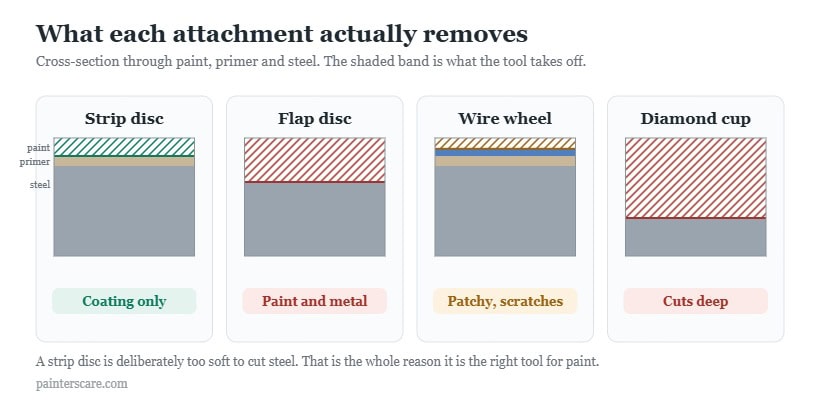
Four things fit the same grinder and only one of them is really a paint tool.
| Attachment | On paint | Risk to the surface | Verdict |
|---|---|---|---|
| Non-woven strip disc | Excellent | Very low — it will not cut steel | The right tool |
| Flap disc, 40 to 80 grit | Fast | High — removes metal, gouges wood | Only for shaping, not stripping |
| Twisted wire wheel | Poor on film, good on rust | Medium — scratches, and throws wire | Rust and weld scale, not paint |
| Diamond cup wheel | Masonry only | Destroys metal and wood | Concrete and render only |
| Fiber or sanding disc | Moderate, clogs quickly | Medium | Feathering edges, not bulk removal |
The distinction that matters: a flap disc is made to remove material, and paint is only the first material it reaches. A strip disc is made to remove coatings and is deliberately too soft to cut the metal under them. On a car panel that difference is the difference between prep and a new panel.
The two numbers to check before you buy
Color gets all the attention. Fit and speed are what stop the disc going on the grinder, or coming apart once it does.
The bore, and the threaded-mount trap
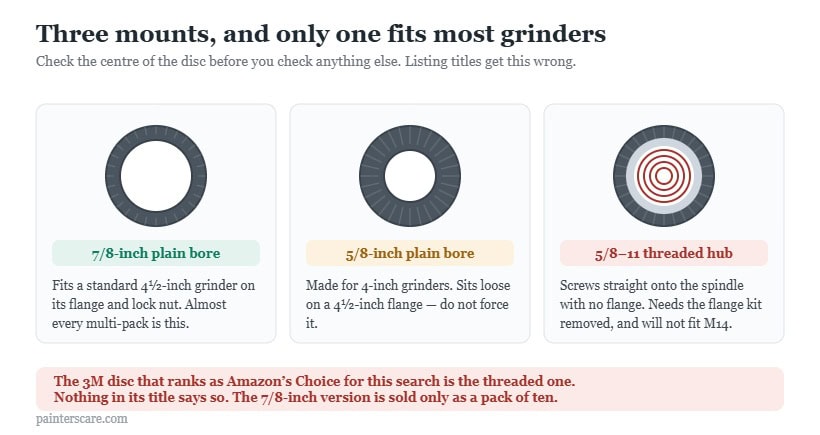
A standard 4½-inch angle grinder takes a disc with a 7/8-inch plain center hole, held on by a backing flange and a lock nut. Most strip discs sold in packs are exactly this.
Two things get sold alongside them that are not:
- 4-inch discs with a 5/8-inch bore. These are for smaller grinders. They will sit loose on a 4½-inch machine’s flange.
- 5/8-inch–11 threaded discs. These screw directly onto the spindle with no flange or nut at all. They are common in the professional range — including the single 3M Scotch-Brite Clean and Strip XT Pro disc that currently comes up as Amazon’s Choice for this search. If your grinder’s spindle is 5/8-11 you can use one, but you have to take the flange kit off first, and if it is M14 you cannot use one at all.
Listings are unreliable here. Checking the current crop, several put one diameter in the title and a different one in the bullet points, and one gave 4½ inches in the bullets, 4 inches in the description, and “4.5 inches (100mm)” in a third place — 100mm is 4 inches, not 4½. Read the specification block, and if the arbor size appears nowhere, buy something else.
The maximum RPM
Every abrasive wheel has a maximum operating speed, and exceeding it is how wheels come apart. The workplace rule is a good one to borrow at home: OSHA requires that the spindle speed of the machine is checked before the wheel is mounted, to be certain it does not exceed the maximum operating speed marked on the wheel.
A typical 4½-inch grinder runs at 10,000 to 11,000 rpm with no load. Discs rated 11,000 or 13,300 rpm are fine on one. A 4-inch disc intended for a smaller, faster machine may be rated lower than your grinder spins.
The awkward part is that most budget listings do not state an RPM figure at all. Of the discs checked for this guide, only a handful gave one. If yours does not, and the disc has no speed marked on the face, treat that as a reason to pick a different pack rather than a detail to shrug at.
How long a disc really lasts, and what the job will cost
Short answer: not long. Every brand markets these as long-lasting and every review section says otherwise, across price points and manufacturers. Plan around it rather than shopping for the one that lasts, because that one does not exist.
The most useful figure we found came from a buyer who ran the comparison himself and posted it on both listings: one budget non-woven disc stripped roughly 104 inches of 2×2 steel tubing before it was finished, and one 3M Scotch-Brite XT Pro did more than twice that. The 3M costs around six times as much per disc.
So the premium disc lasts longer and still costs more per foot stripped. What you buy it for is fewer disc changes and less vibration, not a lower bill.
| Job | Budget discs to allow |
|---|---|
| A gate, a few brackets, one wheel arch | 1 to 2 |
| A door, a hood, a small trailer | 3 to 4 |
| A whole car body back to bare metal | 10 to 15 |
| Railings or a steel frame, thick old paint | Budget by the meter and buy 20 |
Those are rough allowances, not promises — old flaking paint comes off in a fraction of the time that sound two-pack does.
How to use one without ruining the panel or the disc
- Lay the face flat. The whole width of the disc should contact the surface. Working on the edge of the disc digs a line and wears one side away.
- Almost no pressure. Let the abrasive do it. Pressing glazes the web, and a glazed disc stops cutting and starts polishing.
- Keep it moving. Heat is what warps thin sheet steel, and it builds under a stationary disc in seconds.
- Avoid edges, welds and bolt heads. This is the single most common way people kill a disc early — the open web snags on a sharp edge and tears out. Work up to edges, not across them.
- Expect clogging on varnish and oil-based finishes. Despite what the listings claim, soft coatings load the web. Slower passes and lighter pressure help; sometimes the answer is a chemical stripper first.
- Guard on, face shield on. Not safety glasses — a shield. Non-woven discs can shed material, and you are standing in the plane of a wheel spinning at 11,000 rpm.
- Extraction or a respirator. Paint dust is the hazard people forget until they see what comes out of the filter.
When not to use an angle grinder for paint at all
- Anything painted before 1978 in the US, or 1992 in the UK. Assume lead. US federal lead-safe rules prohibit power sanding and grinding without HEPA extraction, and a strip disc on lead paint produces exactly the dust those rules exist to stop. Wet scraping, or a licensed contractor.
- Thin sheet you cannot keep the disc moving on. Tight corners and returns are where panels warp, because you end up dwelling in one spot.
- Interior joinery you plan to varnish. Even a black disc leaves a texture, and the dust gets into everything. A chemical stripper is the better tool indoors — our guide to homemade and shop-bought paint removers covers what works.
- Large flat timber like decking. It can be done, but a dedicated paint-removal sander is easier to control and far less likely to gouge.
- Detail and moldings. A 4½-inch disc cannot follow a profile. Heat or chemicals, every time.
If the job turns out to be a heat job rather than an abrasive one, our guide to heat guns for paint removal covers the machines and the temperature limits that keep lead paint out of the air.
The discs worth buying
Every product below was checked in September 2026 for availability, size and what buyers actually report. Prices move, so treat them as a guide.
Best starting point: KONIGEEHRE 6-pack, mixed colors
Around $20 for six 4½-inch discs with a 7/8-inch arbor, rated 4.6 stars across more than a thousand reviews. The pack mixes black, blue and purple, which makes it the sensible first buy — you find out which grade suits your work without committing to a color.
Be aware the listing’s specification field claims a diamond abrasive at 80 grit. That is almost certainly marketplace boilerplate; these are non-woven web discs with a coated mineral, the same construction as everything else here.
Best for heavy work in bulk: TPmax 10-pack, purple
Around $27 for ten purple 4½-inch discs, 7/8-inch arbor, silicon carbide. If you already know the job is thick coatings or rust on steel, buying one color in quantity is cheaper than mixed packs.
One thing to know: this seller’s 3-pack, 5-pack and 10-pack are variations of the same parent listing, so the review score is shared across all of them rather than being specific to the purple ten.
The only one that states its speed rating: LAIWOO 10-pack
Around $34 for ten, 4½-inch with a 7/8-inch arbor, and 11,000 rpm printed in the specification — which, as covered above, most budget listings simply omit. 4.7 stars from just under 400 reviews. If you want to do the speed check properly rather than hoping, this is the pack that lets you.
The professional option: 3M Scotch-Brite Clean and Strip XT Pro
Silicon carbide, extra coarse, 13,300 rpm, and roughly double the working life of a budget disc. It is the disc the trade uses and the one most often named as the best.
Buy the right one. The cheap single that comes up first in most searches is the 5/8-inch–11 threaded version, which screws onto the spindle and will not mount on a standard flange-and-nut grinder setup. The plain 7/8-inch arbor version is sold as a pack of ten and costs around $140, which works out near six times the per-disc price of the budget packs. 3M also labels these for industrial and occupational use rather than consumer sale.
Worth it if you strip metal regularly and value fewer disc changes. Poor value for one weekend project.
Check the 7/8-inch arbor pack on Amazon
Also worth a look: BHA 5-pack
Around $36 for five, 4.7 stars from over 600 reviews, and a long-standing favorite in auto body work. Two recurring complaints are worth knowing before you buy: several owners report noticeable vibration until the disc has worn in, and despite the anti-clog claims, buyers stripping varnish report them loading up quickly.
A disc is the right answer on flat steel and the wrong one almost everywhere else. Matching the method to the surface covers when to reach for something gentler.
Frequently asked questions
Can an angle grinder remove paint?
Yes, and it is one of the fastest methods for paint on metal. Fit a non-woven strip disc rather than a grinding or flap disc, hold it flat with light pressure, and keep it moving. A 4½-inch grinder will clear a car hood in well under an hour. It is the wrong tool for detailed moldings and for anything that might be lead paint.
What is the best disc for removing paint from metal?
A silicon carbide non-woven strip disc. Purple for thick coatings and rust on solid steel, blue for general work and car panels, black for aluminum and other soft metals. The abrasive is held in an open nylon web that removes the coating without cutting the metal underneath, which is exactly what a flap disc fails to do.
What is the best grinding wheel for removing paint from concrete?
A diamond cup wheel, not a strip disc. Non-woven discs glaze over on masonry within seconds because concrete is harder than the abrasive in them. Use a single or double-row diamond cup wheel, fit a dust shroud connected to a vacuum, and work in overlapping passes. Concrete dust contains silica, so extraction is not optional.
What do professionals use to strip paint off wood?
Rarely an angle grinder. On site the usual choices are an infrared or hot-air stripper for large painted joinery, a chemical poultice for moldings and detail, and a dedicated paint-removal sander for flat timber like decking. A black strip disc on a grinder does work on flat painted wood, but control is poor and the dust is considerable.
What is a good paint remover pad for a grinder?
“Pad” usually means the same non-woven strip disc, sometimes sold as a clean and strip disc, poly strip wheel or stripping wheel. For a standard 4½-inch grinder you want a 4½-inch disc with a 7/8-inch center hole. Hook-and-loop pads that mount on a backing plate exist too, but they are made for sanders and drills rather than grinder speeds.
What do the colors on strip discs mean?
They indicate how aggressive the disc is. Black is light duty, blue medium, purple heavy. It is a widely followed convention rather than a formal standard, so extra colors such as green, orange and red vary by manufacturer. Check the grit and the mineral in the specification if the brand is unfamiliar.
Can you use a paint stripping disc on wood?
Yes, and it is safer on wood than most abrasives, because the nylon web lifts the coating without cutting the fiber. Use a black disc, keep the face flat and the pressure light. What you must not use on wood is a flap disc or a coarse sanding disc — both will carve hollows into the surface faster than you can react.
What size paint stripping disc do I need?
Match the disc to the grinder, not the job. A standard 4½-inch grinder takes a 4½-inch disc with a 7/8-inch bore. Smaller 4-inch machines take a 5/8-inch bore. Some professional discs use a 5/8-inch–11 threaded mount that screws straight onto the spindle and needs the flange kit removed, so check which your grinder has before ordering.
How long does a paint stripping disc last?
Less than the packaging suggests. As a working figure, one budget disc handles roughly a square meter of moderately painted steel, and a premium disc about double that. Allow one or two for a gate, three or four for a door or hood, and ten to fifteen to take a whole car body back to bare metal. Always buy a multi-pack.
Are strip discs better than wire wheels for paint?
For paint, yes. A wire wheel is built to attack rust and scale, and it tends to burnish a sound paint film rather than lift it, while leaving scratch marks in the metal. It also sheds wires at speed, which is a genuine eye hazard. Use a wire wheel for heavy rust and weld cleanup, and a strip disc for coatings.
Can you use a flap disc to remove paint?
You can, and on thick structural steel a 60 or 80-grit flap disc is quick. Understand what you are doing though: a flap disc removes material, so it takes metal along with the paint and leaves a sanded surface. On car panels, thin sheet or any timber, that is damage rather than preparation.
Is an angle grinder safe to use on a car?
With a strip disc, yes, provided you keep the disc flat, the pressure light and the disc moving. The two things that go wrong are heat, which warps thin panels if you dwell in one place, and using the wrong attachment — a flap disc on a wing will thin the metal before you notice. Mask off glass and trim first, because the dust gets everywhere. If the paint is sound and only the top layer has failed, removing the clear coat alone is a different and gentler job.
What to remember
Buy a non-woven strip disc, in a multi-pack, in the color that matches your material rather than the one that sounds strongest. Check the bore against your grinder and the marked RPM against its no-load speed before the disc goes anywhere near the spindle. Hold it flat, barely press, keep it moving, and stay off the edges. And accept that these discs are consumables — the job is finished when you have used a handful of them, not when you have found the one that lasts.
