Last Updated on October 9, 2026
Peeling clear coat cannot be buffed, waxed or patched back. Once it lifts it keeps lifting, and the only lasting fix is to sand the failed clear off that panel and refinish it. Taking the clear off without touching the color underneath is rarely possible, because the clear is only about two thousandths of an inch thick.
That is the honest answer, and almost nothing written about this says it. Most guides — including the summary Google shows above the results — tell you to wet sand with 1500 or 2000 grit and apply a clear coat remover. Neither does what people hope.
So this guide starts with the numbers that explain why, then covers what each real option costs, the DIY method that does work, and the tests that tell you whether your paint is peeling or merely dull.
Peeling clear coat: the short version
- Work out whether it is peeling or just oxidized. Dull and chalky all over polishes back. Flaking with hard edges does not.
- Accept that a peeling panel needs refinishing. There is no polish, pen or spray that reattaches lifted clear coat.
- Decide how long you need the repair to last, then pick from the options table below.
- If you are doing it yourself, sand with 800 grit wet, not 400 and not 2000.
- Feather the edges of the failed area out well past the damage.
- Degrease, then apply 2K clear rather than a standard rattle can.
- Expect a visible edge unless you take the clear to a natural break line — a panel edge, swage line or trim.
- Let it cure properly before polishing. Days, not hours.
Why you cannot take the clear off and leave the paint
This is the part that decides everything else, and it is a question of thickness rather than technique.
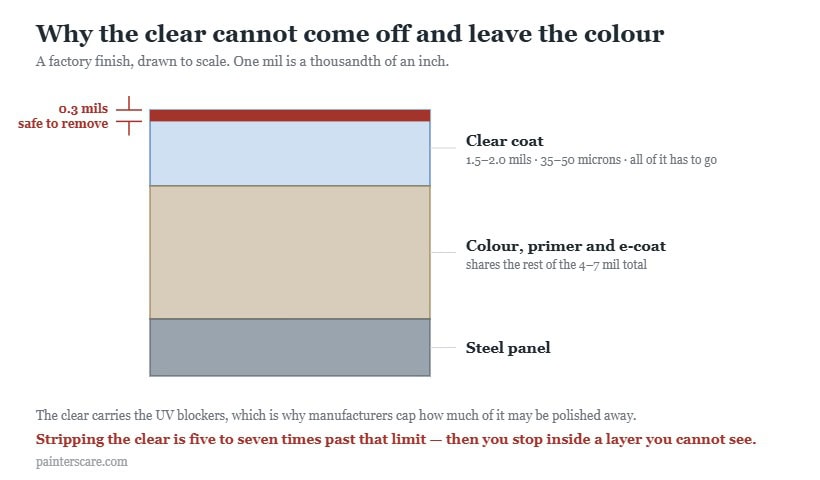
A factory paint finish is usually 4 to 7 mils thick in total — a mil being a thousandth of an inch, so 100 to 180 microns. PPG puts a modern OEM finish at roughly the thickness of a human hair. Of that, the clear coat is only 1.5 to 2.0 mils, around 35 to 50 microns. Everything else — the color, the primer and the factory e-coat that stops the steel rusting — shares what is left.
Now the number that matters. Because the clear carries the UV blockers that protect the color beneath it, most manufacturers say no more than 0.3 mils, about 8 microns, of clear should ever be removed.
Removing the clear coat entirely means taking off five to seven times that budget, and then stopping — by hand, with sandpaper — within a layer you cannot see, before you reach color that is thinner than the clear you just removed. On a curved panel, over an area the size of a hood, with the clear already failing unevenly.
It is not that people are doing it badly. The tolerance is smaller than the tool.
And even where someone does manage it, the result is base coat with no UV protection at all. It will fade, chalk and eventually powder off, because the layer that was protecting it is the layer they just removed. Bare base coat is a surface waiting to be cleared, not a finish.
Why chemical clear coat removers do not help
The obvious thought is to dissolve the clear rather than sand it. The problem is that no solvent knows which layer it is sitting on.
Modern automotive clear is 2K — two-pack — and cures by chemical crosslinking rather than by drying. Once cured it is not re-dissolved by the things people reach for. Anything strong enough to break it down is a paint stripper, and a paint stripper works its way down through every layer it meets until it reaches metal. That is what strippers are designed to do.
So the two outcomes with a chemical are: nothing happens, or it goes through to primer. There is no setting in between. Our guide to how paint removers actually work covers the chemistry, and the same principle applies here — strippers attack the binder, and every layer on your car has one.
The products sold as “clear coat remover spray” are, in the main, aggressive polishing compounds in a bottle. They abrade. They are subject to exactly the same 0.3 mil arithmetic as sandpaper.
First, is it peeling or just oxidized?
These two look similar at ten feet and need completely different work. Oxidized clear can be brought back with a machine polish for the cost of a pad. Peeling clear cannot be brought back at all. Getting this wrong is how people spend a weekend polishing a panel that needed refinishing.
| Look for | Oxidation | Clear coat failure |
|---|---|---|
| Appearance | Evenly dull, chalky, color looks faded | Cloudy patches with hard edges, often flaking |
| Edges | None — it fades gradually across the panel | A defined line you can feel with a fingernail |
| The tape test | Tape lifts nothing | Masking tape pressed down and pulled lifts flakes |
| The polish test | A small area cleans up and gloss returns | The patch stays cloudy, or the edge gets worse |
| Where it starts | Horizontal surfaces first, uniformly | Roof, hood and boot, in patches that spread |
| Fix | Machine polish, then protect | Refinish the panel |
The tape test is the quick one. Press a strip of masking tape firmly onto the affected area, leave it a few seconds and pull it off sharply. If it comes away with clear flakes stuck to it, the clear has let go of the color and no amount of polishing will change that.
Worth knowing why it spreads. Clear coat fails by losing adhesion at its edge, so every exposed edge is a new place for water and UV to get underneath. A patch the size of a hand this summer is a hood next summer. It does not stabilize. Isolated stone chips are a different problem with a much easier fix — our guide to automotive touch-up paint covers those.
What each option actually costs, and how long it lasts
Once you accept the panel needs refinishing, the decision is only about budget and how long you need it to hold.
| Option | Rough cost | Realistic life | Verdict |
|---|---|---|---|
| Wax or sealant over it | Under $20 | Weeks, cosmetically | Changes nothing. Wax cannot stick failed clear back down |
| Machine polish | $30 to $80 DIY | A year, if it is oxidation | The right answer for chalky paint, useless on peeling |
| Sand and 1K aerosol clear | $15 to $25 a can | 1 to 2 years | Yellows, and usually lifts again at the same edge |
| Sand and 2K aerosol clear | $25 to $35 a can | 3 to 5 years | The best DIY outcome. Contains isocyanates — see below |
| Body shop, one panel | Commonly $300 to $1,500 | 10 years plus | The proper fix. Blending into neighbouring panels is most of the cost |
| Full respray | $3,000 to $7,000 done properly | 10 years plus | Only worth it once most panels have failed |
| Vinyl wrap | Similar to a budget respray | 5 to 7 years | Hides it rather than fixes it, and lifts more clear when removed |
Treat the shop figures as a wide ballpark. Quotes swing enormously on the panel, the color, and how far the painter has to blend into the panels either side — a three-stage pearl on a hood is a different job from a solid white door.
The uncomfortable arithmetic on an older car is that a single panel at a good shop can be worth a meaningful fraction of what the car is worth. That is a legitimate reason to choose the aerosol route and accept a three-year fix.
The DIY method that actually works
This is the wet sand and re-clear route. It is well within reach of a careful amateur on a flat panel, and the two things that decide the result are the grit you start with and how far you feather the edge.
- Wash and decontaminate. Car shampoo, then a clay bar or tar remover. Anything left on the panel ends up under the new clear.
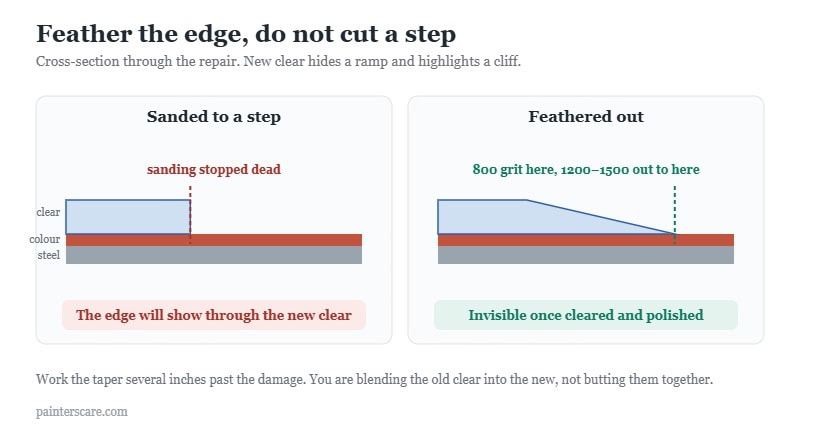
- Mask to a natural break line. A panel edge, a swage line, a piece of trim. Clear that stops in the middle of a flat surface shows, whatever you do.
- Wet sand the failed clear with 800 grit. Keep the surface flooded and the paper moving. 400 is too coarse and will be through the color before you notice. 2000 is a polishing grit — it will burnish the clear rather than remove it, which is why the advice to use it is so frustrating in practice.
- Feather the edge with 1200 then 1500. Work several inches out past the damage. You are making a ramp, not a step.
- Check your depth as you go. Wipe the panel and look at the paper. Color on the paper means you have reached base coat, and that area needs recoloring before any clear goes on — our guide to automotive spray paint covers matching it.
- Degrease with a panel wipe and a clean lint-free cloth. Not household cleaner, which leaves residue.
- Apply 2K clear. Two or three coats, 10 to 15 minutes flash time between them, in warm, still conditions and out of direct sun.
- Leave it alone. A day before it is touch-safe, several days before polishing. Rushing the cure is the most common way a good repair is ruined at the last step.
- Level and polish with 2000 to 3000 grit wet if needed, then a cutting compound and a finishing polish.
A real safety point on 2K aerosols. The reason they outlast rattle-can lacquer is the isocyanate hardener in the second chamber, and isocyanates are a recognized cause of occupational asthma. Once sensitized, people react to tiny exposures for life. Spray outdoors or in a genuinely ventilated space, wear an organic-vapor respirator rather than a dust mask, and keep other people away while it is atomized.
What will not fix peeling clear coat
Every one of these gets recommended somewhere, and each of them wastes an afternoon.
| The suggestion | What actually happens |
|---|---|
| Dawn or other dish soap | Strips wax and oils. It does not touch cured clear coat. Repeated washing with it dulls a finish by removing protection, which is not the same as removing clear |
| Acetone | Attacks base coat at least as readily as clear. You get hazing and softening of both, and no controlled removal |
| Rubbing alcohol | A cleaner. It has no effect on cured 2K clear |
| WD-40 or a “wet look” spray | Makes dull paint look glossy until it rains. Nothing is repaired |
| Clear coat restorer pens and wipes | Built to fill and gloss a fine scratch. They cannot reattach a lifted sheet |
| Heavy cutting compound | Removes clear coat, so it is bound by the same 0.3 mil limit, and it cannot get under a lifted edge to stop it spreading |
| Sealants and “peel stop” | There is nothing for them to bond to on the underside of a flake |
| An angle grinder or power sander | Through the clear, the color and into the primer in seconds. Our guide to stripping discs covers where power tools do belong, and a car panel is not it |
Clear coat is the least forgiving thing on this list. For ordinary paint on ordinary surfaces, matching the removal method to the surface is the place to start.
Frequently asked questions
Does Dawn dish soap remove clear coat?
No. Dish soap is a degreaser — it strips wax, sealant and road film, which is why detailers use it before polishing. It has no effect on cured clear coat. Washing a car with it repeatedly will leave the finish looking dull because the protection has gone, but the clear itself is untouched.
Will acetone remove clear coat?
It will damage it, which is not the same as removing it usefully. Acetone softens and hazes automotive finishes, but it cannot tell clear coat from the base coat underneath, so it attacks both. You end up with a soft, cloudy, uneven patch that still needs sanding and refinishing. Use it to clean a panel before painting, not to strip one.
Does rubbing alcohol remove clear coat?
No. Isopropyl alcohol is a cleaner and a useful pre-paint wipe, and diluted it is safe on automotive clear. Cured 2K clear coat is crosslinked and alcohol does not break those bonds. If alcohol is lifting color on your car, the panel has been resprayed at some point with something that never fully cured.
What is the best clear coat remover?
Wet sandpaper, used at 800 grit. Products sold as clear coat removers are generally aggressive abrasive compounds rather than chemicals, so they do the same job less predictably. A genuine chemical stripper will remove the clear but will not stop there — it goes through the color and the primer too, which is only what you want if you are taking the panel to bare metal.
What grit sandpaper removes clear coat?
800 grit wet for the removal itself, then 1200 and 1500 to feather the edges. Anything coarser than 600 cuts through the clear and into the color faster than you can judge. Anything finer than 1500 is a polishing grit and will burnish the surface instead of removing material, which is why the common advice to use 1500 to 2000 leaves people sanding for an hour with nothing to show.
Can you fix peeling clear coat without repainting?
Not permanently. Nothing bonds to the underside of clear that has already let go, so every product that promises this is either filling and glossing the surface or simply making it look wet for a while. You can improve the appearance for a season. To stop it spreading you have to remove the failed clear and apply new clear over the area.
Can you clear coat over peeling clear coat?
No, and it is the most common wasted attempt. New clear bonds to the surface it is sprayed on, and that surface is a flake already separating from the paint. Within months the new clear lifts with the old. The failed material has to come off and the edges have to be feathered before anything is applied.
Why is my clear coat peeling?
Ultraviolet light, in almost every case. The clear contains UV absorbers that are consumed over years of sun exposure, and once they are spent the resin breaks down and loses grip on the color beneath. That is why it starts on roofs, hoods and boot lids — the horizontal panels that take the most sun. Poor preparation on a previous respray is the other common cause, and that version tends to peel in sheets with very clean edges.
How much does it cost to fix peeling clear coat?
Doing one panel yourself with 2K aerosol clear costs well under $100 in materials. A body shop refinishing a single panel is commonly quoted somewhere between $300 and $1,500, depending on the panel, the color and how much blending the neighbouring panels need. A full respray done properly runs into thousands. Quotes vary widely by region, so get more than one.
Can you remove clear coat and leave the paint?
Rarely, and it is not worth aiming for. Clear coat is 1.5 to 2.0 mils thick and manufacturers advise removing no more than 0.3 mils of it, so taking all of it off means working far past that and stopping inside a layer you cannot see. Even if you succeed, bare base coat has no UV protection and will chalk within months. Removing clear only makes sense as the first step of re-clearing.
Will a vinyl wrap cover peeling clear coat?
It will hide it, and it will make things worse underneath. Wrap needs sound paint to adhere to, it will telegraph the edges of every flake, and when it comes off it takes more of the loose clear with it. Installers generally will not warranty a wrap over failing paint. If the goal is to change how the car looks rather than to preserve it, it is a choice — just not a repair.
How long should clear coat last?
Ten to fifteen years on a factory finish is typical, and considerably longer on a garaged car in a mild climate. What shortens it is sun, heat and neglect — a car parked outside in a hot, bright region can start failing before ten years, while the same model kept under cover may never fail at all. Regular waxing genuinely helps, because it takes the UV hit instead of the clear.
What to remember
Do the tape test first, because oxidation and delamination look alike and only one of them polishes out. If it is peeling, stop looking for a product that reverses it — there isn’t one, and the clear is too thin to remove cleanly from paint you want to keep. Sand at 800, feather wide, finish to a natural break line, and use 2K clear with a proper respirator. Or pay a shop for the panel and get a decade out of it. What does not work is waiting: every exposed edge is where next year’s damage starts.

Clear coat peeling off around edges of my truck bed cover and other spots.rest of area seems ok.
I am doing it to a Red MR2 as we speak first 400 find dry is good then 800 then 1000 1500 2000 cheers I am on the right track
I put on about 10 layers of clear Lacquer,if I remove them will I still have the same shiny paint that I originally started with?