Last Updated on October 9, 2026
To remove paint from metal, match the method to the metal. A solvent gel stripper is safe on all of them, an abrasive disc is fastest on flat steel, and hot water lifts paint off small steel hardware. Caustic strippers and boiling baking soda strip paint well but chemically attack aluminum and galvanized steel.
Ask the internet how to get paint off metal and you get three answers: a chemical stripper, a sanding disc, or the folk favorite — boil it in water with a scoop of baking soda. All three work. None of them ask the one question that decides whether you still have a usable object at the end.
Which metal is it?
Because two of the most common metals in a house — aluminum and galvanized steel — are attacked by the very things that strip paint most effectively. Not scratched. Dissolved. And the damage often shows up after the paint is off and you think the job went well.
Five minutes of identification first, then the method. That order round is the whole article.
Which metal is it? Check that first
Start with a fridge magnet. It splits the world in two and takes a second.
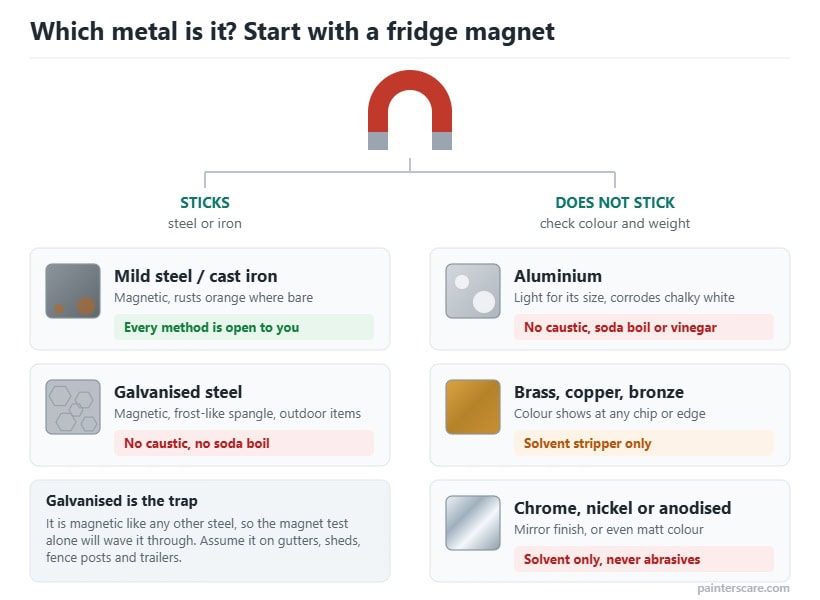
It sticks. You have steel or iron. This is the forgiving case — almost every method is open to you, and your real enemy is rust after the paint comes off rather than the stripping itself. The exception is galvanized steel, which is steel with a zinc coating, and which is magnetic like any other steel. Look for a faint crystalline pattern in the surface, like frost on a window, sometimes called spangle. Also assume galvanized on anything outdoors and unpainted-looking underneath: gutters, downpipes, tool sheds, bin stores, fence posts, trailer parts.
It does not stick. Now you need to look properly. Aluminum is noticeably light for its size, pale gray, and where it has corroded it goes chalky white rather than orange. Brass and copper give themselves away by color at any chip or edge. Stainless steel is heavy and usually only weakly magnetic or not at all. Chrome is a thin plating over something else, and the something else is what matters.
Two things worth ruling out before you commit. Scrape a hidden spot: if the “metal” is warm to the touch and flexes, it may be plastic with a metallic finish, which is common on modern door furniture. And check for a plated finish — chrome, nickel, anodizing — because on a plated part the plating is the surface you are trying to save, and it is thinner than the paint sitting on it.
| Metal | How to tell | Safe to use | Never |
|---|---|---|---|
| Mild steel / iron | Magnetic; rusts orange | Everything, including caustic | Leaving it bare overnight |
| Galvanized steel | Magnetic; frost-like spangle; outdoor items | Solvent stripper, gentle abrasion | Caustic, boiling soda, wire wheel |
| Aluminum | Light, pale gray, corrodes chalky white; non-magnetic | Solvent stripper, hand sanding | Caustic, oven cleaner, boiling soda, vinegar soak |
| Brass, copper, bronze | Color shows at chips and edges | Solvent stripper, hot soapy water | Caustic, coarse abrasives |
| Stainless steel | Heavy; weakly magnetic or not at all | Most things; solvent is easiest | Steel wool, which leaves embedded iron |
| Chrome or nickel plated | Mirror finish, often on a cheaper base | Solvent stripper only, no pressure | Any abrasive, any caustic |
| Anodized aluminum | Even matte color that is part of the surface | Very little; accept the paint or refinish | Caustic, which strips the anodizing too |
Why the alkaline methods eat aluminum and galvanized steel
Aluminum does not corrode the way steel does. It protects itself: the moment bare aluminum meets air it grows a thin oxide skin, and that skin is tougher than the metal under it. Everything about aluminum’s reputation for durability rests on that layer staying put.
It stays put across a narrow band of acidity. Hydro, one of the world’s largest aluminum producers, puts the figure plainly: aluminum oxide is normally stable in the pH range 4 to 9, and outside those limits “the risk of corrosion attack is much higher”. The same article notes the flip side, which is the part that should make you careful: acidic and alkaline solutions are used deliberately to etch aluminum during industrial pre-treatment. It is not an accident or an edge case. It is a standard process, and a paint-stripping afternoon can reproduce it by mistake.
Now put the usual paint-removal products on that scale.
A caustic stripper — the traditional sort, based on sodium hydroxide — runs around pH 13 to 14. Oven cleaner, which turns up in every “cheap hack” thread, is the same chemistry in an aerosol. Both are far outside the window, and on aluminum they do not merely discolor it: the surface pits, goes dull gray-black, and fizzes, because the reaction gives off hydrogen. That is worth knowing on its own if you were planning to do this in a closed garage.
The one that catches people out is the gentle-sounding option. Baking soda dissolved in cold water sits around pH 8.3, just inside the safe band. But boil it, and bicarbonate steadily converts to carbonate — washing soda — and the pH climbs to around 11. The method Google’s own answer box recommends as the natural, chemical-free choice is alkaline enough to etch aluminum by the time it reaches a rolling boil. Worse, the instruction that gets copied from site to site is to do it in a disposable aluminum tray.
And vinegar, the other household favorite, fails at the opposite end: household vinegar is about 5% acetic acid at roughly pH 2.5, which is below 4. Both of the popular “safe” methods sit outside aluminum’s comfort zone, one on each side.

Galvanized steel has the same problem for a different reason. The zinc coating is what stops the steel rusting, and zinc is attacked by alkali much as aluminum is. Strip a galvanized gutter with caustic and the paint will come off beautifully — along with the zinc. You are left with bare mild steel that now has no corrosion protection at all, on an item that lives outdoors. It will rust faster than it would have done if you had left the paint alone.
What kind of paint is on it?
Latex paint comes off with hot soapy water, aerosol lacquer dissolves in acetone, and cured enamel or powder coat needs a stripper or abrasion. Metal is non-porous, so paint grips it mechanically rather than soaking in, which is in your favor. What decides the method is how the paint cured.
| Paint | Where you meet it | What shifts it |
|---|---|---|
| Latex paint overspill | Radiators, pipes, window furniture | Hot soapy water and a plastic scraper |
| Aerosol lacquer | Rattle-can jobs, graffiti | Acetone or lacquer thinner; redissolves fully |
| Alkyd or oil gloss | Railings, gates, radiators, old hardware | Solvent stripper and dwell time |
| Enamel | Appliances, machinery, model parts | Stripper or mechanical; will not redissolve |
| Powder coat | Wheels, garden furniture, modern steel | Blasting or a purpose-made stripper; solvents barely touch it |
| Many layers, unknown age | Reclaimed hardware, period ironwork | Stripper, repeated; assume lead in anything pre-1992 |
That last row matters more than the others. Lead paint was only fully banned for household sale in the UK in 1992, and earlier layers turn up constantly on Victorian and Edwardian ironwork, old radiators and reclaimed door furniture. Do not sand it, do not use a heat gun on it, and do not do it dry. Chemical stripping keeps the lead in a sludge rather than in the air, which is the whole reason to prefer it on old work.
The methods, and what each is actually for
Solvent stripper — the default for anything you care about
Modern strippers are mostly benzyl alcohol or dibasic ester based rather than the old dichloromethane, which means they are slower and need covering to stop them drying out. Trade that patience for the fact that they are safe on aluminum, brass, plated finishes and galvanized steel.
- Work outdoors or with the door open, in nitrile gloves and eye protection. Vapor is the hazard people underestimate.
- Lay it on thick — 2 to 3 mm — with an old brush, in one direction. Spreading it thin is the single most common reason a stripper “does not work”.
- Cover it with plastic wrap or a cut-open carrier bag. This is the trick that turns a modern stripper from disappointing into effective; it stops the solvent evaporating before it has finished the job.
- Leave it. Twenty minutes for a single coat, several hours or overnight for layered old ironwork. Check rather than guess.
- Lift the softened paint with a plastic or wooden scraper. On metal, a steel scraper will gouge and leave marks that show through the new finish.
- Repeat for remaining layers rather than attacking the stubborn patches harder.
- Neutralize and rinse exactly as the can says, then dry it thoroughly and immediately.
If you are buying for a specific job rather than keeping a can on the shelf, our comparison of paint strippers across wood, metal and concrete covers which chemistry suits which surface.
The boiling water method — for small steel hardware only
Genuinely excellent for a bag of hinges, handles, escutcheons and screws. The paint releases in sheets and you get into every detail without touching it with a tool, which is why restorers like it.
Use a slow stove or an old steel pan, water hot but not necessarily boiling, and a squirt of dish soap. You do not need the baking soda at all — the heat and the water do the work, and leaving the soda out keeps the pH neutral and the method safe on far more metals. Give it an hour or two, lift pieces out with tongs, and the paint comes away with a brush. Dry them at once.
Do not use this on aluminum, on anything plated, on anything with a spring, or on pieces with timber or fiber parts you cannot remove. And never use an aluminum pan or foil tray.
Mechanical — fast on flat steel, punishing on everything else
An abrasive stripping disc on an angle grinder will clear a steel gate in a fraction of the time a stripper takes. On thin sheet it will also thin the metal and warp it with heat before you notice, and on aluminum or brass it loads up and gouges. Keep it moving, keep it light, and keep it off anything under about 1.5 mm thick. Our guide to choosing a paint stripping disc covers which type suits which metal and the mounting trap that catches most first-time buyers.
Hand sanding is the safe version: 80 grit on steel, 180 to 220 on aluminum, brass and other soft metals. Avoid steel wool on stainless — it leaves iron particles embedded in the surface that rust later and look like the stainless itself has failed.
Heat — useful, but metal fights you
A heat gun softens paint on metal, but metal conducts heat away as fast as you put it in, so progress is slower than on timber and the heat spreads to whatever the item is attached to. On thin sheet it will warp the panel. It is a reasonable choice on cast iron, which is thick enough to take it, and a poor one on car bodywork or a garage door. Heat guns earn their place on paint removal mostly on wood; on metal they are a second choice. Never use one on paint that might contain lead.
The bit everyone forgets: bare steel starts rusting immediately
Prime bare steel the same day you strip it. Flash rust can show within a few hours in a damp garage, and in under an hour after a water rinse.
You have stripped it, it looks superb, and you leave it on the bench until the weekend. By then there is a fine orange bloom across the whole thing and you have another job.
Flash rust starts the moment bare steel meets damp air. In a humid garage it can be visible in a few hours; after a water rinse it can appear in under one. Paint had been keeping air and moisture off that surface for years, and the second it comes off the clock starts.
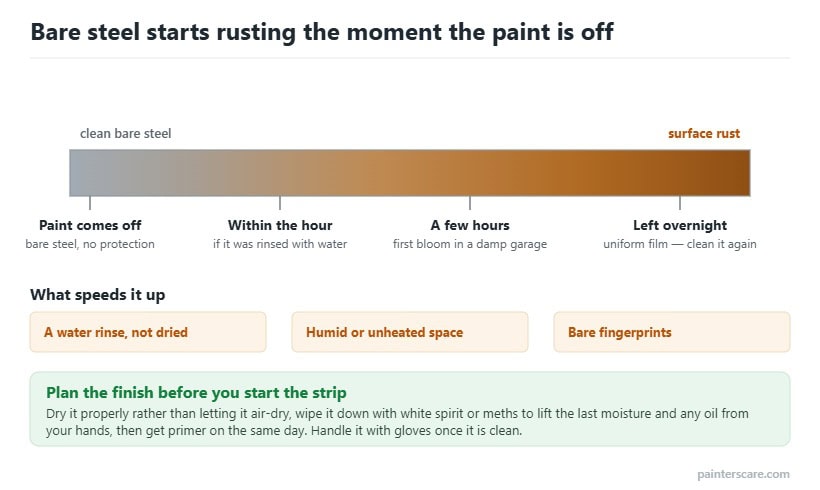
So plan the finish before you start the strip. Work on a dry day, dry the metal properly rather than letting it air-dry, wipe it down with mineral spirits or denatured alcohol to lift the last moisture and any oil from your hands, and get primer on the same day. Fingerprints are enough on their own — the salt in skin oil will print rust onto bare steel within a day. Handle it with gloves once it is clean. If you cannot prime immediately, a wipe of light oil will hold it for a few days, but it then has to come off again before you paint.
Will vinegar remove paint from metal?
Barely, and it is the wrong tool on two counts.
Household vinegar is about 5% acetic acid. Warmed and left on fresh latex paint it will soften it enough to wipe away, which is where the reputation comes from. Against a cured oil-based or enamel coating it does almost nothing, and no amount of soaking changes that — acetic acid does not break the bonds in a cured film.
What vinegar is good at is rust and mineral deposits, which is a different job people often confuse with this one. And on aluminum it sits below the safe pH window, so a long soak will dull and etch the surface while failing to remove the paint. If you want a household route, our look at which homemade paint removers actually work is honest about how little most of them do.
What not to do
- Oven cleaner on aluminum. It is caustic soda in a can. It will strip the paint and pit the metal underneath, and it comes up in every budget hack thread without the warning.
- Boiling soda in an aluminum pan or foil tray. Two problems at once: an alkaline solution and an aluminum container.
- Caustic anything on galvanized, brass or plated work. The coating goes before the paint does.
- A wire wheel on soft metal. Brass, copper and aluminum will take the brush marks permanently.
- An angle grinder on thin sheet. Warping and thinning happen faster than the paint comes off.
- Dry sanding old paint. Assume lead on anything pre-1992 and keep it wet or chemical.
- Skipping the neutralizing step. Stripper residue left in a seam will lift your new paint months later.
- Steel wool on stainless. The embedded iron rusts and gets blamed on the stainless.
One general point on solvents. mineral spirits, denatured alcohol and thinners all leave residue that interferes with adhesion if you paint over them without a final clean; using thinners properly matters more on metal than on wood, because there is nothing porous to absorb the difference. Glass has its own version of this problem — if the job involves glazed panels, getting paint off glass safely follows different rules again.
Metal is the fussiest surface for this, but it is not the only one with rules of its own. Matching the method to the surface covers wood, glass, skin and the rest.
Frequently asked questions
What is the quickest way to remove paint from metal?
On flat steel, an abrasive stripping disc on an angle grinder is by far the fastest — minutes rather than hours. On small hardware, an hour in hot soapy water beats everything for effort per piece because you are not working on each item individually. On aluminum, brass or plated parts there is no fast option that is also safe: use a solvent stripper and accept the dwell time. Speed and safety point in opposite directions here, and which one you can afford depends entirely on the metal.
What is the strongest paint remover for metal?
Caustic soda based strippers are the most aggressive thing widely sold, and they will take multiple layers of old oil paint off iron and steel in one application. They are also the ones that destroy aluminum, zinc and plating, so “strongest” is only the right question once you know the metal can take it. For mixed or unknown metal, a benzyl-alcohol gel stripper is the strongest thing that is still safe. For powder coating, neither works well and you want a purpose-made powder coat remover or blasting.
Does WD-40 remove paint from metal?
No. It is a light oil with a carrier solvent and it will not dissolve a cured paint film. It can soften very fresh spatter and it is useful for lifting adhesive residue and sticker glue off metal, which is probably why the idea circulates. It also leaves an oily film that must come off completely before you prime, or the new paint will not key.
Will acetone remove paint from metal?
On lacquer and aerosol paint, yes — acetone redissolves it and wipes off with a cloth. On cured enamel or oil-based gloss it softens the edges but will not shift the film. Acetone is safe on the metal itself, including aluminum, because it is a solvent rather than an acid or an alkali. Keep it off plastic trim, rubber seals and painted areas you want to keep, and ventilate, because it is highly flammable.
Can rubbing alcohol remove paint from metal?
Isopropyl alcohol shifts fresh latex paint and acrylic craft paint and is the gentlest thing to try first, since it is safe on essentially every metal and every plating. It does very little to cured enamel or oil-based paint. Use it at 70% or stronger, keep the surface wet for a few minutes rather than letting it flash off, and work it with a cloth rather than a scraper.
How do you remove paint from metal without damaging the metal?
Identify the metal first, then pick the mildest method that will work. A benzyl-alcohol gel stripper with a plastic scraper is safe on every common metal including aluminum, brass and plated finishes, and it is the default answer when the metal matters. Avoid anything caustic unless you have confirmed plain steel or iron, avoid abrasives on soft and plated metals, and prime bare steel the same day so you do not trade paint damage for rust damage.
How do you remove paint from a metal door?
Most modern external doors are thin steel skins over an insulated core, which rules out heat guns and angle grinders — both will warp the skin, and heat can damage the core. Use a gel stripper, work in sections, cover it with film so it does not dry out, and scrape with plastic. Take the furniture off rather than working around it. If the door is galvanized or aluminum, which is common on newer builds, do not reach for anything caustic.
Does vinegar or baking soda damage metal?
Both can, on the wrong metal. Aluminum’s protective oxide layer is only stable between about pH 4 and pH 9. Vinegar is around pH 2.5, below that band. Baking soda in cold water is around 8.3 and fine, but boiling it converts bicarbonate to carbonate and pushes the pH to roughly 11, above the band. Zinc coatings on galvanized steel react to alkali much as aluminum does. On plain steel, iron or stainless, neither will do meaningful harm in the timescales involved.
