Last Updated on November 24, 2026
The Wagner FLEXiO 890 is a stationary HVLP sprayer: the turbine sits in a power box on the floor and feeds air through an 11.5 ft hose to a light handheld gun. It comes with two nozzles, sprays up to 8.4 gallons an hour, and is being replaced in stores by the FLEXiO 5000.

This Wagner FLEXiO 890 guide covers the settings for each paint and stain, setup, spraying technique, cleaning and fixes, and how it compares with the 5000.
Pros and cons
Pros
- The turbine sits on the floor, so only the light gun and cup are in your hand
- Two nozzles: iSpray for walls and siding, Detail Finish for cabinets and trim
- Sprays most latex, primers and stains without thinning
- The hose, handle and both nozzles store inside the power box
Cons
- Being replaced by the FLEXiO 5000, which costs less new
- Air power has 3 dial settings rather than a variable control
- The 1.5-quart cup still needs refilling on walls and fences
- Commercial or rental use cuts the warranty to 30 days
FLEXiO 890 specifications
| Spec | FLEXiO 890 |
|---|---|
| Design | Stationary turbine in a floor power box |
| Turbine | X-Boost, 3 PSI, 3 air power settings |
| Output | Up to 8.4 gallons an hour |
| Air hose | 11.5 ft |
| Nozzles | iSpray (1.5-quart cup) and Detail Finish |
| Coverage | 8 x 10 ft wall in under 5 minutes |
| Power | 120 V grounded outlet |
| Warranty | 1 year, or 30 days for commercial use |
Settings for each paint and stain
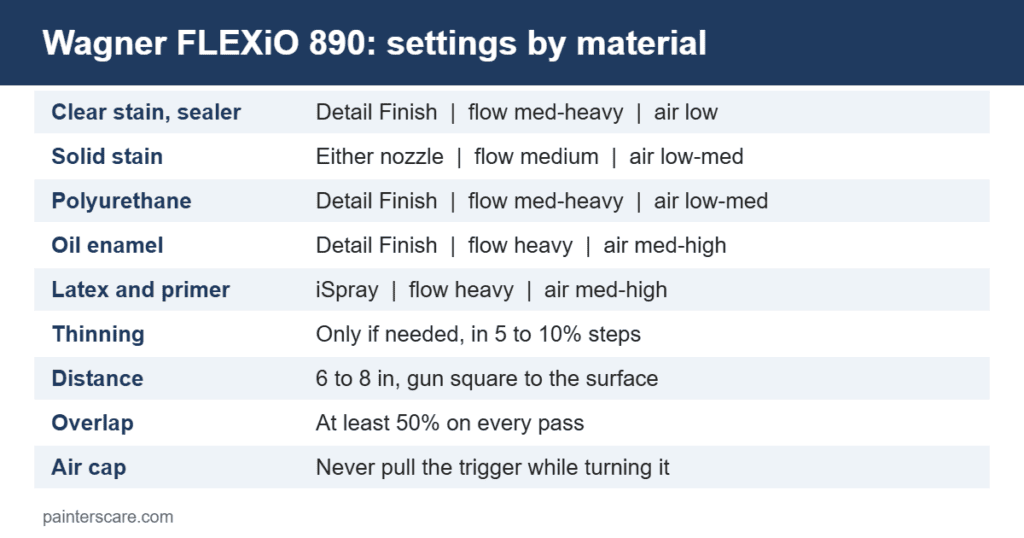
Material flow is the knob on the trigger and air power is the dial on the handle. Start from these settings, then test on cardboard and adjust.
| Material | Nozzle | Material flow | Air power |
|---|---|---|---|
| Transparent stain, sealer, water-based lacquer | Detail Finish | Medium to heavy | Low |
| Solid stain | Either | Medium | Low to medium |
| Polyurethane | Detail Finish | Medium to heavy | Low to medium |
| Oil enamel | Detail Finish | Heavy | Medium to high |
| Latex paint and primer | iSpray only | Heavy | Medium to high |
Thicker coatings need more air, and thin ones need less to keep overspray down. If the pattern is still poor after adjusting, thin in 5 to 10% steps, and use only thinners with a flash point above 100°F. For mixing ratios, see the guide to thinning latex paint.
Setting it up
- Push the air hose firmly into the port on the power box.
- Line up the arrow on the nozzle with the unlock symbol on the handle, push it in and twist toward lock until the tab under the trigger clicks.
- Point the angled end of the suction tube to the front for spraying down, or to the back for spraying up, then fill and screw on the cup.
- Check the air filter, plug the power box into a grounded 120 V outlet and switch on both the box and the handle.
Spraying technique
Hold the gun square to the surface, 6 to 8 in away. Start moving before you pull the trigger and release it before you stop, so paint only comes out while the gun is moving. Overlap each pass by at least 50%, and never pull the trigger while turning the air cap.
Cleaning after each job
- Switch off the box and handle, unplug, loosen the cup half a turn to release pressure, and pull the trigger so paint drains back into the cup.
- Empty the cup, then fill it halfway with warm water for latex, or a quarter full with mineral spirits for oil.
- Refit the cup, switch on and spray the solution into a waste container while gently shaking the gun.
- After mineral spirits, repeat with warm soapy water. Then take the nozzle apart and brush every part clean.
Inspect the air filter before every use and replace it when dirty, with the smooth side facing the turbine. Never run the sprayer without it. Store the unit indoors with the cord packed inside the power box.
Fixing common problems
| Problem | Fix |
|---|---|
| Little or no paint comes out | Clean the nozzle and suction tube, turn up material flow, tighten the cup, clear the air vent on the suction tube, change the filter, or thin the paint |
| Paint leaking | Tighten or replace the nozzle, replace a worn nozzle seal, or clean build-up off the air cap |
| Runs and sags | Turn material flow down, turn air power up, move faster, or thin the paint |
| Pulsing spray | Refill the cup, change the filter, or reconnect the air valve tube |
| Too much overspray | Move closer to 6 to 8 in, or turn air power down |
| Light, splotchy pattern | Slow your passes, increase the flow setting, or lower the air dial |
What owners report
Buyers rate it 4.1 out of 5 across 38 ratings at one large retailer, and 85% would recommend it. Owners praise how quiet the base unit is and how light the gun feels for overhead work. A furniture-flipping shop sprayed more than 250 pieces with one and got a finish it could not match by brush, and another owner has used it on more than 10 kitchens.
A couple who owned both found its spray a little finer than the handheld 590’s, but the base station and short hose bulkier to work around. The problems they describe:
- Drooling and spitting when the black keeper ring at the front works loose while the pattern is changed. Keep that ring as tight as it goes by hand.
- Latex clogs the nozzle if you stop for a break with paint in the gun. Wipe the tip, or flush it, before any pause.
- Thick oil-based enamel goes on in chunks with an orange-peel texture. Thin it or use a different sprayer for oil enamel.
- Cleanup takes longer than the advertised five minutes; one owner timed it at about 15.
- A few owners had the motor burn out partway through a job.
FLEXiO 890 vs 5000
| FLEXiO 890 | FLEXiO 5000 | |
|---|---|---|
| Design | Stationary power box | Stationary power box |
| Air power | 3 settings | Variable |
| Air hose | 11.5 ft | 11.5 ft |
| Nozzles | iSpray and Detail Finish | iSpray and Detail Finish |
| Extras | Storage in the box | Storage in the box, 5 cup liners |
| Price, Nov 2026 | About $332 new | About $229 |
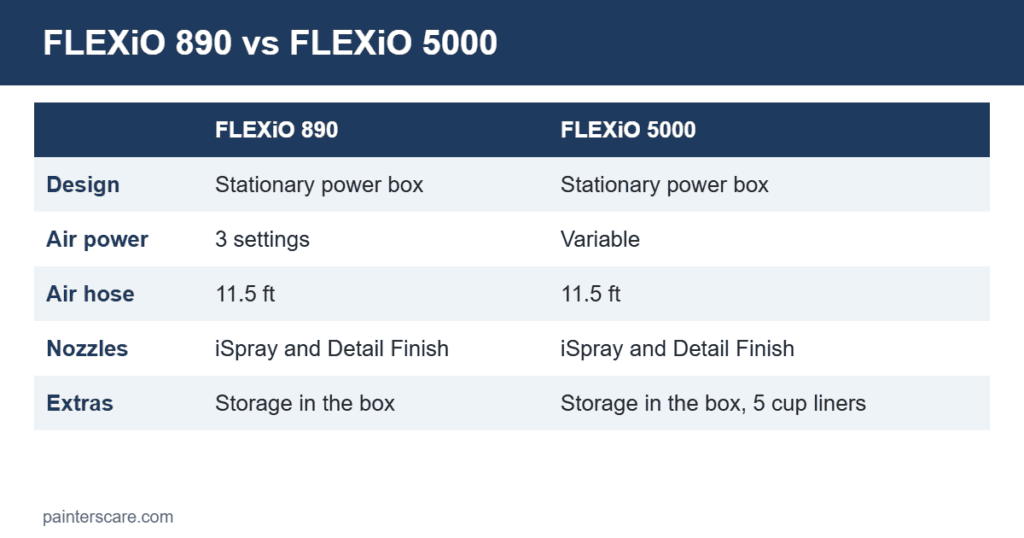
The 5000 keeps the same layout and nozzle pair, adds variable air power and cup liners, and costs about $100 less, so it is the better buy unless you find an 890 at a discount. New 890s were listed at about $332 in November 2026, and the FLEXiO 5000 is the current model on the product page.
For a handheld sprayer with the same two nozzles, see the FLEXiO 590 guide and the FLEXiO 990 guide. The HVLP sprayer guide compares more options, and indoor spraying calls for a respirator.
Frequently asked questions
Do I need to thin paint for Wagner Flexio?
Not usually. The 890 sprays most latex, primer and stain straight from the can through the iSpray nozzle. Thin only if the pattern stays poor after adjusting air and flow, in 5 to 10% steps, and never past what the paint label allows.
Can a Wagner stain sprayer be used for paint?
The 890 handles both. Use the iSpray nozzle with heavy flow and medium-high air for latex, and the Detail Finish nozzle with medium to heavy flow and low air for transparent stains and sealers.
