Last Updated on November 24, 2026
The Semi-PRO 2 is a 2-stage HVLP turbine sprayer for furniture, cabinets, doors and trim, at its best with thin finishes such as lacquer, shellac and stain. Its turbine runs at 5 PSI, which atomizes clear coats easily but means latex paint has to be thinned or sprayed through a bigger air cap.
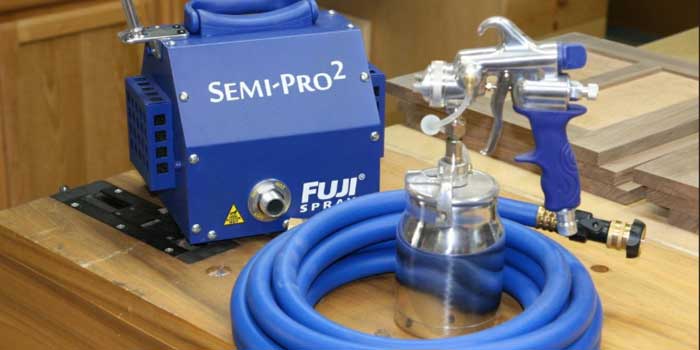
It comes in two versions: the 2202 with a 1-quart bottom-feed cup for about $562, and the 2203G with a 400cc gravity cup for about $563, both in November 2026.
Pros and cons
Pros
- Two turbine air filters slide out without tools and rinse clean
- One gun body takes either a 1-quart bottom cup or a 400cc gravity cup
- Air caps from 0.8 to 2.0 mm fit the same gun
- 2-year parts and labor warranty
Cons
- 5 PSI is low for unthinned latex and thick coatings
- The standard 1.3 mm air cap suits clear finishes, so paint needs another cap set
- The 400cc gravity cup holds a little under half a quart
- The hose stops at 25 ft
Semi-PRO 2 specifications
| Spec | Semi-PRO 2 |
|---|---|
| Turbine | 2-stage, 1,400-watt motor |
| Air pressure | 5 PSI |
| Current | 11.5 amps at 110–120 V |
| Hose | 25 ft |
| Gun | M-Model |
| Cup | 1 quart bottom feed (2202) or 400cc aluminum gravity (2203G) |
| Standard air cap | 1.3 mm |
| Optional air caps | 0.8 to 2.0 mm |
| Turbine weight | 12.35 lb |
| Turbine size | 11 x 8.6 x 8.1 in |
| Warranty | 2 years |
What the Semi-PRO 2 does well
Clear finishes are where a 2-stage turbine is strongest. Lacquer and shellac atomize at 5 PSI, often with the in-line air valve turned down, and two sprayed coats build about the same film as 5 to 7 hand-applied coats.
The M-Model gun keeps both controls at the back of the body: the fan knob sets the pattern width, and turning the fluid knob counterclockwise lets more material through. Both cups fit the same gun body, so a gravity cup kit converts a 2202 for work inside cabinets.
The turbine has a carry handle and a magnetic gun holder rated for 10 lb. The two air filters come out without tools, and washing them in warm soapy water every so often keeps dust out of the finish and extends the motor’s life.
Setting it up for the first spray
- Screw the hose’s hex nut onto the turbine air outlet, check the voltage label on the base, and plug it in.
- On the 1-quart cup, seat the plastic diaphragm with its small air hole toward the back of the cup, not under the air hole in the lid.
- Spray a little clean thinner through the gun to flush out anything left from the factory.
- Thin the coating to the right viscosity, as covered in the next section.
- Turn the fluid knob clockwise until the trigger will not pull, then back it out until a small amount of fluid comes out when you squeeze.
- Hold the gun no more than 8 in from the surface, which gives a pattern about 6 to 8 in wide, and make test passes on scrap plywood or cardboard until the finish levels.
How to thin latex and other coatings
The included viscosity cup measures thickness in seconds: fill it to the brim and time how long it takes to empty through the hole. Latex usually needs 20 to 30% water, depending on the brand, to reach its range, and Floetrol can be added instead.
| Coating | Viscosity cup time |
|---|---|
| Lacquer | 18 to 20 seconds |
| Sanding sealer | 20 to 22 seconds |
| Enamel, oil-based paint, polyurethane | 20 to 25 seconds |
| Latex | 20 to 30 seconds |
| Primer | 30 to 40 seconds |
| Stain | Spray undiluted |
For latex, open the air control valve fully and swap the 1.3 mm cap for a No. 4 or No. 5 cap on trim and louvered doors, or a No. 6 (2.0 mm) for walls.
Where it falls short
Latex paint is the weak spot. At 5 PSI it needs thinned paint and a larger air cap such as the 1.8 mm set, which sold for about $63 in November 2026. If most projects are painted rather than clear-coated, a 3-stage turbine saves most of that thinning.
On the 2203G, a dresser or a run of doors means stopping partway to refill. The bottom-feed 2202 carries a full quart and suits larger pieces.
There is no decibel rating for the Semi-PRO 2, and unlike the Mini-Mite turbines it has no noise-reducing covers, so wear hearing protection for long sessions.
Looking after the turbine and gun
HVLP turbines are built for intermittent use, so switch the turbine off between coats and while refilling the cup, and never cover the case or run it with clogged filters, both of which overheat the motor. The air outlet gets hot, so let it cool for a few minutes before pulling the hose off.
After each job, empty the cup, then spray clean solvent through the gun into a rag or bucket until it runs clear and wipe the air cap and nozzle tip. Never leave paint in the cup overnight or soak the whole gun in solvent; only the metal parts can soak.
What owners report
Owners spray poly and lacquer on guitar builds, kitchen cabinets, furniture, antique fans, a wrought iron fence and the fabric covering of a light aircraft, and describe a finish that is easy to dial in, with no clogging. One woodworker who uses it for all his waterborne finishes gets smooth, even results, but had to thin the water-based paint he sprayed on basement trim, doors and windows, and would want a bigger unit for a whole basement.
What owners and finishers point out:
- It comes set up with one needle size, and one owner says it should include a second. For latex, the gun can take a 1.8 mm set.
- The instruction manual is thin. Plan on practice sprays on scrap to dial it in.
- A 2-stage turbine atomizes thin finishes such as waterborne lacquer, shellac and dyes best. Finishers moving to thick oil-based poly, alkyd varnish or a lot of paint recommend 4 or 5 stages.
- A short whip hose at the gun is more comfortable than the thick main hose and lets the air cool a little before it reaches the gun.
Semi-PRO 2 vs Mini-Mite 3 vs Hobby-PRO 2
| Semi-PRO 2 | Mini-Mite 3 | Hobby-PRO 2 | |
|---|---|---|---|
| Turbine stages | 2 | 3 | 2 |
| Air pressure | 5 PSI | 6.5 PSI | 5 PSI |
| Current | 11.5 amps | 12 amps | 11.5 amps |
| Standard air cap | 1.3 mm | 1.3 or 1.4 mm | 1.8 mm |
| Gun | M-Model | T70, T75G or G-XPC | M-Model |
| Turbine weight | 12.35 lb | 14.56 lb | 12.35 lb |
| Hose | 25 ft | 25 ft | 25 ft |

The Hobby-PRO 2 pairs the same turbine and gun with a 1.8 mm air cap, so it starts out set up for paint rather than clear finishes. The Mini-Mite 3 is the step up: its third stage raises output from 5 to 6.5 PSI, enough for paint and tinted lacquer, for about 2.2 lb more turbine weight. The Mini-Mite 3 T70 kit sold for about $849 in November 2026, roughly $287 more than the 2202.
The HVLP sprayer guide compares other turbine and gravity-feed systems, and the lacquer spray gun roundup covers guns sized for clear coats. Lacquer and shellac give off solvent vapor, so wear a respirator with organic vapor cartridges, and flush the gun after each job as covered in how to clean a paint sprayer.
Frequently asked questions
Is the Mini Mite 3 better than the Semi-PRO 2?
For paint and thick coatings, yes, because its 3-stage turbine runs at 6.5 PSI. For lacquer, shellac and stain, the Semi-PRO 2 has enough pressure and carries a lighter turbine.
Which Fuji spray gun is best?
The one matched to the turbine and the finish. The M-Model comes with 2-stage turbines, while Mini-Mite turbines take the T70 bottom-feed, T75G gravity or G-XPC side-mounted gravity gun, and the G-XPC’s 1.4 mm air cap is a good all-round setup.
What is the best overall paint sprayer for home use?
For walls, ceilings and siding, an airless sprayer that pulls from a 5-gallon bucket covers the most ground. For furniture, cabinets and trim, an HVLP turbine lays down a finer finish with less overspray.
