Last Updated on October 6, 2026
Most interior latex and 100% acrylic wall paint is dry to the touch in 1 to 2 hours, ready for a second coat in 2 to 4 hours, and fully cured in 2 to 4 weeks. Oil-based paint is dry to the touch in 6 to 16 hours and ready to recoat in 16 to 24 hours, but it finishes curing in 5 to 15 days.
Those two sets of numbers run in opposite directions. The oil-based paint takes up to eight times longer to dry, and it finishes curing two weeks sooner. Anyone asking how long does paint take to dry usually gets both figures quoted without that inversion being named, and it is the cure column — not the dry column — that decides when you can wash the wall and push the sofa back.
Paint drying times at a glance
| Paint type | Dry to touch | Ready to recoat | Full cure |
|---|---|---|---|
| Interior latex / 100% acrylic | 1–2 hours | 2–4 hours | 2–4 weeks |
| Oil-based (alkyd) | 6–16 hours | 16–24 hours | 5–15 days |
| Aerosol spray paint | Up to 8 hours | Check the can | Up to 48 hours |
| Masonry / concrete paint | 24 hours | 24 hours | 48 hours – 7 days |
| Latex primer | 30 min – 1 hour | 1 hour | — |
| Oil-based primer | 1–3 hours | Check the can | — |
Aerosol timings vary by surface, which is covered in how long spray paint takes to dry, and primer has its own schedule in how long oil-based primer takes to dry.
Dry and cured are two different things, and the order is not what you would expect
Dry means the water or solvent has left and the surface no longer transfers to your finger. Cured means the film has reached its final hardness and can take cleaning and contact. Paint cannot cure until it has dried.
The two paint families get there by different routes, which is why the ranking flips:
- Latex and acrylic dry when the water evaporates. The acrylic particles left behind then have to knit together, and that continues slowly for weeks. Published figures cluster at 2 to 3 weeks, and some products are quoted at 4.
- Oil-based alkyds dry when the mineral spirits evaporate, which is slow. The oil then reacts with oxygen and crosslinks, and once that reaction is running it completes in days. Quoted ranges run from about five days to fifteen.
- Aerosol is the most extreme case. Figures run up to 8 hours to dry and up to 48 hours to cure — the slowest dry on the chart and the fastest cure.
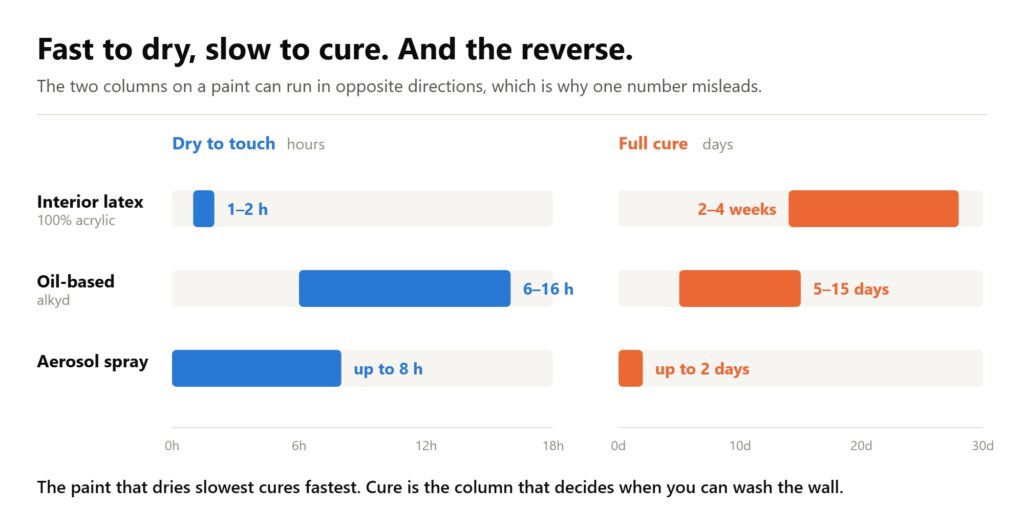
So the paint that keeps you waiting longest between coats is the one you can put back into service soonest. If you are repainting a kitchen door or a handrail that needs to be handled, that trade matters more than the dry figure does.
Where the numbers on the can actually come from
The dry times printed on a paint can are not estimates. They are the result of a standard test, ASTM D1640, “Standard Test Methods for Drying, Curing, or Film Formation of Organic Coatings.” In California, the South Coast Air Quality Management District writes it into Rule 1113 and requires dry-to-touch and dry-to-recoat times for architectural coatings to be determined by that method.
The laboratory method runs at 23 ± 2 °C (about 73°F) and 50 ± 5% relative humidity, with the panel lying flat, under diffused light and never direct sunlight, and all readings taken at least half an inch in from any edge of the film. Manufacturers publish their figures at 77°F and 50% relative humidity. A north-facing hallway in February is not that room, and neither is a bathroom in August.
The standard also breaks drying into seven separate stages, each with its own physical test:
- Set-to-touch — touch the film lightly with a clean fingertip and press the fingertip to clear glass. The film is set-to-touch when it is still tacky but nothing transfers.
- Dust-free — cotton fibers dropped from one inch above the film can be removed by blowing lightly across it.
- Tack-free — a 300 gram weight rests on a foil-and-tape pad for five seconds; the film is tack-free when the tester tips over the instant the weight comes off.
- Dry-to-touch — the film no longer sticks to your finger and does not rub up when you draw a finger lightly across it.
- Dry-hard — press down hard with the end of your thumb without twisting, then polish the spot with a soft cloth. The film is dry-hard when the thumb mark polishes out completely.
- Dry-through (dry-to-handle) — press with your thumb using the full weight of your arm and turn it through 90 degrees in the plane of the film. The film is dry-through when nothing loosens, detaches, wrinkles or distorts.
- Dry-to-recoat — a second coat can go on without lifting or loss of adhesion in the first.
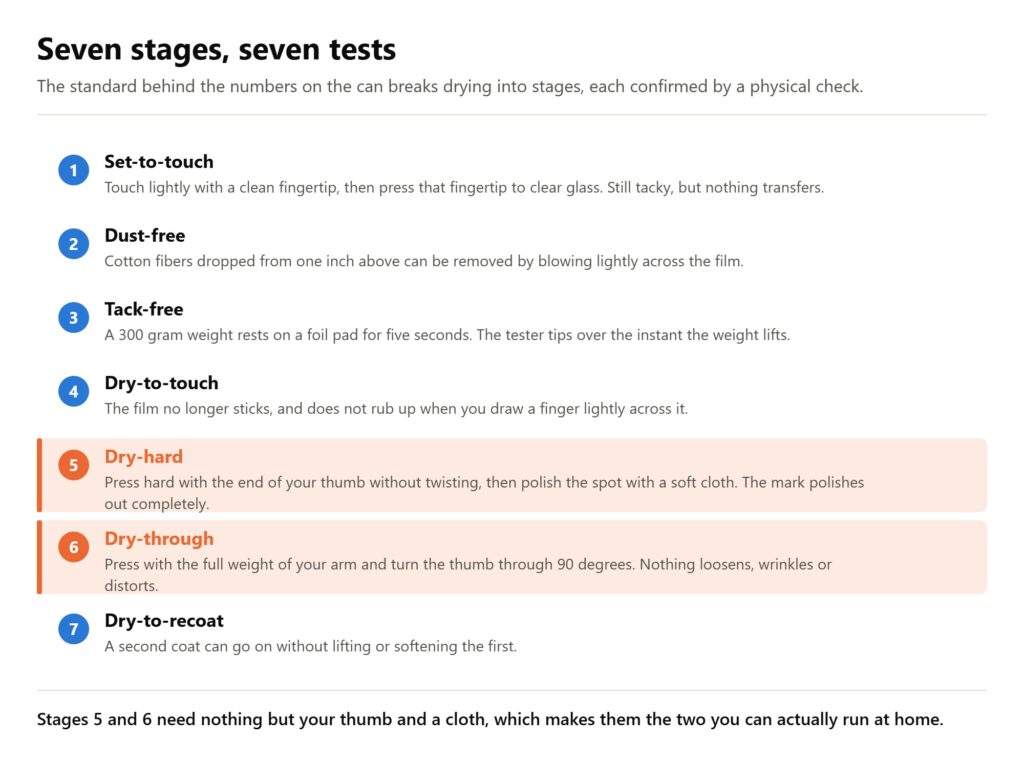
Two of those are worth borrowing. The dry-hard test and the dry-through test need nothing but your thumb and a cloth, and they tell you far more than touching the wall with a fingertip does. Run them somewhere that will not show — behind a door, low on a wall, inside a cabinet.
The standard records that these dry times carry no bias, because the values are defined only in terms of the test itself. The number on the can describes what happened on a flat panel in a controlled room — a reference point, not a promise about your wall.
Sheen and color change the answer more than the brand does
Comparing published figures within one brand’s own range removes brand as a variable. These are all products from one manufacturer, measured at 77°F and 50% relative humidity:
| Behr product | Sheen | To touch | To recoat | Full cure |
|---|---|---|---|---|
| Premium Plus Interior | Flat | 1 hour | 2 hours | 2 weeks |
| Premium Plus Interior Satin Enamel No. 7050 | Satin | 1 hour | 2 hours | 4 weeks |
| Premium Plus Ultra Interior Flat Enamel | Flat | 2 hours | 4 hours | — |
| Premium Plus Exterior Flat No. 4050 | Flat | 1 hour | 2 hours | 4 weeks |
| Marquee Exterior Flat No. 4450 | Flat | 1 hour | 2 hours (3 hours deep base) | 4 weeks |
Three things fall out of that table.
Sheen doubles the cure time. Same brand, same product line, same 100% acrylic resin: the flat cures in two weeks and the satin in four. If you are tracking a cure deadline, the sheen on the can matters more than the logo. Our guide to paint sheens and finishes covers which to use where.
The more expensive line is slower, not faster. Premium Plus Ultra is dry to the touch in two hours and ready to recoat in four. The cheaper Premium Plus does both in half the time. Paying more buys hide and durability; it does not buy a shorter wait.
Dark colors recoat later. One exterior line gives two hours to recoat in the standard base and three hours in the deep base — 50% longer, on the same can. The reason is in the tint load: Ultra Pure White accepts up to 2 fluid ounces of colorant per gallon, while Deep Base accepts up to 14. Seven times the colorant has to dry along with everything else. Another line says the same thing in words — darker colors may need extra time between coats.
How thickly you rolled it, in actual numbers
“Apply thin coats” is standard advice, and there is a figure for it.
A typical interior satin enamel is 39% solids by volume. Around 60% of what you roll onto the wall has to leave the film before it is dry. The same product gives two spread rates, and the difference between them is not small:
- A gallon spread over 400 sq ft lays down 4.0 mils wet, drying to 1.6 mils.
- A gallon spread over 250 sq ft lays down 6.4 mils wet, drying to 2.5 mils.
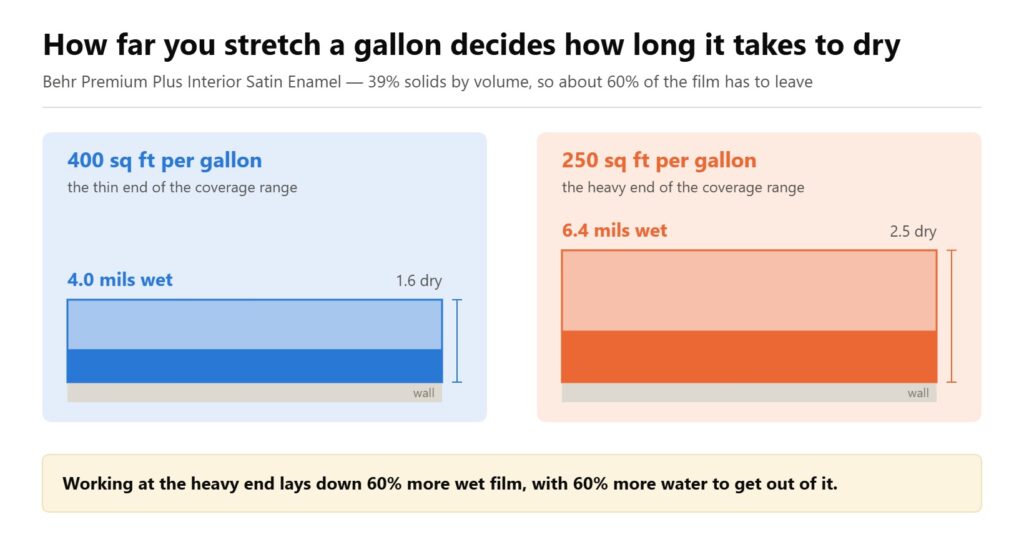
Work at the heavy end of the coverage range and you have put down 60% more wet film, with 60% more water to get out of it. That is the mechanism behind a coat that is still tacky four hours later. Two thin coats reach dry-to-recoat sooner than one heavy coat reaches dry-to-touch.
Temperature, humidity and airflow — including the parts usually stated wrong
Temperature: there are three of them, not one
The range quoted almost everywhere is 50°F to 85°F. The cans are more specific than that, and they do not agree with each other:
- Premium Plus Interior Satin: apply when air, material and surface temperatures are between 50°F and 90°F. Above 90°F the paint can dry too fast; below 50°F proper film formation is inhibited.
- Premium Plus Exterior Flat: apply when air temperature is between 35°F and 90°F, and it must stay in that range for at least four hours after you finish.
The exterior paint tolerates colder weather than the interior paint does, and it is rated 15 degrees below the figure usually quoted. A cold-weather exterior job is not automatically off the table — check the can rather than the rule of thumb.
The instruction on the can is to check both air and surface temperature, because they differ. For exterior work the surface must be above 35°F and at least 5°F above the dew point, with a maximum recommended surface temperature of 125°F. The dew point rule is the one that catches people out in fall: the air can be 50°F and perfectly pleasant while the siding is sitting two degrees above dew point and about to pick up condensation overnight.
Both sheets also say to avoid painting in direct sunlight, and to keep the surface below 125°F — a south wall in July clears that easily.
Humidity: opening a window is not automatically right
Manufacturers qualify the ventilation advice heavily. Open the windows, but check first that the air outside is not more humid than the air inside. On a genuinely humid day, leave them shut and skip outdoor painting too.
On a damp day the window makes it worse. What works instead is a dehumidifier, or an air conditioner — both window units and central HVAC act as dehumidifiers and help considerably on humid days.
Airflow: fans yes, heat no
Both manufacturers endorse fans with the same two conditions: keep the fan a few feet back from the painted surface, and angle it across the surface rather than pointing it straight at the wall. Clean the blades first, because a dusty fan will deposit grit into a wet film.
Heat is a different matter. Heaters, infrared heat lamps and heat guns are all advised against for drying paint, and there is a number behind it: a temperature change of 11°C (about 20°F) can alter the paint’s color. Both major brands give the same warning. Air movement is free and safe; forced heat risks a finish that does not match the can.
Drying outside, and the rain window
One exterior flat gives a specific rain figure with the conditions attached: allow the film at least 60 minutes of drying before expected rain, at 60°F or above and 50 to 70% relative humidity. Lower temperatures, higher humidity and darker colors all extend that window.
A 55°F afternoon at 80% humidity in a deep-base color meets none of those conditions, so the hour no longer applies.
The substrate has to be dry first, and the cans set measurable limits rather than leaving it to judgment. Using an electronic moisture meter, the maximum moisture content is 15% for wood and 12% for concrete and masonry. New work waits longer: new plaster and new masonry should cure for 30 days before painting. If you cannot wait, the alternative is to let masonry cure seven days and prime with an alkali-resistant primer, with the surface pH at 10 or lower.
When can you use the room again?
Dry to the touch and safe to sleep in are not the same question, and the honest answer sits in the emissions figures rather than the dry-time table.
A typical interior satin enamel is under 5 g/L VOC, which clears the “super-compliant” threshold of under 10 g/L. Even at that level, the wording is direct about what still comes off the wall:
- Most emissions occur during painting and for 48 hours after.
- Some continue for two weeks or longer.
- Sensitive groups, including babies and people with asthma or allergies, should minimize exposure.
The label instruction is to keep fresh air moving during application and during drying, not only while the brush is in your hand. It also says that if you notice eye watering, a headache or dizziness during application or drying, increase the fresh air or leave the area.
That gives a workable rule: treat the first 48 hours as the ventilation period, with windows open and air moving, and sleep elsewhere for the first night or two if you have the option. There is more detail in how long paint fumes last.
What cure time is actually protecting
Cure time translates into one concrete instruction. Interior and exterior paints alike call for four weeks before washing or cleaning the surface.
How long that window lasts depends on which can you bought. One brand’s flat reaches full cure in two weeks; the satin in the same line takes four. Until the film has hardened it marks easily, and two painted surfaces pressed together can stick to each other — which is why a freshly painted door can lift paint off its jamb when you open it, and why a bookcase pushed back against the wall too early leaves an outline. The practical version for the first few weeks:
- Leave a gap behind furniture rather than pushing it flush to the wall.
- Leave freshly painted doors and windows open rather than closed against their frames.
- Wipe marks off with water rather than scrubbing with a cleaner.
- Hold off on hanging anything heavy that bears against the surface.
Everyday use is fine long before four weeks — it is sustained pressure and contact that cause the problems, not walking past.
If you are planning a whole project around these windows, how long it takes to paint a room puts the drying waits into a realistic schedule, and caulk has its own timings that usually have to clear before paint goes on. The dry times also differ by paint chemistry, which is covered in enamel paint vs latex.
The figures in this article can be checked against the full specification for Premium Plus Interior Satin Enamel.
Frequently asked questions
Can I sleep in a room while paint is drying?
If another room is free, use it for the first night or two. The reason is the 48-hour window covered above rather than the smell — a paint can be rated under 5 g/L and still be releasing while you sleep. If you have no choice, open a window and leave a fan running overnight, which is what the label asks for during drying in any case.
How long should you stay out of a room after painting?
Manufacturer guidance is written around ventilation rather than a fixed number of hours, because it depends on the product and on the airflow you can actually achieve. Most of the emissions land in the first 48 hours, so two days with the windows open and air moving covers the main period. If the room cannot be ventilated — an interior bathroom with no window, say — run a fan out to an open window elsewhere and stretch the period rather than relying on time alone. A smell hanging around after that is not the same thing as a high emission rate; odor and VOC level are separate measurements.
Can paint dry in 20 minutes?
Not wall paint. The fastest dry-to-touch figure on an interior sheet is one hour, measured at 77°F and 50% relative humidity. A latex primer is quicker — latex primer runs 30 minutes to an hour dry to the touch. Aerosol paint feels dry within minutes because its solvent flashes off fast, but the same chart gives aerosol up to 8 hours to dry properly.
How do you dry paint faster?
Four levers, in order of how much they move the result: thin coats, air movement, lower humidity, and a room temperature inside the range printed on the can. Thin coats do the most work — a gallon over 400 sq ft is 4.0 mils wet against 6.4 mils at 250 sq ft. Then a fan a few feet back at an indirect angle, and a dehumidifier or air conditioner if the air is damp.
Will paint dry in 2 hours?
Dry to the touch, usually. Ready for the next coat is the question that matters more, and that depends which can you bought — the comparison table above shows one product in a single brand’s range needing twice as long to recoat as another. Cooler air, higher humidity, a heavier coat or a deep-base color all push whichever figure applies to you further out.
How to dry paint in 5 minutes?
No method does it. Forcing the film with a heat gun or a lamp skins the top while the layer beneath is still wet, and it puts the color at risk — Heaters and infrared lamps are advised against and heat guns, putting the threshold for a color shift at an 11°C change. A skinned film also traps solvent underneath, so the paint ends up taking longer than if you had left it alone.
How long do 3 coats of paint take to dry?
Add the recoat interval twice, then the final coat’s dry time. On a two-hour recoat that is four hours of waiting before the last coat goes on; on a four-hour recoat it is eight, which turns a three-coat job into two days. Check which interval your can gives before planning the day around it, and allow extra if you are working in a deep-base color.
Do fans help paint dry faster?
Yes, and the mechanism explains why placement matters more than power. Drying paint releases water vapor into the air sitting right against the wall, and in a closed room that saturated layer is what holds everything up. A fan’s job is to carry it away, not to blast the surface — which is why both manufacturers call for distance and an indirect angle instead of maximum airflow.
How to dry paint in 10 minutes?
The quickest realistic figure for interior latex is about an hour to dry-to-touch, and that assumes a thin coat at around 77°F, humidity near 50%, and a fan moving air across the surface. At ten minutes you have a film that has skinned over on top with wet paint underneath, which is how lifting on the second coat and roller marks happen.

Thank you for this informtive content.