Last Updated on October 6, 2026
Painter’s tape is masking tape. Both are crepe paper with a pressure-sensitive adhesive on one side. Walk into any hardware store and the blue roll costs three or four times what the beige roll costs, and nothing on the shelf explains why.
The painters tape vs masking tape answer comes down to one spec: it is printed on every roll of painter’s tape and on no roll of masking tape.
The short answer
Masking tape uses a rubber-based adhesive. Painter’s tape uses an acrylic one. Rubber grabs harder the moment it touches the wall and then degrades — in heat, in sunlight, and simply with time — until it splits on removal and leaves half of itself behind. Acrylic grips more slowly, keeps its strength, and comes away as one film.
That difference is expensive to manufacture, which is why the blue roll costs more. And because it is a measurable property, every painter’s tape carries a tested clean-removal rating — the number of days the maker guarantees it will come off without taking your wall with it. Masking tape carries no such number, because it was never engineered to meet one.
Those ratings range from 1 day to 60 days depending on which tape you buy.
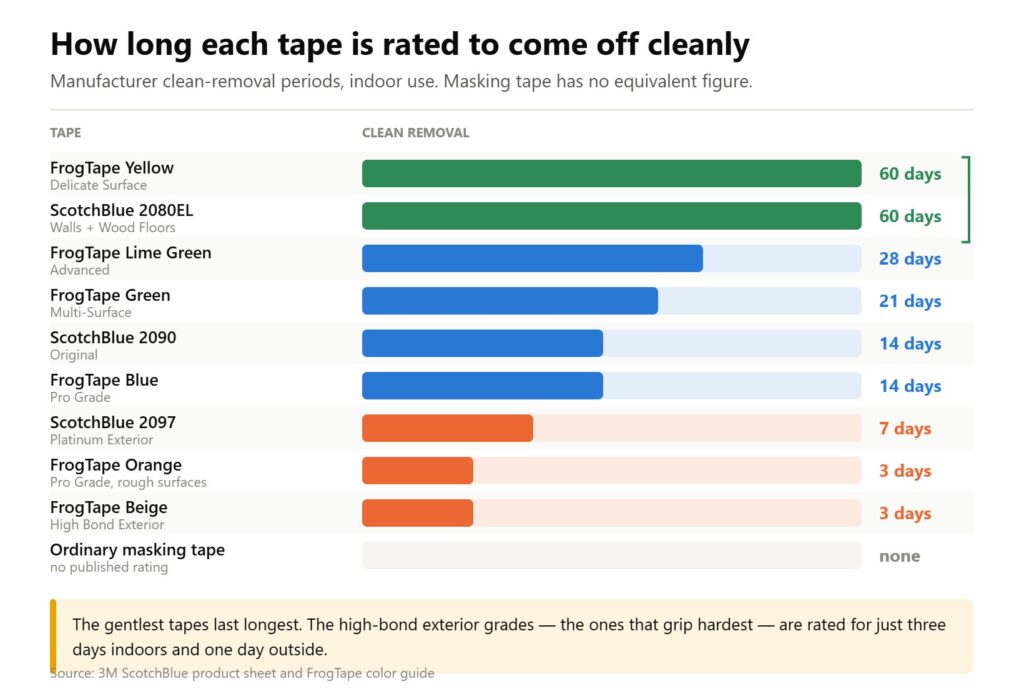
The spec nobody reads
Here is 3M’s own ScotchBlue range, taken from their product sheet rather than the packaging blurb:
| ScotchBlue tape | Clean removal | Made for |
|---|---|---|
| Walls + Wood Floors (2080EL) | 60 days | Walls, cabinets, floors, delicate surfaces, freshly painted work |
| Original (2090) | 14 days | Wood, glass, painted walls. UV resistant |
| Platinum Interior (2098) | 14 days | Zero-VOC paints, baseboards, trim, metal, glass |
| Trim + Baseboards (2093EL) | 14 days | Baseboards, trim, metal, glass |
| Platinum Exterior (2097) | 7 days | Sun, wind, humidity, rain |
And FrogTape, whose color coding is a rating system most people read as decoration:
| FrogTape | Indoors | Outdoors | Made for |
|---|---|---|---|
| Yellow — Delicate Surface | 60 days | — | Fresh paint, wallpaper, laminate, veneer |
| Lime green — Advanced | 28 days | 7 days | Curves and intricate surfaces |
| Green — Multi-Surface | 21 days | 7 days | Trim, baseboards, general work |
| Blue — Pro Grade | 14 days | — | Residential and commercial |
| Orange — Pro Grade | 3 days | 1 day | Rough surfaces, production painting |
| Beige — High Bond Exterior | 3 days | 1 day | Exterior, self-cleaning paint |
The counterintuitive part: tougher tape comes off dirtier
The tapes built for the hardest conditions have the shortest clean-removal windows. FrogTape’s High Bond Exterior and Pro Grade Orange — the two toughest, grippiest tapes in the range — are rated at three days indoors and one day outside. ScotchBlue’s Platinum Exterior, the one sold for sun and rain, gets 7 days, half what the ordinary indoor Original gets.
Meanwhile the delicate-surface tapes — the gentle yellow and light-blue rolls people buy nervously for wallpaper — are rated at 60 days on both brands. They are the longest-lasting tapes either company makes.
It makes sense once you stop thinking of adhesion and removal as the same axis. A high-bond tape has to hold onto rough stucco in wind. It does that by gripping hard, and gripping hard is exactly what makes it difficult to release later. A delicate tape only has to hold onto smooth interior drywall, so it can afford an adhesive tuned entirely for letting go.
The practical consequence: if you buy the strongest tape on the shelf because you want it to stay put over a long job, you have bought the one most likely to leave a mess. Buy for the surface, not for the grip.
Why the two tapes behave differently
Rubber adhesive: grabs instantly, ages badly
Standard masking tape uses a rubber-based pressure-sensitive adhesive. Rubber has a higher initial tack than acrylic — it sticks the instant it touches, with no pressure and no waiting, which is exactly what you want when you are taping a box shut or bundling cable.
What rubber does badly is last. It has poor resistance to chemicals, to UV and to temperature swings. Left on a wall it hardens; left in sunlight it hardens faster. When you finally pull it, the adhesive layer is no longer strong enough to hold itself together, so it tears. Some comes away on the tape and some stays on your wall. That gummy stripe is not the tape being cheap — it is rubber adhesive doing exactly what rubber adhesive does after a few warm days.
Acrylic adhesive: grips slowly, lets go cleanly
Painter’s tape uses acrylic. Acrylic builds its bond gradually rather than instantly — roughly 50% of full strength after 20 minutes, 80% after 24 hours and 100% after 72 hours. That is why painter’s tape feels less grabby when you first lay it, and why pressing the edge down properly matters so much more than it does with masking tape.
In exchange, acrylic has far greater resistance to chemicals, UV, moisture and temperature change. It does not go brittle over two weeks on a wall, so when you pull it the adhesive releases as a single film instead of splitting.
On the better tapes there is a second mechanism. FrogTape’s PaintBlock is described by its maker as a “super-absorbent polymer that reacts with the water in latex paint to form a micro-barrier” — it gels the instant water-based paint touches the edge, sealing the exact gap that paint bleeds through. That is a genuine mechanism, and it only works with water-based paint.

What sunlight does to your window
Look at FrogTape Multi-Surface again: 21 days indoors, 7 days outdoors. Same roll, same adhesive, one third of the window. Nothing changed except exposure.
3M is explicit about the mechanism. Their guidance states that if tape is left on longer than the recommended time, “or if a non-UV resistant masking tape is exposed to large amounts of sunlight, then the adhesive may transfer to the surface.”
Two things follow. First, a sunny interior wall is not a neutral environment either — a south-facing room in summer will shorten a rated window. Second, if a tape does not explicitly say UV resistant, treat outdoor use as a one-day job. Ordinary beige masking tape left on exterior trim over a weekend in July is close to the worst case you can construct for a rubber adhesive.
When to pull the tape
Both tapes come off at the same moment: once the top coat is dry to the touch, about 1 hour after you put it on. The difference is what happens if you miss it — the rubber adhesive keeps building grip while the acrylic one does not, so masking tape punishes a late pull far harder than painter’s tape does.
The full timing, the surface-by-surface differences and the rescue for tape that has already been on too long are in our guide to when to remove painters tape.
Taping over fresh paint
Wait at least 24 hours before putting any tape on a freshly painted surface, and treat anything painted in the last 30 days as fresh. Inside that window neither the blue nor the green standard tape belongs on the wall — a delicate-surface tape at 14 oz/in does, which is why those carry a 60-day rating.
When masking tape is the right choice
None of this makes masking tape bad. It makes it a different product that happens to look similar. Reach for the beige roll when:
- Nothing is being painted. Bundling, labeling, holding a template, sealing a box, marking a floor for a day.
- You are masking something that is not a finished surface. Taping plastic sheeting or a drop cloth to a bare subfloor, covering hardware you are about to replace anyway, protecting a window you will scrape afterward.
- The tape comes off the same day. Inside a few hours, on a non-delicate surface, out of sunlight, rubber adhesive has not had time to do anything you will regret.
- You need instant grab on something rough. Rubber’s higher initial tack genuinely wins on dusty or textured surfaces where acrylic struggles to wet out.
Where it goes wrong is the middle case that feels harmless: masking off trim on a Friday, painting on Saturday, pulling the tape on Sunday. Three days is nothing — except for a rubber adhesive on a warm wall, where it is enough.
Which tape for which job
| Situation | Use | Why |
|---|---|---|
| Standard interior walls and trim | Blue painter’s tape, 14-day | The default. Covers almost every room repaint |
| Painted within the last 30 days | Delicate surface, 60-day | Standard tape will lift paint that has not finished curing |
| Wallpaper, laminate, veneer | Delicate surface, 60-day | Lowest tack in the range |
| Outside, any tape | UV-resistant exterior grade, and pull it fast | Sunlight can cut the window to a day |
| Rough stucco or brick | High-bond exterior | Only tape with the grip — but remove within 1 to 3 days |
| Curves and detail work | Narrow multi-surface or advanced grade | Thinner backing conforms without creasing |
| Not painting at all | Ordinary masking tape | Cheaper and grabs faster. No reason to pay more |
If you want specific product picks rather than categories, our painter’s tape roundup covers the rolls worth buying, including the textured-wall problem. For the technique side — where to start a run and how to handle inside corners — see how to use painter’s tape properly, and for the trickiest case of all, taping baseboards against carpet.
And one honest alternative: for long straight runs against carpet or a ceiling line, a paint edger or a paint shield is faster than taping and cannot bleed at all.
One more trick worth knowing for a truly invisible line: after taping, run a thin bead of paintable caulk along the tape edge and wipe it flush before you paint. The caulk seals the microscopic gap that paint bleeds through, and it comes away with the tape. Our guide to caulking neatly covers the bead technique.
The two rolls worth keeping in the cabinet are a standard 14-day blue for everyday work and a delicate 60-day for fresh paint and wallpaper — ScotchBlue Original and FrogTape Multi-Surface are the two we reach for most.
Verdict: is painter’s tape worth the money?
For painting, yes — but not for the reason it is usually sold. The crisp-line argument is real and slightly overstated; a careful hand with masking tape and a scored edge will produce a decent line. The argument that actually holds is time. Painter’s tape is the only one of the two that tells you how long you have, and then honors it.
Put plainly: if the tape is off the same day, the beige roll is fine. If it will sit overnight, sit in sunlight, or sit on fresh paint, the three-dollar premium buys a guarantee the cheap roll does not offer at any price.
Whichever you buy, the two habits that matter most are free: seat the edge with a putty knife, and score before you pull.
Ratings and removal guidance in this article come from 3M’s ScotchBlue product sheet and FrogTape’s published color guide.
Frequently asked questions
Can I use masking tape instead of painter’s tape?
For a short job on an ordinary interior wall, usually yes. Masking tape will hold paint back perfectly well for a few hours. The risk is time and exposure: its rubber adhesive hardens with warmth and sunlight, and once it does it tears on removal and leaves residue. If the tape is coming off the same day, out of direct sun, and the surface is not freshly painted or delicate, you will probably get away with it.
Does painter’s tape peel off paint?
It can, in three situations: the paint underneath was applied within the last 30 days and has not finished curing, the tape was left on past its rated clean-removal period, or the tape was pulled after the new paint had fully dried over the edge. Remove when the paint is dry to the touch, about an hour, and score the edge with a razor blade first. On anything painted recently, use a delicate-surface tape rather than standard blue.
Why is painter’s tape so expensive?
Two reasons. The adhesive is acrylic rather than rubber, and acrylic costs considerably more to make. And the tape is manufactured to hit a tested clean-removal figure — 14 days, 60 days, whatever is printed on the roll — which means the backing is treated and the product is specified and verified. Masking tape has no number to hit, so it is made to a price instead.
Is blue painter’s tape better than masking tape?
For painting, yes. Blue painter’s tape is typically rated for 14 days of clean removal and is UV resistant, where beige masking tape is rated for nothing and degrades in sunlight. For any job that is not painting, masking tape is cheaper, grabs faster and is the sensible choice.
Is green or blue painter’s tape better?
Color is a brand’s rating system, not an industry standard, so compare the printed numbers rather than the shade. Within FrogTape, green Multi-Surface is rated 21 days indoors against 14 for their blue Pro Grade, and green carries PaintBlock for sharper lines with water-based paint. Across brands the colors mean different things entirely — always read the days figure on the roll.
Do you pull off painter’s tape when it’s wet or dry?
Dry to the touch, which is typically about an hour after painting. Pulling while wet smears paint along the line. Leaving it until the paint has fully cured lets the film bond across the tape edge, so removal tears it. Score the edge with a razor blade first and pull slowly back on itself at around 45 degrees.
How long can you leave masking tape on?
There is no published figure, because masking tape is not rated for clean removal. Treat same-day as the safe limit indoors and a few hours in direct sunlight. Painter’s tapes, by contrast, carry a specific rating that runs from 1 day for high-bond exterior grades outdoors to 60 days for delicate-surface tapes indoors.
Can you paint directly on masking tape?
You can, and that is how masking works, but the crepe backing on ordinary masking tape absorbs water-based paint and swells. A swollen edge lifts slightly and lets paint creep underneath, which is the wrinkled, bled line people blame on bad technique. Painter’s tape uses a treated backing that resists this, and the better grades add a polymer at the edge that gels on contact with latex paint.
