Last Updated on October 7, 2026
Search for the best deck paint and the first thing you are told is to buy a thick resurfacer that fills cracks up to a quarter inch. A few lines later, the same answer warns that film-forming coatings peel and that a solid stain soaks in and lasts better. Both halves are true. Nothing connects them, and you are left holding two pieces of advice that point in opposite directions.
The short answer: divide 1,604 by the coverage figure on the can and you get the wet film in mils. A coating rated 75 square feet per gallon leaves 11 mils of dry film on your deck. A solid stain rated 300 leaves about 2. That one division is what decides whether a deck wears or peels.
Below are 7 products grouped by how much film they leave behind, with the published numbers for each. One of them is not a deck coating at all and is included because it keeps turning up on these lists.
Coverage on the can is film thickness
A gallon spread over 1,604 square feet lands one mil thick. That is arithmetic, not a rule of thumb, so every coverage figure converts straight to a film thickness. At 400 square feet per gallon you are laying 4 mils wet, at 200 you are laying 8, and at 75 you are laying 21.
Wet film shrinks to dry film as the water leaves, in proportion to the solids. A deck resurfacer running 51 percent solids by volume keeps about half its wet thickness; a floor enamel at 37 percent keeps a bit over a third. Run the three classes through it and the spread is not subtle:
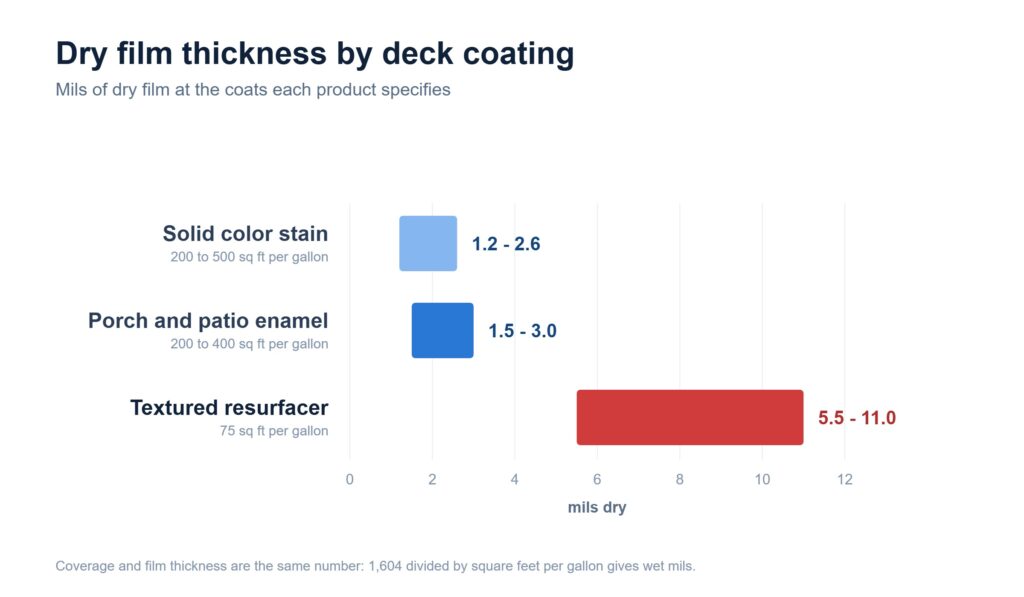
| Coating class | Coverage | Dry film | Airless spray |
|---|---|---|---|
| Solid color stain | 200 to 500 sq ft/gal | 1.2 to 2.6 mils | Yes |
| Porch and patio floor enamel | 200 to 400 sq ft/gal | 1.5 to 3.0 mils | .015 to .019 inch tip |
| Textured deck resurfacer | 75 sq ft/gal | 11 mils over 2 coats | Not permitted |
All three are 100 percent acrylic. The resin is the same. The only difference is how much of it stays on the wood, and the resurfacer stays four to nine times thicker than either alternative.
Why 11 mils fails on a deck and 2 mils does not
Decking moves. A board takes on water in spring, gives it up in August, and swells and shrinks across its width every year it stays outside. A 2 mil film is thin enough to move with it. An 11 mil film is a sheet of plastic sitting on top of wood that will not hold still, and the joint that gives first is the one between the film and the board.
The labels say as much without saying it. The enamel at 1.5 to 3.0 mils carries a label claim that it resists scuffing, fading, cracking and peeling. The 11 mil resurfacer makes no peel claim at all, and its published film thickness is where that 11 comes from. Solid stains go further and cap you at two coats, in print, so you cannot build the film thicker even if you want to. The resurfacer requires two coats to reach its rated thickness.
The thick coatings also give up the two things that make the job easy. The textured resurfacer cannot go through an airless sprayer and cannot be thinned, which leaves a brush and a quarter to half inch nap roller, applied with pressure, as the only method. The floor enamel sprays through a .015 to .019 inch tip behind a 60 mesh filter, which is the same orifice range that latex wall paint needs, and takes up to half a pint of water per gallon if it is dragging.
Buyer ratings already show it
Look at what the market says about these three classes rather than what the lists say. KILZ Over Armor textured sits at 3.9 out of 5 across 325 ratings and Rust-Oleum RockSolid at 3.2 across 214, while the thin BEHR porch and patio enamel sits at 4.3 across 3,200. Ten times the sample, and the highest score goes to the thinnest film.
That is the pattern you would predict from the film numbers, and it is the opposite of the ranking order you get served.
One name, two products, 5 times the paint
There is a trap on the shelf worth knowing before you order. Two coatings share a product name: one is textured at 75 square feet per gallon, the other is smooth at 400. Same brand, same crack-filling claim, 5.3 times the difference in material. The smooth one sprays; the textured one does not. If a review names the product without saying which, it has not told you what you are buying.
7 Best Deck Paint Picks, Grouped by Film Thickness
Two picks to start. For a sound deck that only needs color and protection, number 1, because a penetrating stain has no film to lose. For an opaque finish you want to last, number 6, because the thin enamels are the class that rates highest and peels least.
1. Defy Extreme Semi-Transparent Wood Stain

Defy Extreme is a penetrating stain rather than a coating, which puts it at the thin end of everything on this page. There is no film to delaminate, so the failure mode is fading rather than peeling, and the fix is a wash and a recoat instead of a strip. It will not hide splinters or bridge a crack. On pressure treated boards that are still sound, that is the trade most people should take.
2. KILZ Over Armor Smooth Wood Coating

This is the smooth version, rated at two thin coats and 400 square feet per gallon, which works out around 4 mils wet per coat. It still claims to conceal cracks up to a quarter inch, and it will go through an airless sprayer. If you want a solid opaque color with a film you can live with, this is the one of the two Over Armor products to order, and it is worth checking the label reads smooth rather than textured.
3. KILZ Epoxy Acrylic Garage Floor Paint

This is a concrete floor coating and it keeps appearing on deck lists anyway. It is built for a slab that does not move and for tire traffic, neither of which describes a wood deck. The textured deck resurfacer from the same brand carries an explicit instruction not to use it on drivable surfaces, and the logic runs the other way too. Buy it for a garage floor, not for decking.
4. Montage Signature Exterior Paint

A low odor recycled-content acrylic, which is the reason to pick it. Treat it as a floor enamel rather than a resurfacer: thin film, two coats, and prep that actually removes mill glaze. Check the stated spread rate on the can you receive and run the 1,604 division on it before you decide how many gallons to buy, because that number is what tells you the film you are getting.
5. TotalBoat TotalTread Non-Skid Deck Paint

TotalTread is a one-part polyurethane rather than an acrylic, with wax spheres instead of silica for the non-skid, which is why it is comfortable under bare feet when most grit finishes are not. It is a marine product and it belongs on docks, boat decks, swim platforms and ramps. On a dry residential deck you are paying for wet grip you do not need.
6. KILZ Interior and Exterior Floor and Deck Paint
Thin-film floor enamel, which is the class that rates best and peels least. Expect something in the 200 to 400 square feet per gallon band, so 1.5 to 3 mils dry over two coats. It wants a primed or previously painted surface and it wants the mill glaze gone. Full cure on coatings in this class runs out to 4 weeks even though you can walk on them in 72 hours, so keep furniture off it longer than feels necessary.
7. Rust-Oleum Marine Topside Paint
Another marine enamel, gloss and hard, designed for topsides above the waterline. It has no non-skid in it, so a horizontal deck finished in gloss marine enamel is slick when wet. People use it on decks for the durability and the color range, and it does hold up, but plan on an additive for grip or keep it to railings, trim and vertical faces.
Prep is the part that decides it
Every one of these products puts mandatory prep ahead of the coating, and the thick ones ask for the most. Mill glaze has to come off, either by sanding or with a wood cleaner and brightener, because a coating cannot key into a burnished surface. Rotting boards get replaced and loose splinters get pulled first, not bridged.
Two numbers from the prep instructions are easy to get wrong. When you rinse with a pressure washer, hold the nozzle at least 24 inches off the boards on the widest pattern, because closer than that you are tearing fibers open and creating the fuzz you then have to sand. And allow a full 24 hours of drying after rinsing before any coating goes down.
| Condition | Limit | Why it matters |
|---|---|---|
| Air, material and surface temp | 50 to 90°F | Below 50 the film will not form properly; above 90 it dries before it levels |
| Surface hot to the touch | Too hot, wait | Stated outright on the BEHR enamel label |
| Humidity | Below 80 percent | Named as a limit on the KILZ resurfacer |
| Rain expected | Not within 24 hours | Named on the resurfacer |
| Direct sunlight | Avoid | On both labels |
Recoat windows are tighter than the cure times suggest. 4 to 6 hours between coats is typical, light foot traffic at 24 to 48 hours, 72 hours before normal use, and on the thin enamels a full cure out at 4 weeks. The deck is walkable long before the film is hard.
Frequently Asked Questions
What is the best paint for outdoor decking?
A thin-film product: a solid color stain at 1.2 to 2.6 mils dry, or a porch and patio floor enamel at 1.5 to 3.0 over 2 coats. Both move with boards that swell and shrink across their width every year. The thick resurfacers at 11 mils dry are built for a different problem, which is hiding damage, and they trade peel resistance to do it.
Can you just paint over old deck paint?
Only over a sound film. All loose and peeling material has to come off first, the surface has to be clean of dirt, grease, mold and mildew, and a glossy film needs sanding to give the new coat something to grip. Coating over a film that is already letting go just adds 2 or 3 more mils of weight to it.
Is it better to paint a deck with a brush or roller?
Both, in that order. A brush fills nail holes and cracks and cuts the edges, then a roller covers the field, and on the textured resurfacers brush-and-fill first is an instruction rather than a preference. Nap matters: a quarter to half inch for the thick coatings, three eighths to three quarters for the thin enamels depending on how rough the boards are.
Is there deck paint that lasts 10 years?
No coating on a horizontal wood surface carries a 10 year rating. Decks take sun, standing water and foot traffic on the same face, which is the hardest service a coating sees on a house. What extends the interval is a thin film that fades rather than peels, because fading is fixed with a wash and a recoat while peeling means stripping back to bare wood.
What is the best deck paint to use on an existing deck?
Match what is already there. A penetrating stain recoats with stain. A sound thin film recoats with the same class of enamel after cleaning and a scuff sand, 2 coats with 4 to 6 hours between them. If the existing film is failing in patches, stripping and going back with a stain is usually less work over the following 5 years than resurfacing over the top of it.
Which decking paint is best?
Judge it by the film it leaves, not the name on the can. Under 3 mils dry and the coating flexes with boards that move. Around 11 mils and it hides splinters and cracks but loads the bond holding it on. Decide which of those two problems you actually have, then buy the class that solves it.
Final word
A deck coating fails at the bond line between film and wood, and thickness is what loads that bond. The number is printed on every can as a coverage rate, and it is the one figure on the label that predicts how the job ends: 300 square feet per gallon means about 2 mils and a deck that fades, 75 means 11 mils and a deck that flakes. Read it before you read the price. If you are spraying, the sprayers sized for deck stain and the exterior sprayers are separate shortlists, and thinning limits matter because two of the products here forbid it.
