Last Updated on October 6, 2026
Painting the walls of an average bedroom takes 4 to 6 hours of hands-on work for two coats, spread over 6 to 9 hours once you add the wait between coats. Painting the whole room — walls, ceiling, baseboards, window frames and doors — takes closer to 16 hours, which is two full working days for one person.
That gap is why anyone asking how long does it take to paint a room gets a different answer from every source. The widely quoted “5 to 8 hours” is a walls-only figure. The standard trade estimate for a 15 by 12 foot bedroom covering walls, ceiling, baseboards, two window frames, two doors and light prep, and puts it at 16 hours. At the production rate from the same source, the walls in that room account for about five of those hours. Walls are roughly a third of the job.
How long by room size
These are walls only, two coats, previously painted and smooth, at a worked production rate of 85 square feet per hour for two coats. Ceilings are 8 feet.
| Room | Wall area | Walls, 2 coats | Plus recoat wait | Whole room |
|---|---|---|---|---|
| 10 x 10 ft | 320 sq ft | 3.8 hours | ~6 hours | ~12 hours |
| 12 x 12 ft | 384 sq ft | 4.5 hours | ~6.5 hours | ~14 hours |
| 12 x 15 ft | 432 sq ft | 5.1 hours | ~7 hours | 16 hours |
| 14 x 16 ft | 480 sq ft | 5.6 hours | ~8 hours | ~18 hours |
One person, one room, walls only, and you can start and finish inside a day. Add the ceiling and the trim and you are into a second day, whatever your rolling speed. Budget a little at the end for the tools too, though cleaning the roller takes about fifteen minutes and the frame is the part always worth saving. A bathroom is the exception to the arithmetic: it is small, but the fixtures slow it down, and the wall behind the toilet needs its own approach.
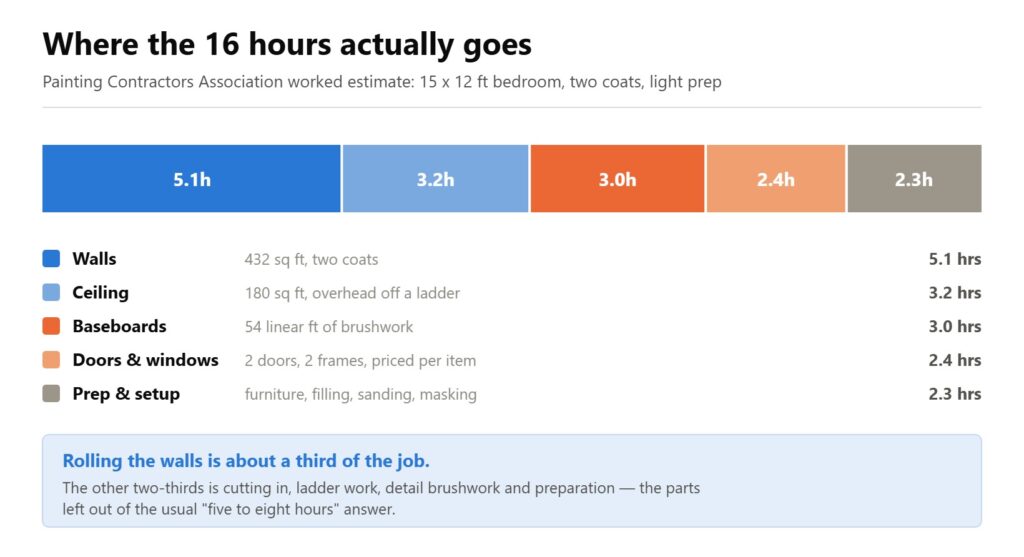
Why the usual estimate is roughly half the real number
Ask how long a room takes and almost every answer describes rolling four walls. That is the fastest part of the job and the smallest part of the time.
Break the 16-hour bedroom into what is actually being painted and the shape of the job changes:
- Walls — 432 square feet, two coats, about 5 hours.
- Ceiling — 180 square feet, and slower than walls because you are working overhead off a ladder.
- Baseboards — 54 linear feet of slow, detailed brushwork.
- Two window frames and two doors — priced per item rather than per square foot, because the time has nothing to do with their area.
- Prep and setup — moving furniture, filling, sanding, masking, laying drop cloths.
Only the first line is rolling. The rest is cutting in, detail brushwork, ladder work and preparation, and it is where two-thirds of the clock goes. A room with five windows and two doors takes meaningfully longer than a room of the same floor area with one window, even though the wall square footage is almost identical.
The wait between coats does not shrink, no matter how many people you have
Rolling is the only element a second person genuinely halves. The drying interval is fixed by the paint, not by how many of you there are.
Recoat runs 2 hours for Premium Plus, 4 hours for Premium Plus Ultra, and 3 hours for a deep-base color in their Marquee exterior line, all measured at 77°F and 50% relative humidity. Take a 12 by 12 room, walls only, two coats, on a 2-hour recoat:
- One person: 4.5 hours of work plus a 2-hour wait — about 6.5 hours start to finish.
- Two people: 2.3 hours of work plus the same 2-hour wait — about 4.3 hours.

Doubling the labor cuts the day by about 35%, not 50%. Buy the slower-drying paint and it is worse: on a 4-hour recoat, the same two-person job runs to 6.3 hours and the second pair of hands has bought you almost nothing. The can on the shelf sets your schedule more firmly than your crew size does. Our guide to how long paint takes to dry and cure sets out the figures by paint type.
Measuring the room: the rule that makes your area bigger than you think
Wall area is the perimeter of the room multiplied by the ceiling height. A 12 by 12 room with 8-foot ceilings is (12 + 12) x 2 = 48 feet of perimeter, times 8, so 384 square feet.
The instinct is then to subtract the windows and doors. The trade rule of measurement says not to. Their standard is to treat a small opening in a continuous surface as part of the surface, and only deduct an opening larger than 100 square feet.
The reasoning is about time rather than paint. Cutting a clean line around a window takes as long as, or longer than, rolling the wall you would have painted there. Deduct the opening and your estimate goes down while the actual work goes up. For a normal room, nothing gets deducted at all — a patio door is around 40 square feet, well under the threshold.
How much paint, and what that does to the timing
Coverage is quoted at 250 to 400 square feet per gallon, the spread depending on application method and how porous the surface is. Two coats on that 12 by 12 room is 768 square feet of coverage:
- Smooth, previously painted walls at 400 sq ft per gallon — about 2 gallons.
- Porous, textured or bare patched walls at 250 sq ft per gallon — about 3 gallons.
At 400 square feet per gallon that is 4.0 mils of wet film; at 250 square feet per gallon it is 6.4 mils. The porous wall is holding 60% more wet paint, which takes longer to dry, which pushes the recoat wait out past the figure on the can. Textured walls compound it from the other direction: published production rates for textured surfaces run at less than half the rate of smooth ones.
Roller or sprayer?
Published production rates put brushing and rolling at roughly 200 to 350 square feet an hour on smooth walls, against up to around 1,000 for spraying an open surface. That three-to-one gap is the smaller half of the decision. Masking a furnished bedroom to spray standard takes longer than rolling the walls would have, so for a single occupied room a roller usually finishes first.
The sprayer wins when masking is cheap relative to the area: an empty room, a whole house before you move in, ceilings across several rooms at once, or anything with a lot of trim and spindles where brushwork would be slow. Estimators price doors and window frames per item rather than per square foot, and that is the clue — the cost sits in the detail work rather than the area, which is exactly what a sprayer removes. There is more on the trade-off in rollers vs paint sprayers, and the technique itself in how to use a paint sprayer.
Two things cut time for either method. Buying the right nap for your wall texture stops you rolling the same area twice — covered in choosing a paint roller. And cutting in freehand with a good brush is faster than taping, if you can hold a line; if you cannot, taping properly is quicker than correcting a wobbly edge afterwards.
What it costs, and whether $25 an hour is cheap
Two authoritative numbers settle this one.
The Bureau of Labor Statistics puts the median wage for painters in construction and maintenance at $23.75 an hour, or $49,400 a year, as of May 2025. The lowest 10% earn under $37,440 and the highest 10% over $78,810. Painters working for painting and wall covering contractors sit slightly below the overall median at $48,830.
The trade body works its pricing example from an average loaded labor cost of $27 an hour — wage plus payroll taxes, workers’ compensation and the rest — and, targeting labor at 40% of company expenses, arrives at a charge-out rate of $67.50 an hour.
So $25 an hour is not a cheap quote, it is a quote below cost. It is roughly what the painter earns before their employer has paid a single tax on it. A legitimate business charging that rate is either losing money, working off the books, or not carrying insurance. Expect a real quote in the region of the association’s $67.50 an hour, which puts their 16-hour bedroom at about $1,080 in labor, before paint.
Those are national figures and labor rates vary sharply by metro area, so treat them as the floor rather than the going rate where you live.
The order you work in, and why it costs a second day
What turns a whole-room repaint into a two-day job is not the painting. It is the handovers between surfaces.
The ceiling has to be dry before you can cut a clean wall line up to it. The walls have to be dry before you can cut the baseboards against them. Each of those handovers carries a full recoat interval of its own, and they sit end to end rather than overlapping. Three surfaces at a 2-hour interval is six hours of waiting built into the job before anyone has picked up a brush.

Work in the order ceiling, then walls, then trim. Each surface is cut against one that has already hardened, overspray and roller spatter land on things not yet painted, and the trim — the slowest, fussiest element — goes on last when nothing else can spoil it. Painting trim first, which feels productive because it is the part you can do while the furniture is still being moved, means cutting the walls down to a finished edge and doing the hardest brushwork twice.
When can you move back in?
Finishing the painting and finishing the job are different dates, and the second one is set by the paint rather than by you.
Interior paint puts the bulk of VOC emissions in the first 48 hours after painting, with some continuing for two weeks or longer even on a product rated under 5 g/L. The same sheets say to allow four weeks before washing or cleaning the paint, because the film has not reached full hardness before then.
In practice that means two days of ventilation, and a few weeks of leaving a gap behind furniture rather than pushing it flush to the wall. Both are covered in detail in how long paint takes to dry and cure and how long paint fumes last.
The estimating and production-rate guidance is at pcapainted.org.
Frequently asked questions
Can I paint a room in one day?
Walls only, in a cleared room, yes — about six and a half hours for a 12 by 12 including the wait between coats. Walls plus ceiling and trim is a two-day job, because each surface has to dry before you can cut the next one to it and those waits stack. Clearing the furniture the night before is what most often decides whether a one-day plan holds.
Is $25 an hour expensive for painting?
It is the opposite of expensive, and that is the problem. The median painter’s wage sits at $23.75 an hour for May 2025, and the trade pricing model assumes $27 an hour once payroll taxes and insurance are added, charging out at $67.50. A contractor quoting $25 an hour is below what it costs to employ the person doing the work.
How long should you stay out of a room after painting?
Treat the first 48 hours as the ventilation window, since that is where the bulk of emissions sits even for a low-VOC product. Keep windows open and air moving across that period rather than counting hours from when you put the brush down. Sleeping elsewhere for the first night or two is the easy version if you have the room.
How long should it take to paint a 12×12 room?
384 square feet of wall, so about 4.5 hours of work for two coats and roughly 6.5 hours elapsed once the recoat wait is in. Add the ceiling, baseboards, window and door and you are at around 14 hours, which is two days for one person. Two people bring the walls-only version down to about 4.3 hours, not half.
How much would a painter charge to paint a 12×12 room?
Working from the $67.50 hourly charge-out, a whole 12 by 12 room at around 14 hours comes to roughly $950 in labor, with paint on top. Walls only, at about 4.5 hours, is nearer $300. Those are national-average figures and labor rates vary a lot between metro areas, so use them to sanity-check a quote rather than to predict one.
What is the hardest color to paint over?
Deep reds and strong yellows, because the pigments are transparent and keep bleeding through a light topcoat. Expect a tinted primer plus two finish coats rather than two coats total, which adds a full coat and its recoat interval to the schedule. Dark colors also take longer going on: A deep base needs three hours to recoat against two for the standard base, because it carries up to 14 fluid ounces of colorant a gallon against two.
