Last Updated on October 6, 2026
The Wagner Control Pro 130 is an airless paint sprayer with a 1.5-gallon onboard tank, a 1600 PSI maximum pressure and a 0.24 GPM flow rate, sold for around $250. Wagner markets it on two claims: that it produces up to 55% less overspray than a conventional airless, and that it “can be used with a wide range of unthinned paints and stains.”
Both claims are true. Neither is the number that decides whether you will be happy with this sprayer. That number is buried in the specification table on page 12 of the owner’s manual, and almost no review mentions it.
The short answer
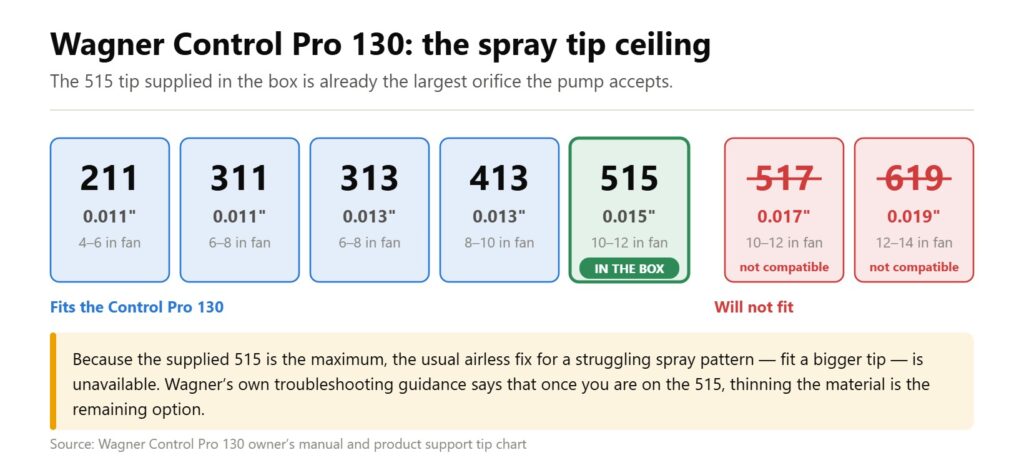
The Wagner Control Pro 130 has a maximum spray tip size of 0.015 inches, and the 515 tip that comes in the box is already that maximum. There is no larger tip you can fit. Wagner’s own support page states plainly that “the 517 and 619 for thicker materials are not compatible with the Control Pro 130.”
That single limitation explains nearly everything people complain about and nearly everything they praise. Spray thin material through it — solid stain, primer, standard-body latex on a big flat surface — and it performs like a machine costing twice as much. Spray anything heavy-bodied, or try to get a furniture-grade finish, and you will fight it, because the usual fix for a struggling airless is to fit a bigger tip, and on this model that option does not exist.
Wagner Control Pro 130 specifications
These figures come from the Control Pro 130 owner’s manual, not from the marketing page.
| Specification | Wagner Control Pro 130 |
|---|---|
| Maximum pressure | 1600 PSI (11.1 MPa) |
| Flow rate | 0.24 GPM (0.91 LPM) |
| Maximum tip size | 0.015 in |
| Tip supplied | 515 HEA (10–12 in pattern) — the maximum |
| Motor | 0.38 HP |
| Tank capacity | 1.5 gallons (5.7 L), onboard |
| Hose supplied | 25 ft (35 ft and 50 ft sold separately) |
| Power required | 15 amp minimum circuit, 115 VAC, 60 Hz |
| Generator required | 2500 W, idle-down feature disabled |
| Warranty | 2 years, accessories excluded |
| Street price | Around $250 ($259.99 list) |
Two of those numbers deserve a second look. At 0.38 horsepower the Control Pro 130 has the smallest motor in the entire Control Pro range, and at 0.24 GPM it has the lowest flow rate — yet at 1600 PSI it runs the highest pressure of the two cheapest models. It is a small pump working hard, which is a reasonable engineering trade for the price but does explain why owners who push it report more valve trouble than owners who don’t.
The 0.015-inch ceiling, and what it costs you
On an airless sprayer, tip size is the throttle. The last two digits of a tip number give the orifice in thousandths of an inch — a 515 tip has a 0.015 in orifice and throws a 10 to 12 inch fan; a 517 has 0.017 in; a 619 has 0.019 in. Thicker coatings need a bigger hole, and a bigger hole needs a pump with the flow to feed it.
The recommended tip range for the Control Pro 130 runs from the 211 (a 4 to 6 inch fan, for polyurethane, water-based lacquer and transparent stain) up to the 515. The chart stops there, with a one-line note: the 517 and 619 for thicker materials are not compatible with this sprayer.
So the tip in the box is the ceiling. Every other tip Wagner sells for this machine is a step down.
Do you have to thin paint for the Wagner Control Pro 130?
This is the most-asked question about the sprayer, and the honest answer is: usually no, sometimes yes, and Wagner tells you both things in two different places on its own website.
The product page says the 130 “can be used with a wide range of unthinned paints and stains.” The support page, in the troubleshooting section for a tailing spray pattern, says something rather different: if you are getting tails, you need a larger tip size, and “if you are already using the largest tip size compatible with the Control Pro 130 (515 tip), you can try to thin the material.”
Both statements are accurate. Read together they give you the actual rule, which is the thing no product listing states:
- Standard-bodied interior latex, exterior latex, primer and solid stain: spray them as they come. This is what the machine is built for and thinning is not required.
- Heavy-bodied, high-build or “paint and primer in one” products: expect tails at the edges of the fan. Because you cannot go up a tip, thinning is your only remaining lever.
- Semi-transparent and wood stains: Wagner rates these only “acceptable performance” with the 515 and recommends dropping to a smaller tip, such as the 311 or 413. Here the problem is too much material, not too little.
If you do need to thin, follow the thinning instructions printed on the coating rather than a rule of thumb from a forum — most latex products tolerate very little water before the film starts to suffer. Our guide to thinning latex paint correctly covers the ratios and the viscosity check.
What the Control Pro 130 cannot spray at all
The manual is specific, and this list is worth reading before you buy rather than after. It states that the pump “should not be used with textured materials, block filler, lacquers, industrial enamels, or asphalt sealer or materials containing HHC.” It also sets a flash point floor: do not spray or clean with liquids having a flash point below 100°F.
Note that “industrial enamels” appears on the prohibited list. Several AI-generated summaries of this sprayer currently claim it handles oil-based enamels without qualification. It handles ordinary oil-based paint; industrial enamel is explicitly excluded.
What “up to 55% less overspray” actually means
HEA stands for High Efficiency Airless, and the claim is that it “produces up to 55% less overspray than traditional airless sprayers.” The mechanism is real: the HEA tip geometry lets the pump atomize at a lower working pressure than a conventional airless, and lower pressure means less of the paint bounces off the surface and drifts.
Two qualifications matter. First, “up to” is doing work, and the comparison is against a traditional high-pressure airless, not against an HVLP unit or a roller — an HVLP sprayer will still put less material in the air than this will. Second, 55% less overspray is not zero overspray. You still mask, you still drop-cloth, and you still wear a respirator. If overspray is your main worry, the techniques in our guide to preventing overspray will save you more paint than the tip technology does.
How long does one tank actually last?
The 1.5-gallon onboard tank is the Control Pro 130’s headline feature and the thing that separates it from every other model in the range. It is also the feature most likely to surprise you, because Wagner’s own two published numbers tell you exactly how long it lasts and nobody does the arithmetic.
A 1.5-gallon tank emptying at 0.24 gallons per minute gives you about six and a quarter minutes of continuous trigger time per fill.
You will never pull the trigger for six minutes straight, so in practice a fill lasts far longer in wall-clock terms. But it sets the real coverage figure. Wagner also claims the 130 “covers an 8 ft x 10 ft wall in 2 minutes” — 80 square feet in two minutes, which at 0.24 GPM is 0.48 gallons, or roughly 167 square feet per gallon. That is a normal sprayed film build, about half what the same gallon covers under a roller, and it means:
- One full tank covers roughly 250 square feet of wall at spray film thickness.
- A 12 x 12 ft room with 8 ft ceilings has about 384 square feet of wall, so you will refill in the middle of a single room.
- A one-car garage or an average fence run will take three or four fills.

That is the real trade the Control Pro 130 asks you to make. You get a sprayer that stands on its own and needs no bucket, no siphon tube and no second pair of hands — and in exchange you stop, depressurize, pour and restart several times on any job bigger than a bedroom. Whether that is a fair deal depends entirely on your project, which is why the reviews look the way they do.
Why the star ratings disagree so badly
Very few tools produce a rating spread this wide across retailers:
| Retailer | Rating | Reviews |
|---|---|---|
| Wagner (manufacturer site) | 4.5 / 5 | 338 |
| The Home Depot | 3.9 / 5 | 1,083 |
| Lowe’s | 3.8 / 5 | 226 |
| Walmart | 3.5 / 5 | 913 |
A full star between the manufacturer-hosted reviews and Walmart’s is not a sampling accident. It is the 0.015-inch ceiling showing up in the data.
People who buy from Wagner’s own site have usually read the range comparison and the tip chart first; they arrive knowing what the machine is for and they use it for fences, decks, sheds and exterior siding. People who pick it off a big-box shelf because it is the cheapest airless with a tank tend to arrive with a different project in mind — kitchen cabinets, interior trim, a heavy-bodied one-coat paint — and they meet the tip ceiling on day one. Same machine, opposite experiences, and the ratings simply record which group is buying where.
The practical lesson is that the star rating is close to meaningless for this product. Match the machine to the job and it earns its five stars. Mismatch it and no amount of technique will rescue you.

Control Pro 130 vs 150 vs 170 vs 190
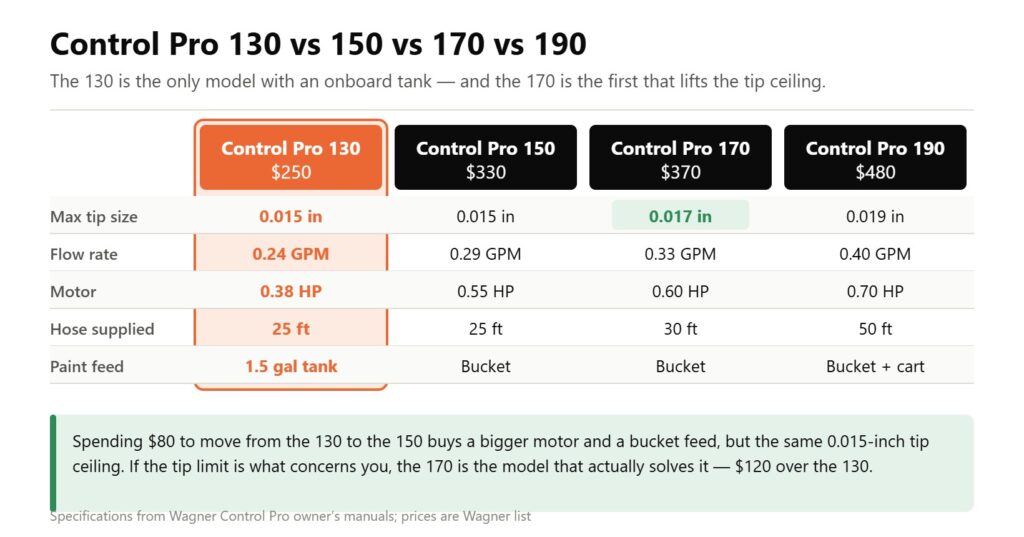
Wagner’s naming suggests a simple ladder, but the 130 is the odd one out: it is the only model in the range with an onboard tank instead of a suction tube that drops into your paint bucket.
| 130 | 150 | 170 | 190 | |
|---|---|---|---|---|
| Max pressure | 1600 PSI | 1500 PSI | 1500 PSI | 1600 PSI |
| Flow rate | 0.24 GPM | 0.29 GPM | 0.33 GPM | 0.40 GPM |
| Motor | 0.38 HP | 0.55 HP | 0.60 HP | 0.70 HP |
| Max tip size | 0.015 in | 0.015 in | 0.017 in | 0.019 in |
| Hose | 25 ft | 25 ft | 30 ft | 50 ft |
| Paint feed | 1.5 gal tank | Bucket suction | Bucket suction | Bucket suction, cart |
| Gun | Hybrid | Hybrid | All metal | All metal |
| List price | $250 | $330 | $370 | $480 |
Read across that table and the upgrade path is clearer than the model numbers imply. The 150 costs $80 more and gives you a 45% bigger motor and a suction tube, but it shares the same 0.015-inch tip ceiling — so it solves the refilling problem and nothing else. The 170 is the first model in the range that raises the tip ceiling, to 0.017 inches, and it adds an all-metal gun and five more feet of hose for $120 over the 130. If the tip limit is what worries you, the 170 is the model to look at, not the 150.
What the Control Pro 130 is genuinely good at
Wagner’s own material compatibility chart rates the 130 “ideal performance” for exactly two categories — solid stain, and paint and primer — and “acceptable performance” for wood stain and semi-transparent stain with a smaller tip fitted. That is a short list, and it is an accurate one.
The jobs it does well share a shape: large, flat or open, forgiving of a slightly heavier film, and near a power outlet. In that territory it is very hard to beat at the price.
- Fences and decks. Solid stain through a 515 is the machine’s home turf, and the standalone tank means you are not dragging a bucket along the fence line. See our picks for deck stain sprayers and for fence and wood staining.
- Exterior siding and sheds. Large uninterrupted runs where the 10 to 12 inch fan pays for itself. Our exterior house sprayer guide puts it in context against bigger pumps.
- Priming new drywall and bare interior walls. Primer is thin, forgiving and exactly what a 0.015 tip wants.
- Garages, basements, workshops and ceilings — anywhere the finish standard is “even” rather than “flawless.” For dedicated overhead work, see the best sprayers for ceilings.
If you have never used an airless before, read our walkthrough on how to use a paint sprayer before you load the tank. The single biggest cause of a bad first result on this machine is holding the gun at the wrong distance — Wagner specifies 10 to 12 inches, and the difference between that and 6 inches is the difference between an even coat and a wall full of runs.
When to buy something else
If you want to spray cabinets, doors or trim
Don’t. Not because the 130 sprays badly, but because fine-finish work wants a fine-finish tip and a low, steady delivery, and the 130’s smallest compatible tip still sits on a pump tuned for walls. It also cannot spray lacquer at all, which rules out a large share of cabinet coatings outright. Our cabinet sprayer guide and furniture sprayer guide cover the machines built for that finish standard.
If you are painting a whole house interior
Six minutes of trigger time per fill becomes a genuine irritation once you are past two or three rooms. A suction-fed machine that runs straight out of a five-gallon bucket will finish the job faster even if its spray quality is identical. That is the 150 upward within Wagner’s own range, or one of the units in our interior wall sprayer roundup.
Graco or Wagner?
At this price point the comparison people actually mean is the Control Pro 130 against the Graco Magnum X5, and they are different tools wearing similar badges. The X5 is suction-fed from a bucket and takes tips up to 0.015 inches with a stainless piston pump rated for higher annual usage; the Control Pro 130 is tank-fed, sprays at lower pressure for less overspray, and costs less. Graco’s advantage is unlimited paint capacity and a longer service life if you spray often; Wagner’s is portability, lower overspray and price. Neither will spray cabinets properly. Our Graco Magnum X5 review has the full spec-for-spec breakdown, and our airless sprayer roundup places both against the wider field.
Common problems with the Wagner Control Pro 130
You can infer a manufacturer’s real failure modes from which troubleshooting videos it bothers to film. Wagner hosts five for this sprayer, and they are a fair map of what goes wrong:
- Clogged spray tip. By far the most common. The fix is built in: reverse the tip, trigger into a waste bucket to blow the blockage back out, then reverse it again. Strain your paint before it goes in the tank and this mostly stops happening.
- Clogged inlet valve. Shows up as the pump running but not drawing. Usually dried material from an incomplete previous cleanup.
- Clogged outlet valve. Shows up as the pump running, priming, but producing no pressure at the gun. Same root cause.
- Paint leaking around the spray tip. Normally a seal or a tip guard that has not been seated and tightened properly.
- Loss of pressure mid-job. Work through the gun filter first, then the inlet and outlet valves. A gun filter mesh that is too coarse for the tip is a frequent culprit.
Notice that four of the five are a clog, and every clog traces back to either unstrained paint or an incomplete cleanup. There is also one failure mode that is not on Wagner’s list and will void nothing but will kill the pump: the manual warns that “this pump is liquid-cooled. Do not allow the sprayer to run without paint or water in the tank.” Running it dry while you go and fetch another gallon is a genuinely expensive mistake.
Cleaning the Control Pro 130
Budget 20 to 30 minutes, every single time. The manual’s rules are short and non-negotiable:
- Latex: clean the sprayer and components with warm, soapy water.
- Oil-based: use mineral spirits. The manual adds, in bold, “never use mineral spirits with latex materials.”
- Never use gasoline to clean the sprayer.
- Relieve the pressure first — turning the motor off does not do it. The PRIME/SPRAY valve has to be moved to release system pressure.
- If you have been spraying oil-based material, the gun must be grounded while you prepare the hose or clean.
The tank is the part people skimp on and the part that causes the inlet and outlet valve failures above. Our guide to cleaning a paint sprayer gun covers the filter and valve steps in more detail.
Parts, accessories and what they cost
Two things are worth knowing before you spend anything on this sprayer. The first is that there are two versions of the Control Pro 130 in circulation: the original, with Wagner’s standard HEA gun, and a later “Control Pro 130 with T2 Gun” version sold through Lowe’s. The pump, the 1.5-gallon tank, the 0.015-inch tip ceiling and the supplied 515 tip are identical across both. Only the gun differs — and it changes what a replacement costs you by a factor of two.
| Part | Wagner list price | Notes |
|---|---|---|
| T2 gun assembly + hose | $74.99 | For the T2 version. No spray tip included |
| HEA Pro Metal Gun | $150.00 | All-metal upgrade gun — read the warning below |
| HEA spray tip (211, 311, 313, 413, 515) | $35.00 each | 515 is the largest the 130 accepts |
| HEA 25 ft hose | $45.00 | Replaces the supplied hose |
| HEA 50 ft hose | $60.00 | Reach for two-story exteriors |
| Tip guard | $25.00 | Common wear part; also a leak source if not seated |
| 20 in extension wand | $50.00 | Ceilings, soffits, deck boards |
| Paint Easy conditioner | $10.00 | Wagner’s own thinning additive for water-based paint |
| Sprayer cleaning brush | $2.99 | The cheapest way to avoid the valve problems above |
The $150 gun upgrade has a trap in it
Wagner lists the HEA Pro Metal Gun as compatible with the Control Pro 130, and it is. But the gun ships with a 517 tip — and Wagner’s own support page for this sprayer states that the 517 and 619 are not compatible with the Control Pro 130. So the $150 upgrade arrives with a tip your machine cannot use, and you need to budget another $35 for a 515 to actually spray with it.
That is worth weighing against the alternative. If you have the T2 version, a complete replacement gun and hose is $74.99. If you have the original and the gun fails, the metal gun at $150 plus a $35 tip is $185 — roughly three-quarters of what the whole sprayer costs new. At that point, replacing the sprayer is the more sensible purchase.
The inlet valve kit does not fit the 130
Wagner sells an Inlet Valve Kit for $37.60, and it is a common first thought when a sprayer stops drawing paint. Read the compatibility line before you order: it covers the Control Pro 150, 170 and 190 — not the 130. On this model, a blocked inlet or outlet valve is a cleaning job rather than a replacement job, which is exactly why Wagner has filmed a separate troubleshooting video for each. Take the valve out, clean it properly, and it usually comes back.
One piece of good news on sourcing: HEA tips are shared with Titan’s ControlMax sprayers, so you are not limited to Wagner-branded stock when you need a 515. Graco tips remain incompatible.
Verdict: who should buy the Wagner Control Pro 130
| Painters Care rating | Score |
|---|---|
| Finish quality on the materials it is built for | 4.5 / 5 |
| Versatility across materials | 2.5 / 5 |
| Setup and cleanup | 3.5 / 5 |
| Value for money | 4.5 / 5 |
| Overall | 3.8 / 5 |
We rate the Wagner Control Pro 130 3.8 out of 5. It loses points for versatility rather than for quality: within the narrow band of materials it is designed for it performs like a more expensive machine, but the 0.015-inch tip ceiling and the list of prohibited coatings rule out a large share of what people buy a sprayer to do.
Buy it if your projects are exteriors, fences, decks, sheds, garages and priming — large open surfaces sprayed with solid stain, primer or standard latex — and you value a machine that stands on its own without a bucket and tube trailing behind it. At around $250 with genuinely lower overspray than a conventional airless, nothing else in the category does that job better.
Skip it if you are buying a sprayer for cabinets, doors, trim or anything where the finish will be inspected from two feet away; if you are spraying lacquer, industrial enamel, block filler or textured coating, all of which the manual prohibits; or if you are painting enough square footage that stopping to refill a 1.5-gallon tank every 250 square feet will wear you down. In that last case the Control Pro 170 — the first model that lifts the tip ceiling to 0.017 inches and feeds from a bucket — is worth the extra $120.
Before you buy, read Wagner’s Control Pro 130 owner’s manual, specifically the specification table and the list of materials the pump must not be used with. It takes five minutes and it is the difference between a five-star purchase and a three-star one.
Check the current price of the Wagner Control Pro 130 on Amazon
Frequently asked questions
Do I need to dilute paint for a Wagner sprayer?
It depends on the model. Wagner’s HVLP and handheld sprayers generally do need paint thinned; its airless Control Pro units mostly do not. On the Control Pro 130 specifically, standard latex, primer and solid stain spray unthinned, but heavy-bodied coatings will need thinning because the 0.015-inch tip ceiling leaves no room to fit a larger tip instead. Always follow the thinning instructions printed on the coating rather than a fixed ratio.
Is the Wagner Control Pro 130 a good sprayer?
It is a good sprayer for a specific set of jobs: fences, decks, exterior siding, garages, sheds and priming, using solid stain, primer or standard latex. It is a poor choice for cabinets, trim or any fine-finish work, and the manual prohibits lacquer, industrial enamel, block filler and textured coatings entirely. The wide spread in its retailer ratings — 4.5 stars on Wagner’s own site against 3.5 at Walmart — mostly reflects whether buyers matched it to the right job.
What size tip does the Wagner Control Pro 130 take?
Up to 0.015 inches. It ships with a 515 HEA tip, which gives a 10 to 12 inch fan and is the largest compatible size. Smaller HEA tips — 211, 311, 313 and 413 — also fit and are recommended for thinner materials like transparent and semi-transparent stains. The 517 and 619 tips are not compatible.
How much paint does the Wagner Control Pro 130 hold?
The onboard tank holds 1.5 gallons. At the sprayer’s 0.24 GPM flow rate that is about six and a quarter minutes of continuous trigger time, or roughly 250 square feet of wall at typical sprayed film thickness — enough for most of a small room before you need to refill.
Can the Wagner Control Pro 130 spray cabinets?
It can put paint on them, but it is not the right tool for a cabinet-grade finish. It cannot spray lacquer at all, which rules out many cabinet coatings, and its tip range is tuned for wall-sized fans rather than fine finishing. A dedicated fine-finish or HVLP sprayer will give a noticeably better result.
Does the Wagner Control Pro 130 come with a warranty?
Yes, two years from the date of purchase. It does not cover accessories, normal wear, damage from improper use or negligence, or damage caused by repairs carried out by anyone other than a Wagner Authorized Service Center.
Are Graco spray tips compatible with the Wagner Control Pro 130?
No. The Control Pro 130 uses Wagner’s HEA tip and tip-guard system, which is not interchangeable with Graco’s standard airless tips. HEA tips are shared with Titan ControlMax sprayers, so those will fit, but Graco tips will not.
Can you run the Wagner Control Pro 130 from a generator?
Yes, with a 2500-watt generator, and the manual specifies that the generator’s idle-down feature must be disabled. On mains power it needs a 15 amp minimum circuit at 115 VAC, 60 Hz.
