Yes, in both directions — but the 3 things that actually ruin these jobs are not the things the usual guides warn you about.
Paint over polyurethane is an adhesion problem, it is fixed with 1 coat of bonding primer, and it is the one everyone covers. Polyurethane over paint has two traps nobody mentions: a water-based clear coat can yellow over white paint, and poly laid over fresh latex can stay tacky for weeks.
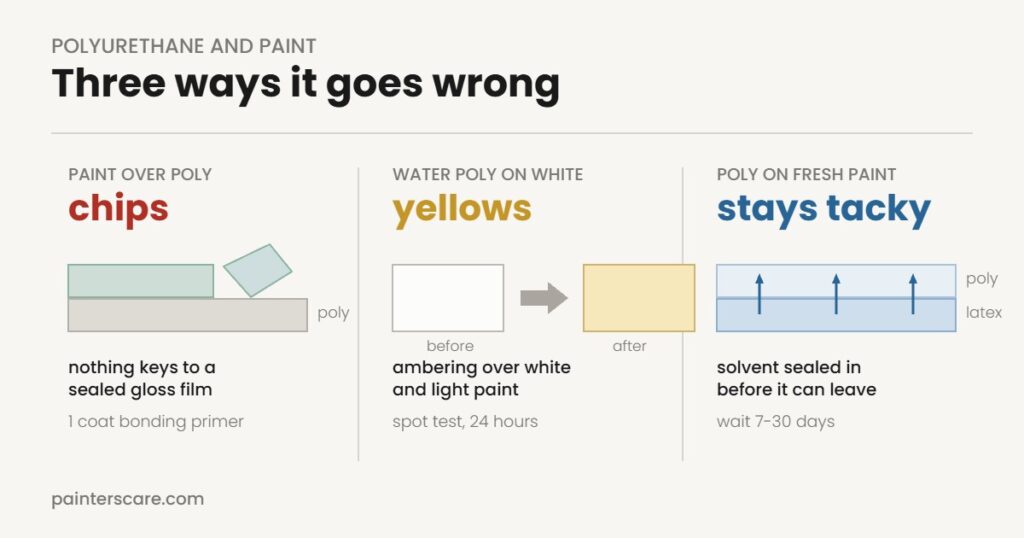
The three failure modes
| What you are doing | What goes wrong | Why |
|---|---|---|
| Paint over poly | Chips and peels | Nothing keys to a sealed, glossy film |
| Water-based poly over white paint | Turns yellow | Ambering, which the product carries a warning about |
| Any poly over fresh latex | Stays tacky for weeks | Latex is sealed before it has finished curing |
Painting over polyurethane
Cured polyurethane is a hard, closed, slick film designed to shed things. Paint applied straight onto it has nothing to grip, and comes off with a fingernail or the first knock.
The fix is mechanical and chemical together. Scuff with 120 to 220 grit until the sheen is uniformly gone — you are not sanding back to wood, just destroying the gloss. Then a bonding primer, because a standard latex primer fails on poly for the same reason the paint does, and it is the same trap behind paint refusing to stick to cabinets.
Numbers worth knowing before you plan the day:
- Zinsser B-I-N shellac: recoat at 45 minutes, full adhesion at 1 to 3 days
- Acrylic urethane bonding primer: recoat at 3 to 4 hours, full scrape resistance at 3 to 4 days
- Waterborne adhesion primer: recoat at 30 minutes. Our primer comparison covers the oil-based options
That recoat figure is when you may paint. It is not when the bond is finished. Rehanging a door or stacking shelves inside the cure window is what pulls primer off poly days after the job looked done. The same gap catches people putting latex over oil-based paint, and for the same reason.
One thing to check first: if the poly is cracked, flaking or lifting anywhere, prep will not save it. Anything unsound has to come off, or the new paint fails along with the layer underneath it.
Polyurethane over paint, and the yellowing nobody mentions
Here the advice online is near-unanimous that water-based poly stays clear and oil-based poly ambers. The first half of that is not what the product documentation says.
Minwax Polycrylic, the water-based acrylic most people reach for, carries an explicit warning that ambering may occur when it is applied over white or light-colored paints and stains, with an instruction to spot test in an inconspicuous area and let it dry first. On a white-painted table top — the surface people most want to protect — that is precisely the failure mode they chose water-based to avoid.
The surface preparation line is just as blunt. The specification calls for surfaces free of lacquer, shellac, paint, wax, grease and polishes. The product is documented as a wood finish, and using it over paint is outside what the sheet describes — which does not make it impossible, but does mean the spot test is the whole safety net.
So before clear-coating anything painted and pale:
- Test on an offcut or a hidden area and give it a full 24 hours, not 10 minutes
- Expect some warming on white and pastel paint from either type
- Ask whether you need it at all — a quality interior paint is already a sealed film, and a clear coat over it adds a layer that can yellow, scratch and eventually need stripping
- If it is a hard-wear surface such as a stair tread or a table, 2 coats of protection are probably worth the color shift
Why poly over fresh paint stays tacky
This is the one that produces a sticky table top that is still sticky a month later, and it is a curing problem rather than a product problem.
Latex paint is touch dry in an hour and recoatable the same day, but it keeps curing for roughly 30 days as water and coalescing solvents leave the film. Lay a sealed clear coat over it at day two and those solvents have nowhere to go. The poly traps them, and the surface stays soft and faintly tacky until they finally work their way out — which can take 2 to 4 weeks, and sometimes does not resolve at all on a thick coat.
The fix is unglamorous: wait. Give latex a minimum of 7 days before clear-coating, and 30 if the surface is horizontal, thickly painted, or going to carry anything heavy. Warmth and air movement shorten it; a cold room and a closed door do the opposite.
Dry-time figures on tins assume 77°F and 50% relative humidity. Lower temperature, higher humidity, no air movement or thick coats all extend them, and the tacky-finish problem lives entirely in that gap between the stated figure and the actual conditions.
Which polyurethane, by the numbers
| Recoat | Notes | |
|---|---|---|
| Water-based acrylic | 2 hours brush, 30 min aerosol | Ambers over white and light paint; cleans up with water |
| Fast one-coat water-based | Dries in 1 hour | Fewer coats, less build |
| Water-based oil-modified | 2 hours | Warmer tone than straight acrylic |
| Oil-based fast-drying | 3 to 4 hours | Light use 24 hours, full cure 72 hours |
| Oil-based, 350 VOC grade | 2 hours | No sanding needed between coats |
Two practical notes from the same documentation. Sand between coats with 220 grit and not steel wool — steel fragments left in the surface rust under a water-based coat. And apply 3 coats on bare wood but only 2 over an already-finished surface, which includes anything painted.
Coverage on aerosols is modest at roughly 20 to 25 square feet per can, so a single chair soaks up more than people expect. For anything larger, spraying polyurethane properly from a gun works out cheaper and flatter than a stack of rattle cans.
Doing it: paint over polyurethane
- Check the existing film is sound. Cracked or lifting poly comes off first.
- Degrease. Mineral spirits or a proper degreaser, especially on anything from a kitchen.
- Scuff with 120 to 220 grit until no sheen is left anywhere. Corners and moldings are where people stop early and where the paint lifts later.
- Remove every trace of dust with a tack cloth or a lint-free rag.
- One coat of bonding primer. Shellac or an adhesion-specific product — a general-purpose latex primer is not the same thing.
- Wait the recoat interval, then two thin topcoats.
- Leave it 3 to 4 days before anything rubs, stacks or hangs against it.
Doing it: polyurethane over paint
- Let the paint cure. 7 days minimum, 30 for horizontal or heavily coated surfaces.
- Spot test for ambering on a hidden area and let it dry fully before judging.
- Scuff gloss paint lightly. Flat and eggshell need only a clean.
- Two thin coats, not one heavy one — thick coats are what stay soft.
- Key the first coat lightly before the second. No steel wool on a water-based finish.
- Allow 24 hours before heavy use, and 72 for an oil-based finish on a hard-wear surface.
Frequently asked questions
How long should you wait before applying polyurethane over paint?
Seven days at an absolute minimum, and 30 for table tops, stair treads, shelves or anything thickly painted. Latex keeps curing for about a month, and sealing it early is what produces a tacky finish.
Can you paint over polyurethane without sanding?
Only with a shellac-based primer such as B-I-N, which is specified to adhere to glossy surfaces without scuff sanding. Everything else needs the scuff, and even with shellac an hour with 220 grit removes the gamble.
Can you polyurethane over acrylic paint?
Yes, with the same two conditions: let the acrylic cure, and spot test first if the paint is white or pale. Acrylic and latex behave the same way here.
Can you varnish over paint?
Yes, and the considerations are identical — cure time, a spot test for color shift, thin coats. Oil-based varnish adds a deliberate amber tone, so on white paint the shift is a certainty rather than a risk.
Can you paint over polyurethane on concrete?
Treat it as the harder version of the same job. Concrete sealers are usually thicker and harder than furniture poly, so mechanical abrasion matters more and a dedicated masonry bonding primer beats a general one.
Can you spray polyurethane over paint?
Yes, and spraying gives the flattest result. Aerosols cover only 20 to 25 square feet per can, so anything bigger than a chair is cheaper through a gun.
What are the downsides of polyurethane?
It yellows over time, oil-based faster than water-based but neither is permanent. It is hard to spot-repair, because a damaged area usually needs the whole surface sanded and recoated. And once it is on, anything you want to do later starts with removing it.
Can you tint polyurethane?
Not reliably, and it is the wrong tool for color. Pigment suspended in a clear coat goes blotchy where the film varies in thickness. Color the layer underneath and keep the clear coat clear.
