Last Updated on October 12, 2026
Every roundup of the best paint sprayer for ceilings ranks the machines. None of them prints the one number that decides whether yours can spray the paint you just bought: the largest tip it will accept.
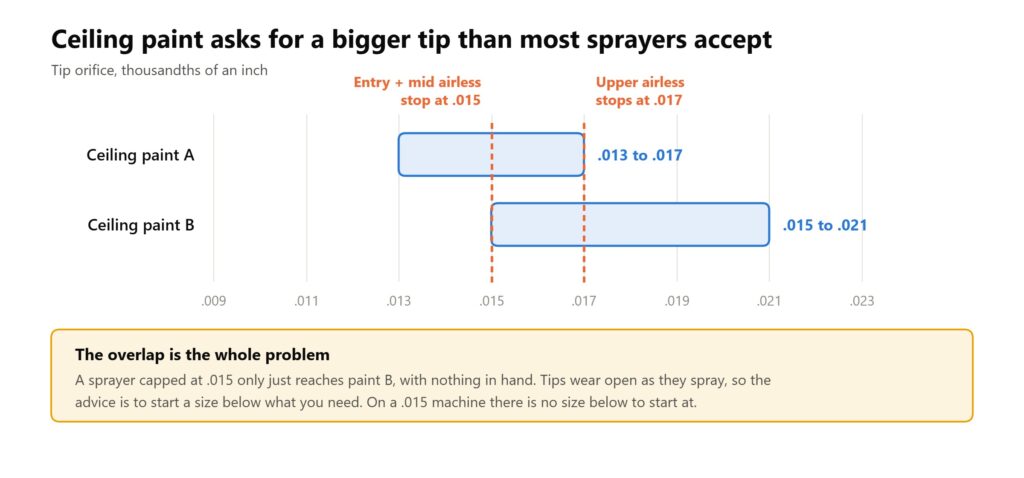
Ceiling paint asks for a tip between .013 and .021 of an inch, depending on which one you buy. Two of the three sprayers most often named for this job stop at .015. On those machines .015 is not a starting point, it is the end of the road.
What ceiling paint asks for
Ceiling paint is a flat latex, and how much solid it carries varies far more than the category name suggests: volume solids across ceiling paints run from 28% to 46%, which is what decides how much film each pass actually leaves behind. Two typical ones specify this on the can for airless spraying:
| Ceiling paint A | Ceiling paint B | |
|---|---|---|
| Tip size | .013 to .017 in | .015 to .021 in |
| Spray pressure | 1,800 to 2,500 psi | 1,500 to 2,000 psi |
| Coverage | 350 to 425 sq ft per gal | Up to 400 sq ft per gal |
| Solids by volume | 35.1% | 29% |
| Wet film | 4.3 mils | 4 mils |
| Dry film | 1.5 mils | 1.1 mils |
| Thinning | — | Do not thin |
The tip range is a requirement rather than a suggestion, and the pressure range sits well below what a consumer airless will do flat out.
Not thinning, meanwhile, is an instruction printed on the paint rather than a feature of a sprayer. A machine that handles unthinned latex is not doing you a favor, it is meeting the minimum.
Your sprayer’s maximum is not its working number
A tip is named by three digits. The first, doubled, is the fan width in inches measured a foot from the surface. The last two are the orifice in thousandths of an inch. A 515 throws a 10 inch fan through a .015 orifice, which is why it is the standard answer for ceilings.
The catch is that the orifice does not stay .015. As a tip sprays, the hole wears open and the fan narrows, so you get more paint through a smaller stripe — thicker passes, more of them, and the finish drifts. The advice in the manuals is to pick a tip a size below what you need so there is room to wear into.
That advice collapses on a machine capped at .015 spraying a paint that asks for .015 as its minimum. There is nothing below to start at, and nothing above to move to when the tip opens up.
| Sprayer | Largest tip | Flow | Longest hose | Max pressure | Paint per year |
|---|---|---|---|---|---|
| Entry bucket-fed airless | .015 in | 0.24 gpm | 50 ft | 2,800 psi | 50 gal |
| Mid bucket-fed airless | .015 in | 0.27 gpm | 75 ft | 3,000 psi | 125 gal |
| Upper bucket-fed airless | .017 in | 0.31 gpm | 100 ft | 3,000 psi | 125 gal |
| Handheld airless | — | 0.12 gpm | none | — | — |
| Floor-standing turbine | n/a, no tip | — | 11.5 ft air hose | — | — |
Only the upper airless clears .015 with anything to spare. It is also the one that moves the most paint per minute and reaches furthest, which matters more on a ceiling than anywhere else in the house.
Most of the overspray is a dial, not the machine
The complaint about spraying a ceiling is always the same: fine mist everywhere, including on your face. Some of that is unavoidable overhead. A good share of it is the pressure knob.
Both ceiling paints above want somewhere between 1,500 and 2,500 psi. A consumer airless runs to 2,800 or 3,000. Spray at the top of the dial and the paint is atomized far finer than it needs to be, and the part that does not land becomes the cloud.
The instruction in the manual is to spray at the lowest pressure that atomizes the paint: start low, bring it up a little at a time, and stop as soon as the pattern loses its tails. Ragged edges at the top and bottom of the fan mean too little pressure, and the moment they disappear you are done turning.
Doing that puts you inside the paint’s own range rather than above it, and it is the single biggest thing you can do about mist without buying anything.
Where the weight sits
Paint a wall and the sprayer hangs at your side. Paint a ceiling and whatever holds the paint is above your head, at arm’s length, for as long as the job takes. A handheld carries a 32 oz container, which is a quart of paint plus the tool, held up and moving, for an hour.
The other two formats exist to solve that. A floor-standing turbine keeps the motor on the ground and sends paint up a hose, so only the gun is in your hand. A bucket-fed airless goes further and draws straight from the can, so nothing is in your hand but the gun and the hose.
The trade is reach. The turbine’s air hose is 11.5 feet. Measure from the floor where the unit sits, up to an eight foot ceiling, and then out across the room, and that runs out quickly — particularly from a ladder. Airless hose runs 50 to 100 feet, which is why it wins on a whole house rather than on raw power.
How much paint a ceiling takes, and how often you stop
A 12 by 15 foot room has 180 square feet of ceiling. At 350 to 425 square feet per gallon that is about half a gallon a coat, so a gallon covers the two coats a ceiling almost always needs.
Half a gallon is not much paint. What differs between machines is how many times you climb down to fetch more of it.
| Machine | Holds | Covers before refilling | Stops per coat on a 180 sq ft ceiling |
|---|---|---|---|
| Handheld airless | 32 oz | About 90 to 105 sq ft | 1 to 2 |
| Floor-standing turbine | 1.5 qt | About 120 sq ft | 1 |
| Bucket-fed airless | The can | The can | 0 |
On one small ceiling that difference is an annoyance. Across a floor of a house it is the difference between an afternoon and a day, because every stop means climbing down, opening the paint, filling, priming the pump again and finding your wet edge a second time.
A wet edge is the thing you are protecting. Ceiling paint stays workable for a couple of hours before it is ready to recoat, but it skins over in minutes, and a pass laid against a skinned edge shows as a line once the light crosses it.
Fan width matters more overhead than anywhere else
Lap marks hide on a wall. On a ceiling they do not, because the light from every window in the room crosses the surface at a shallow angle and rakes along it. Anything slightly thicker throws a shadow.
A wider fan lays the same gallon over more surface in each pass, so there are fewer passes and fewer joins between them. That is what the first digit of the tip number buys you: a 515 gives a 10 inch fan, and the wide-pattern tips roughly double it.
Keep the tip a consistent distance from the surface, about a foot, and keep it square to the ceiling rather than tilted. An arc through the pass puts more paint in the middle than at the ends, which is the same problem as a worn tip from a different direction.
The sprayers
The five sprayers below are handhelds and small units, and on a ceiling that is a real limitation rather than a detail: the paint rides above your head the whole time. They earn their place on one room, a garage ceiling, a closet, a patch of repair work, where setting up a bucket-fed machine and cleaning it afterward costs more than the job. For a floor of a house, the formats in the table further up are the ones that keep the weight off your arm.
1. Graco 16Y385 TrueCoat 360 Paint Sprayer

Graco TrueCoat 360 is a versatile paint sprayer that will reduce the time it takes to paint your ceiling and the work involved in the job.
The stainless steel piston pump allows you to use paint that has not been thinned so you get better coverage out of each coat of paint. That means you will use fewer coats to get the job completed.
You will have the ability to spray in any direction because of the VacuValve technology used in the design of Graco 16Y385 TrueCoat 360 paint sprayer.
It takes FlexLiner bags rather than a rigid cup, so a color change is a new bag instead of a wash-out, and there is no cup to scrub at the end.
In the handle of the paint sprayer, you will find room to store extra tips for the paint sprayer. This means your extra tip is always handy and ready to use.
This sprayer comes with 2 reversible spray tips that are .015 in size, they are a 215 and a 615, and 2 FlexLiner bags that have a holding capacity of 32 ounces, and the easy to read and understand instruction manual.
2. Astro 4008 Spray Gun for Ceilings

This spray paint gun is perfect for ceilings and wall because it is specifically designed to handle thicker paints and primers. We all know that a great primer coat is needed if we want a great finished product and the 1.8 nozzle that comes on this spray painter is perfect for putting that primer on.
Astro 4008 spray paint gun only weighs three pounds so you can hold it longer and finish the job faster. It is also designed to produce less waste while you are painting so you will use less paint and get a better coat from each application. It can easily be operated by a compressor that is no more than a three horsepower, and this paint sprayer only needs between 7 and 12 CFM.
The anti-spill line assures you that you can hold this sprayer at any angle you need to and you will not have paint leaking from the cylinder. If you need to hold the gun upside down you can, and the paint will come out of the nozzle and not out around the connector hose.
3. REXBETI Ultimate-750 Paint Sprayer

Three fan patterns, horizontal, vertical and circular, which is how you keep a narrow run of trim from overspraying the ceiling beside it.
There are three nozzles made of copper supplied with the paint sprayer. The nozzles are a 1.5 mm, a 1.8 mm, and a 2.5 mm, you also get a 30 fl oz (900 ml) canister, a cleaning brush, a small wrench to help you disassemble the sprayer for cleaning, a funnel, a user’s manual, a cleaning needle to keep the nozzles clean, and the paint sprayer.
Under 5 pounds empty, which is about 7.9 pounds once a quart of paint is loaded, and that is the figure that matters overhead.
4. Graco 17D889 TrueCoat 360 VSP Handheld Paint Sprayer

A VacuValve pickup lets it spray at any angle, upside down included, without losing prime, which is the one thing a ceiling asks of a handheld.
The TruCoat 360 uses the Flexliner bags to hold the paint you are applying so clean up and multi-color projects are a breeze to do. You simply remove the bag that the paint was in and toss it when you are finished. There is no cleaning of a canister before you can change paint colors or after you have finished.
The TruCoat 360 comes with a storage case. The case will hold all of the accessories, like your extra FlexLiner bags and paint tips. The case keeps everything you need for the painting project in one place so you are always ready to go to work.
5. HomeRight C800971 Power Painter Home Sprayer – HVLP Spray Gun

This spray painter gives you multiple settings that you can choose so the projects you take on have professional quality finishes. The tips are color coded so it is easy to discern the different sizes, You have 6 setting sizes to choose from.
The orange tip and the 1.0mm setting is great for sealers and varnishes. The blue tip and the 1.5 mm setting is perfect for stains and polyurethane applications. The green tip and the 2.0 mm setting is designed for latex paints, chalk paints, and milk paints.
The yellow tip and the 2.5mm setting is also for latex, chalk and milk paint varieties. The black tip and the 3.5 mm setting is best for primer and thicker latex paint, and the red tip and the 4.0 mm setting is for primers and thicker latex paints.
Under 3 pounds empty, the lightest here, and roughly 5.9 pounds with a quart of paint on board.
Frequently Asked Questions
Can you spray ceilings with a paint sprayer?
Yes, and a ceiling is the surface a sprayer suits best. It is one unbroken plane with nothing to cut in except the edges and nothing on it to work around. The effort moves to the preparation instead: every surface below has to be covered, because mist thrown upward settles on all of it on the way down.
Is it better to roll or spray paint a ceiling?
Spray an empty room, roll a furnished one. Spraying is quicker and leaves none of the stipple a roller does, but it only pays once the masking costs less time than the rolling would have. In a room still full of furniture the masking is most of the day, and a roller on a pole wins outright.
What is the best paint spray gun for walls and ceilings?
For both in one session, a bucket-fed airless taking a tip of .015 or more. The two surfaces usually take the same flat latex through the same tip, so a machine chosen for interior walls does not need to change between them. Hose length is what settles it: 50 feet and up lets you work a whole floor without moving the unit, where a turbine’s 11.5 feet means relocating it for every wall.
What is the best tool for painting ceilings?
The room decides, not the ceiling. Empty and stripped back, a bucket-fed airless with a 10 inch fan tip. Furnished, carpeted or small, a roller on an extension pole, because the hours you would spend sheeting everything are worth more than the hour the spraying saves.
What paint sprayer is best for a ceiling?
Whichever one takes a bigger tip than the paint demands. Read the tip range off the paint first, then check the sprayer’s largest, and leave a size in hand because the orifice opens as it wears. A sprayer that stops where the paint starts will work on the day and drift out of spec by the second room.
What is the trick to painting ceilings?
Drop the pressure until the fan just stops showing ragged tails at its edges, then leave it there. Hold the tip about a foot from the surface, square rather than tilted, and overlap each pass by half its width, the same basic spraying technique every surface wants. Those three things decide whether the finish is even, and none of them costs anything.
Final word
Two numbers settle the purchase. The tip range on the paint, which runs somewhere between .013 and .021 depending on which one you pick up, and the largest tip the sprayer will accept, which on consumer airless machines is .015 or .017. If the second is not above the first with a size in hand, the machine is at its limit on day one and out of range once the tip has worn open.
Then two settings that cost nothing. Bring the pressure down into the 1,500 to 2,500 psi the paint asks for, rather than leaving it at the 2,800 or 3,000 the machine can reach, and most of the mist stops. Get the paint off your arm, into a bucket or onto the floor, and the job stops being a fight at the second hour. Neither is a purchase, and together they matter more than which box you took home.
