Last Updated on October 7, 2026
Every guide to spraying interior walls tells you to mask the floors, the trim, the windows and the doors completely, and then moves straight on to which sprayer to buy. Nobody puts a number on the masking. That omission is the whole decision, because the spraying itself is over in minutes.
The short answer: a 12 by 12 room has 384 square feet of wall, and an airless sprayer covers it in under 4 minutes. A turbine HVLP takes 24. Masking that room properly takes longer than either, and it costs the same whichever machine you own. So a paint sprayer for interior walls pays off on the ratio of wall area to masked edges, not on the sprayer.
Below are the 6 sprayers this page lists, sorted into the two classes that matter for walls. Four of them are the fine-finish class, and one is sold by its maker for exteriors.
The spraying takes minutes. The masking does not.
Published flow rates make this arithmetic rather than opinion. A gallon of wall paint covers about 400 square feet at a normal film, so a sprayer moving 0.27 gallons a minute is laying roughly 108 square feet a minute. Run that against one room:
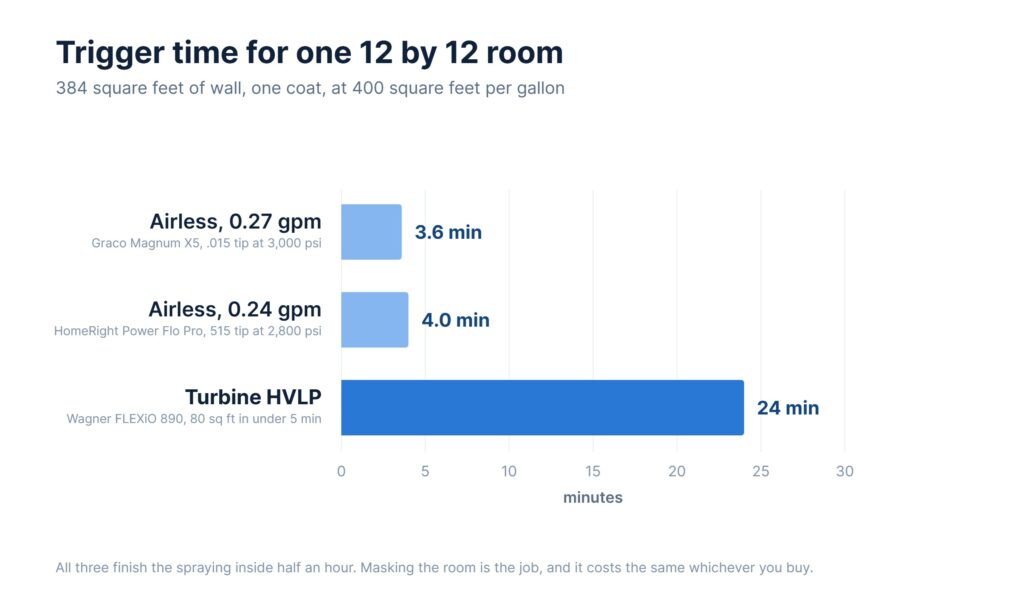
Even the slowest option here is done in under half an hour, and the quickest is done in the time it takes to make coffee. What that means is uncomfortable for anyone selling sprayers: the machine is not the bottleneck on a single room, and buying a faster one does not shorten the day.
Masking is what fills the day, and it scales with edges rather than with area. A room with six windows, a radiator, two doors and baseboards needs the same plastic and tape whether you are spraying 200 square feet or 500. That is why spraying wins decisively on an empty house before move-in, a stairwell, or a ceiling, and loses on one furnished bedroom.
| Situation | Wall area per masked edge | Faster option |
|---|---|---|
| Empty house, no furniture, before move-in | Very high | Spray |
| Stairwell or double-height wall | High | Spray |
| Ceilings across several rooms | High | Spray |
| One empty room being redecorated | Moderate | Either |
| One furnished room, several windows | Low | Roller |
| A single accent wall | Very low | Roller |
Airless and HVLP are not two grades of the same thing
For walls the choice is between two different machines. An airless pump, the Graco and HomeRight units below, forces paint through a small orifice at 2,800 to 3,000 psi, atomizing it by pressure, and draws straight out of a 1 or 5 gallon can. A turbine HVLP, which is what the Wagner units are, wraps the paint in a large volume of low-pressure air instead, feeding from a cup or a hose, and atomizes more gently.
| Airless | Turbine HVLP | |
|---|---|---|
| How it atomizes | Pressure, 2,800 to 3,000 psi | Air volume, under 10 psi at the cap |
| Tip or nozzle | .015 inch orifice, 515 tip | Wide nozzle plus a detail nozzle |
| Paint supply | Straight from a 1 or 5 gallon can | Cup or hose from a floor turbine |
| Flow | 0.24 to 0.27 gallons a minute | Roughly 16 square feet a minute |
| Thinning | Unthinned latex | Unthinned latex on the better units |
| Overspray | High | Lower |
| Right for | Walls, ceilings, whole rooms | Trim, doors, cabinets, small rooms |
That overspray row is the one that decides your masking. Pressure atomization throws a cloud, which is the price of the speed, and it is why the guidance to cover everything exists in the first place. Low-pressure units throw less, which is why they suit a room you cannot empty, and they are slower for exactly the same reason.
The orifice is the other hard limit. Wall latex needs a .015 inch tip as a floor, which is the same number that latex sprayers are built around, and the 515 tips that ship with these units throw a 10 inch fan at that orifice. Go narrower and the paint will not pass; go wider and you are spraying a fan too big to control near a ceiling line.
Technique that actually changes the result
Hold the gun perpendicular, 10 to 12 inches off the wall, and keep it moving at a steady speed with each pass overlapping the last by 50 percent. Spray the ceiling first if you are doing both, then the walls top to bottom. Start the trigger before the wall and release it after, so the heavy start and stop of each pass lands on the masking rather than on the finish.
Two things people skip. Back-roll the first coat on bare or patched walls, which means running a dry roller over the wet paint within about 2 minutes of spraying, because it pushes the film into the surface instead of leaving it sitting on top. And switch the heating or air conditioning off before you start, because moving air carries atomized paint into rooms you did not mask.
Prep decides more than the gun does. A sprayed wall at 3 mils shows every imperfection a roller would have hidden under its stipple, so fill and sand first and check with a light held flat to the wall. Drywall primer choice matters here for the same reason, and thinning is rarely needed on the units below.
6 Best Paint Sprayer For Interior Walls Picks, By Class
Two picks. For whole rooms and ceilings, number 1, because an airless at 0.27 gallons a minute is the class built for open wall. For one room you cannot empty, or a job that is half walls and half trim, number 6, because lower pressure means less of the masking that dominates the day.
1. Graco Magnum X5 Airless Paint Sprayer

The right class for walls and the correct pick at the top of this list. It runs a .015 inch maximum tip at 3,000 psi and 0.27 gallons a minute, with a 515 tip in the box, and it draws straight from a 1 or 5 gallon can so you are not refilling a cup mid-wall. That flow covers a 384 square foot room in under 4 minutes of trigger time. The Magnum family rates 4.4 out of 5 across roughly 3,800 ratings, the best-supported score on this page.
2. HomeRight Finish Max HVLP Sprayer

A fine-finish handheld, and the clue is in the name. Its tip range is built for stain, polyurethane and chalk paint on furniture and trim, not for covering 400 square feet of wall. On a small room it will work and it will throw less overspray than an airless, so if you cannot empty the space it is a reasonable compromise. For a whole house it is the wrong tool and you will be refilling the cup constantly.
3. HomeRight Power Flo Pro 2800

An airless at 2,800 psi and 0.24 gallons a minute, with a 515 reversible tip and a 100 mesh gun filter, drawing from a 1 or 5 gallon can. On specification it is the right class for walls. Worth knowing before you order: its maker positions it for home exteriors, fences, sheds and garages, and interior walls are not in its stated uses. The capability is there, the warranty framing is aimed elsewhere.
4. Wagner Control Spray Max Corded HVLP

A corded low-pressure turbine, so the weight sits on the floor and the gun stays light in your hand. That matters on a ceiling more than people expect. It is still the fine-finish class: good on doors, cabinets, trim and a small room, slow across open wall. If your job is one bedroom plus all the trim in the house, this is a sensible single purchase.
5. REXBETI Ultimate-750 HVLP Paint Sprayer

A budget handheld with a set of nozzle sizes, which on paper covers stain through to thicker paint. Check which nozzle is fitted when it arrives and expect to thin wall paint despite what the box says. The honest use for a unit at this price is practice: somewhere to learn trigger control and overlap before you point a 3,000 psi machine at a finished room.
6. Wagner FLEXiO 890 Stationary HVLP
The turbine unit from the chart above, and the best HVLP option here for walls specifically. The motor sits on the floor in its own box and feeds the gun down an 11.5 foot hose, it sprays unthinned latex straight from the can, and it ships with a broad nozzle for walls and a detail nozzle for trim. Its own figure is an 8 by 10 foot surface in under 5 minutes, which is the 24 minute room on the chart. It rates 4.1 out of 5 across 793 ratings.
Frequently Asked Questions
Are paint sprayers good for interior walls?
Yes, on the right job. An airless leaves a film with no roller stipple in it, and it does a bedroom in minutes rather than hours. The condition is that you can mask the room properly, because pressure atomization throws a cloud. On open wall in an empty room a sprayer is the better tool; in a furnished room it is slower once the plastic goes up.
What is the best paint spray gun for interior walls?
An airless at 0.24 to 0.27 gallons a minute running a .015 inch tip, which is the class that includes the Magnum X5. If the room has to stay furnished, a turbine HVLP at lower pressure throws less overspray and takes about 24 minutes a room instead of 4. The fine-finish handhelds are for trim and cabinets rather than walls.
Is it better to use a paint sprayer or roller for interior walls?
Count your edges, not your area. Spraying wins where there is a lot of wall per masked edge: an empty house, a stairwell, ceilings across several rooms. A roller wins on one furnished room with several windows, or a single accent wall, because the masking takes longer than the painting. The spraying itself is never the slow part.
Can I paint inside my house using a paint sprayer?
Yes, with two indoor-only precautions. Kill any forced air in the building before you start, including the furnace fan, or you will find paint dust 2 rooms away. And wear a respirator rather than a dust mask: atomized latex at 3,000 psi stays airborne for minutes in a room with no breeze.
What paint sprayer should I use for interior walls?
Match it to the room count. A whole house or several ceilings wants an airless drawing from a 5 gallon can. One room plus the trim wants a turbine HVLP with two nozzles. A single accent wall wants a roller. Buying above your job adds masking rather than saving time, which is the opposite of what the flow rate implies.
What are the downsides of using a paint sprayer?
Masking time, overspray, and paint use. An airless atomizes by pressure, so some of every pass ends up in the air rather than on the wall, and the time you save on application comes back as plastic and tape. A sprayed wall also shows defects a roller would have hidden in its texture, so the prep standard goes up. Cleanup runs 15 to 30 minutes every time you stop.
Final word
The 4 minute figure is the one to hold on to. Spraying 384 square feet is quick on any of these machines, so the sprayer is not what decides your day, and the specification sheet cannot tell you what will. Walk the room and count the edges you would have to cover. If that number is small relative to the wall, spray it. If it is not, the roller is already the faster tool.
