Last Updated on November 24, 2026
The FLEXiO 590 is a handheld HVLP sprayer with two nozzles, one for walls and siding and one for cabinets and fine finishes. It has dropped out of the current US range and been replaced by the FLEXiO 595, but new units still sell for about $181 at some retailers and used ones for roughly $50 to $100.

This Wagner FLEXiO 590 guide covers the settings, setup, thinning and cleaning, and how it compares with the models that replace it.
Pros and cons
Pros
- Two nozzles: iSpray for walls and siding, Detail Finish for cabinets and furniture
- Comes with a carry case for the sprayer and both nozzles
- Sprays up to 8 gallons an hour with the iSpray nozzle
- Few parts to strip down and rinse after each job
Cons
- No longer in the US range, replaced by the FLEXiO 595
- Tipping it past 45° can let paint into the turbine
- The 1.5-quart cup needs refilling on bigger jobs
- Commercial or rental use cuts the warranty to 30 days
FLEXiO 590 specifications
| Spec | FLEXiO 590 |
|---|---|
| Turbine | X-Boost, air power 1 to 9 |
| Nozzles | iSpray and Detail Finish |
| Cups | 1.5 quart (48 oz) for iSpray, 600 ml for Detail Finish |
| Output | Up to 8 gallons an hour |
| Coverage | 8 x 10 ft in about 1 minute with stain, 5 minutes with latex |
| Patterns | Horizontal, vertical or diagonal; wide or narrow on iSpray |
| Power | Standard 120 V outlet |
| Warranty | 1 year, or 30 days for commercial use |
Which nozzle and setting to use
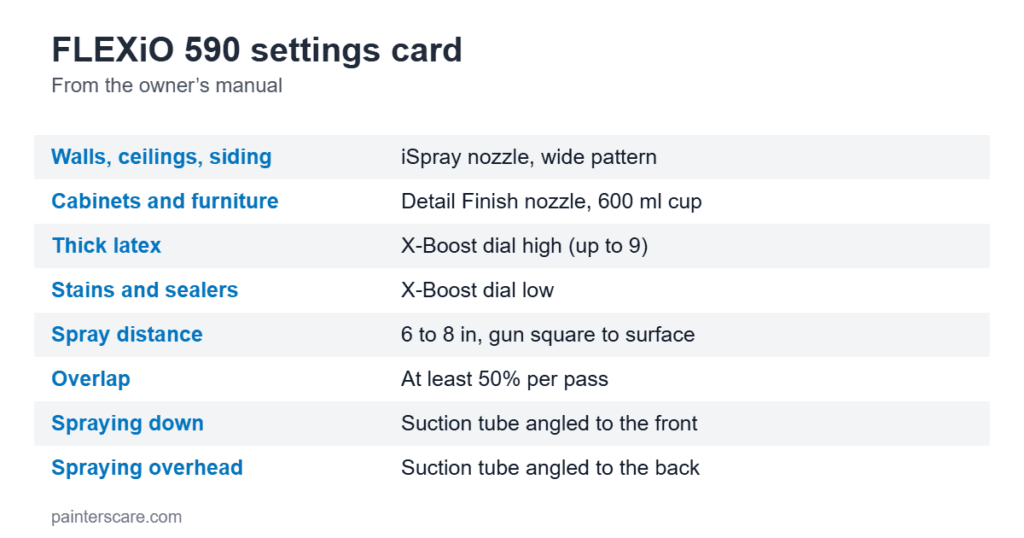
The iSpray nozzle takes unthinned latex, latex primers, oil enamels, solid stains and polyurethane on broad surfaces such as walls, ceilings, fences and siding. The Detail Finish nozzle is for thinner coatings, including transparent stains, sealers and water-based lacquer, on smaller pieces where the finish matters more than speed.
Run the X-Boost dial high for thick paint, which gives faster coverage and a smoother finish. Turn it down for thin materials, which sprays larger droplets with less overspray. The red knob on the trigger sets how much material flows, and the width lever on the iSpray switches between a wide pattern for open walls and a narrow one for corners and edges.
Setting it up
- Fit the nozzle you need to the turbine and fill the cup, then screw it on firmly.
- Turn the angled end of the suction tube toward the front of the gun to spray downward, or toward the back to spray overhead, so it stays in the paint.
- Set the X-Boost dial and the flow knob low, plug in, and test on cardboard before the real surface.
- Raise air power and flow a step at a time until the pattern lays down evenly.
Thinning and spraying
Start unthinned. If the pattern sputters, dilute the paint in 5 to 10% steps, testing after each one.
Hold the gun square to the surface, 6 to 8 in away, keep your arm moving whenever the trigger is pulled, and overlap each pass by at least 50%. Never tip the sprayer more than 45°, because paint can run back into the turbine and damage it.
Cleaning after each job
Unplug, loosen the cup half a turn to release pressure, and pull the trigger so paint drains back into the cup. Empty it, then fill the cup halfway with warm soapy water for latex or a quarter full with mineral spirits for oil, refit it, and spray the solution into a waste container while gently shaking the gun.
After mineral spirits, repeat the rinse with soapy water. Then press the tab below the trigger, twist the nozzle off the turbine, take it apart and brush every part clean, including the air vent on the suction tube. Never submerge the turbine.
Care and limits
Inspect the turbine air filters before every use and replace them when dirty; never spray without them. Use only water-based or mineral-spirit materials with a flash point of at least 100°F.
What owners report
Buyers rate it 3.6 out of 5 across 143 ratings at one large retailer, and two in three would recommend it. The good reports come from exterior work and stain: vinyl siding, decks, porches, outside doors and a cedar fence. Owners who used one for years call it easy to run, quieter and with less vibration than older handhelds, with little overspray once the air and flow are matched to the paint.
The complaints that come up again and again, and how owners get around them:
- Globs of latex spit onto the wall partway through a room. A couple who used one for years thin a little with Floetrol rather than water and keep a brush or small roller handy to catch drips.
- It sputters when tilted. Keep the gun mostly upright and turn the wall, door or panel instead of the sprayer where you can.
- Cleanup takes about 30 minutes, because the front end comes apart and each piece needs a scrub.
- One owner laid it on its side to refill, and stain ran back into the power head and shorted the switch. Stand it upright every time you refill.
- Several owners had the motor quit after a handful of jobs, some just past the warranty. Keep the receipt.
- The cup cross-threads easily. Start the thread by hand and check it is straight before tightening.
FLEXiO 590 vs 595, 3500 and 2500
| Model | Nozzles | Notes | Price |
|---|---|---|---|
| FLEXiO 590 | iSpray and Detail Finish | 9 air settings, 1.5-quart cup | About $181 new, $50 to $100 used |
| FLEXiO 595 | iSpray and Detail Finish | 9 speeds, 1.5-quart cup, cup liners, 10% lighter than earlier models | About $183 |
| FLEXiO 3500 | iSpray and Detail Finish | 9 speeds, side on/off switch | $189.99 list |
| FLEXiO 2500 | iSpray only | Side on/off switch | $159.99 list |
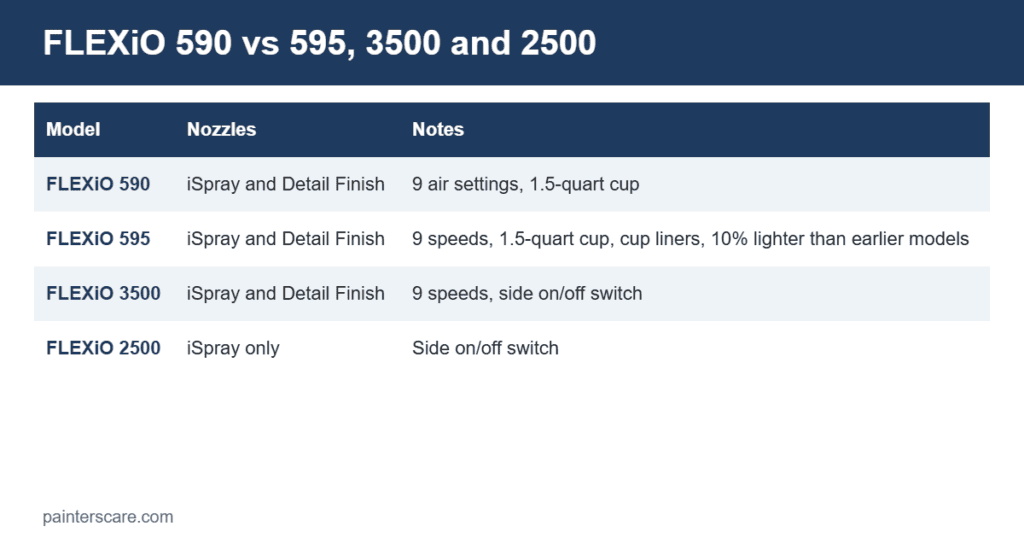
The 595 is the direct successor, with the same nozzle pair and cup size, and it sold for about $183 in November 2026. The 2500 and 3500 split the range by nozzles: the 2500 suits walls and fences only, while the 3500 adds the Detail Finish nozzle for furniture and trim. Its predecessor, the FLEXiO 3000, still turns up in discounted kits.
For a turbine that stays on the floor, the Fuji Semi-PRO 2 review covers a 2-stage system built for fine finishes, and the FLEXiO 990 guide covers the 590’s discontinued sibling that pulled paint straight from the can. The HVLP sprayer guide compares more options, and indoor spraying calls for a respirator.
Frequently asked questions
What is the difference between FLEXiO 2500 and 3500?
The 3500 adds the Detail Finish nozzle and a 9-speed X-Boost turbine, while the 2500 comes with the iSpray nozzle only. Both have the compact body and side on/off switch, and they list at $189.99 and $159.99.
Do I need to thin paint for Wagner FLEXiO?
Most interior and exterior latex goes through the iSpray nozzle unthinned. Thin only when the pattern breaks up, adding 5 to 10% at a time, and keep the Detail Finish nozzle for stains, sealers and other thinner coatings.
How much is a Wagner FLEXiO 3500?
Its list price is $189.99, about the same as the FLEXiO 595 at $183 in November 2026. The 595 is the closer match to the 590 because it keeps the same nozzle pair and 1.5-quart cup.
