Last Updated on October 6, 2026
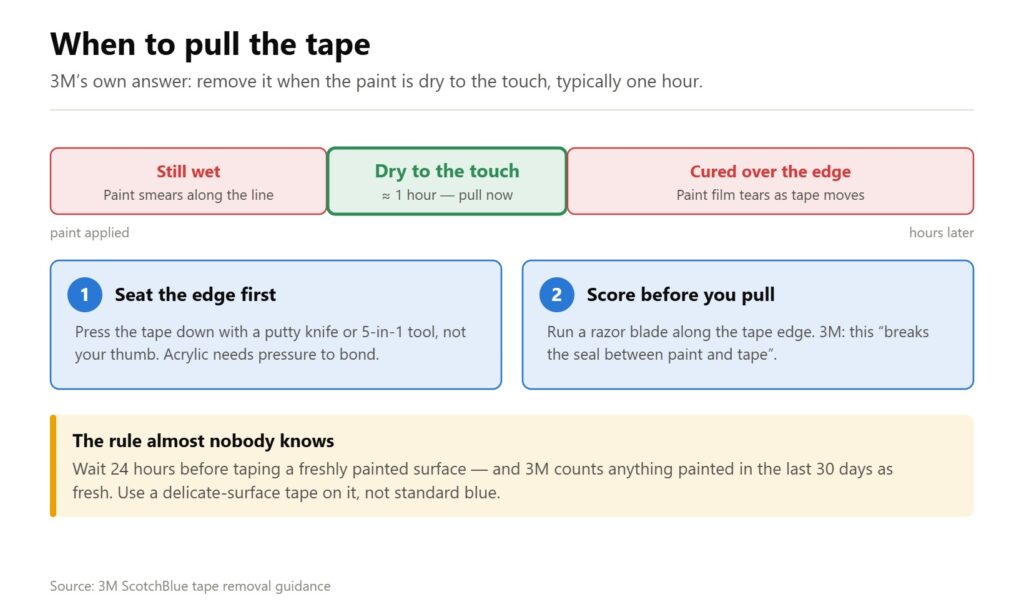
Pull the tape when the top coat is dry to the touch, which is about 1 hour after you put it on. Not while it is wet, because the edge smears. Not the next morning, because by then the paint has formed a continuous film across the tape edge and will tear when the tape moves.
If the tape has already been on overnight, score along its edge with a razor blade before you pull. If it has been on for days, there is still a documented rescue, covered further down.
Why two tape manufacturers tell you opposite things
Search when to remove painters tape and the top of page one hands you two pages that both come from companies which make the tape and flatly contradict each other. One says to wait until the paint is dry to the touch, typically 1 hour after application. The other says it is best if the tape is removed while the paint is still wet, so the paint and the tape never bond into one film.
Google’s own answer box splits the difference and tells you “while the paint is still wet or immediately after it becomes dry to the touch”, which is not an instruction you can act on. What neither page mentions is that the right answer tracks the adhesive on the roll rather than the paint on the wall.
| Tape | Clean removal rating | Adhesion to steel | Tensile strength | Adhesive |
|---|---|---|---|---|
| Scotch Delicate Surface 2080 | 60 days | 14 oz/in | 22 lb/in | Acrylic |
| ScotchBlue Original 2090 | 14 days | 23 oz/in | 27 lb/in | Acrylic |
| FrogTape Multi-Surface CF120 | 21 days | 30 oz/in | 22 lb/in | Rubber-based |
The green tape grips 30 percent harder than the blue one, 30 ounces per inch against 23, and tears more easily, 22 pounds per inch against 27. A tape that grips harder and tears sooner has a narrower window, which is why its maker tells you to pull it before any film can form. A tape with lower grip and higher tensile strength can afford to wait the full hour. Both companies are giving correct advice about their own product, and neither is giving advice about yours unless you check the roll. The full comparison of the two adhesives sits in our guide to painters tape versus masking tape.
The timeline, hour by hour
Latex paint does not go from wet to finished. It passes through four states, and only one of them is a good moment to pull tape. The hours below come off the back of the can: a typical interior latex is touch dry in 1 hour and ready to recoat in 2 to 4 hours, measured at 77 degrees Fahrenheit and 50 percent humidity.
| Time since the last coat | What the film is doing | Tape |
|---|---|---|
| 0 to 60 minutes | Still wet. Water is leaving, no film yet | Too early for most jobs. Pulling now smears the edge |
| About 1 hour | Dry to the touch. Film formed but soft | Pull now. It parts cleanly at the tape edge |
| 2 to 4 hours | Hard enough to recoat | Still workable, but score the edge first |
| Overnight and after | Film continuous and getting tough | Score with a razor blade or it will chip and tear |
| Days | Bonded across the tape edge | Repaint the edge, wait for tack, then pull |
| 14 days | Hard enough to wash | The film keeps hardening this whole time |
That last row is the part people miss. 1 hour gets you a film you can touch; the coating goes on hardening for about 2 weeks, which is why a manufacturer will tell you to wait at least 14 days before washing a fresh wall. Tape left on a wall for a two weeks is sitting on a film that has been quietly getting tougher and more elastic the entire time, which is exactly what makes it pull off in sheets.
Cold and damp stretch every row. The 1-hour figure assumes 77 degrees and 50 percent humidity; a cold room or a humid day stretches it, and the honest test is a fingertip in a corner rather than a clock.
How to pull it

- Lift one end and fold the tape back on itself so it peels against its own backing rather than away from the wall.
- Keep it at about 45 degrees to the surface. That angle shears the paint film at the tape edge instead of stretching it.
- If adhesive stays behind on the wall, steepen to 90 degrees for the rest of the run.
- Go slowly, a few inches at a time. Speed is what turns a clean part into a tear.
- Masking over carpet changes the order of operations, which is covered in painting baseboards with carpet. Pull toward yourself in one continuous strip where you can, rather than in short sections, because every stop and restart leaves a mark in the line.
Seat the tape with a putty knife or a stiff card rather than a thumb, because an unsealed edge is where bleed comes from. And run a razor blade along the edge before pulling if the paint has had longer than a couple of hours, which breaks the seal between paint and tape rather than relying on the film to part on its own. Both figures come straight from the tape maker’s own guidance.
If you already left it on too long
This is the situation most people are actually in when they search for this, and the fix is counterintuitive: you add more paint. Brush a stripe of the same paint along the tape edge, let it come to the point where it feels slightly tacky rather than dry, and lift the tape through it.
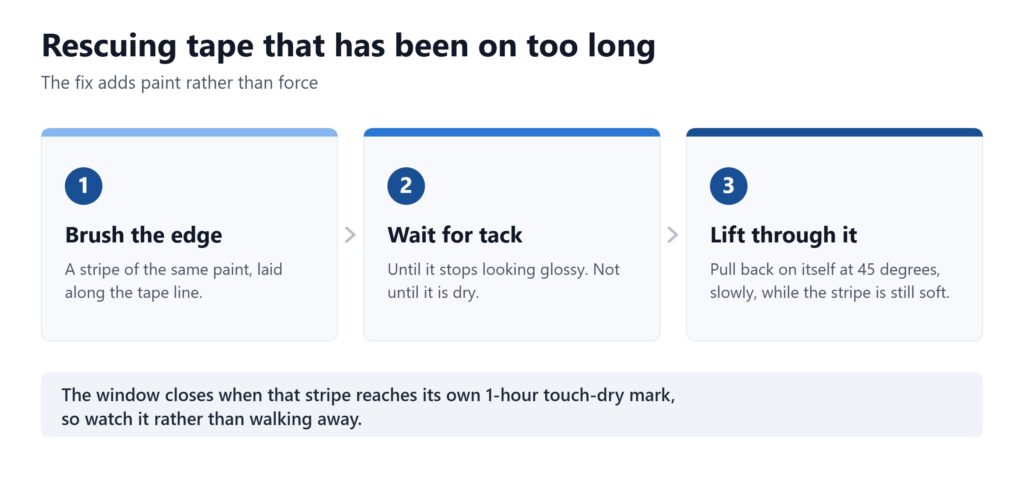
It works because the new wet paint softens and swells the hardened film right at the tape line, which is the only place the bond matters. The tape then comes away through paint that is still forming instead of through a film that has set across it. Tacky is the window, not dry, so stay with it and pull at the moment it stops being glossy.
The window you are aiming for is short: you want that stripe before it reaches its own 1-hour touch-dry mark, so plan on watching it rather than walking away. Paint lifting with the tape, or hairline cracks traveling along the line as you work, both mean the film has already bridged. At that point no change of angle or speed helps and a blade is the only thing that separates the two.
Multiple coats: leave it on
Do not pull the tape between coats. Leave it in place until the final coat is on and has had time to dry, then remove it once. Every re-tape is a new chance to misalign the line, and a second strip laid over a fresh edge is being applied to paint that is hours old rather than weeks.
That means the 1-hour clock starts from the last coat, not the first. 2 coats with 4 hours between them puts your tape on the wall for roughly 5 hours, which is fine for a standard blue or green tape and well inside any clean-removal rating.
Does the surface change the timing?
The hour is a property of the paint, so it does not move much between a wall and a door frame. What changes is how much the surface underneath can afford to lose if you get it wrong, and that decides which tape goes on and how carefully it comes off.
| Where the tape is | What to watch | Timing |
|---|---|---|
| Painted walls and trim | The surface the standard blue tape is built for | Touch dry, about 1 hour |
| Woodwork and bare trim | Grain can hold adhesive in the open pores | Touch dry, and score before pulling |
| Glass and metal | Nothing to tear, so the only risk is residue | Flexible; pull at any point up to the rating |
| Ceilings | Paint over paper tape joints is the weakest film in the room | Pull early, at touch dry, never overnight |
| Wallpaper and bare drywall | Standard tape should not go here at all | Delicate tape only, 14 oz/in |
| Wood floors | Finish lifts in sheets | Delicate tape only, 60-day rating |
The bottom two rows come from the exclusion list on the standard blue tape itself, which names wallpaper, unpainted wallboard, wood floors and poorly bonded finishes as surfaces it is not for. Reaching for the roll already in the drawer is how people end up searching for why their tape took the paint with it.
Ceilings deserve the extra caution. A taped drywall joint carries paper and compound under the paint, so the weakest layer is not the paint film but what it is sitting on, and a tape pulled the next morning can take a strip of the whole stack. Pull ceiling tape at the 1-hour mark and score it if you cannot.
Taping a wall you painted recently

Tape going onto fresh paint has its own rule, and it is stricter than people expect: wait at least 24 hours before applying tape to a freshly painted surface, and treat anything painted in the last 30 days as fresh. A wall you did three weeks ago still counts.
For anything inside that window the standard blue or green tape is the wrong choice. A delicate-surface tape grips at 14 ounces per inch against the blue tape’s 23, and carries a 60-day rating precisely because it is built to sit on vulnerable paint and still let go. Our roundup of painter’s tapes covers which rolls hold a line on a textured wall. Standard blue tape also carries its own exclusion list: not wallpaper, not unpainted wallboard, not wood floors, and not any finish that is already poorly bonded. Masking a bead of sealant is a different timing problem again, handled in our guide to smoothing silicone caulk.
Frequently asked questions
Is it better to remove painters tape when it’s wet or dry?
Dry to the touch, which is the state between the two and lasts a couple of hours rather than a moment. The two failure modes are different mechanisms, not degrees of the same one: with no film yet, wet paint has nothing to part along and runs into the gap the tape leaves; with a finished film, the coating spans the tape line and moves as one sheet. What makes the middle state work is how little material is holding that edge together: a 4 mil wet coat of interior latex leaves only about 1.4 mils of dry film, and at 1 hour that 1.4 mils is formed but still soft enough to part where the tape lifts.
Can you leave painters tape on too long?
Yes, and the day rating on the roll will not save you. Those numbers, 14 days for the standard blue, 21 for the green, 60 for the delicate, describe how long the adhesive stays liftable on a bare surface. They are not a 14-day window to pull your tape after painting. The moment paint bridges the tape edge, the governing clock is the paint film’s, and that film keeps toughening for two weeks. Tape found behind a radiator a month later comes off through the repaint-the-edge method, not by pulling harder.
Do you take frog tape off when paint is wet or dry?
Its manufacturer says while the paint is still wet, and the specification backs that up rather than contradicting it. The green multi-surface tape grips at 30 ounces per inch on a rubber-based adhesive and tears at 22 pounds per inch. Harder grip and a weaker backing mean a shorter window, so pulling before a film exists is the safer play with that specific tape. If you are using blue acrylic tape instead, the 1-hour touch-dry rule applies.
How to take painters tape off without peeling paint?
Three things, in order of effect. Score the edge with a razor blade, because that breaks the bond instead of asking the film to tear along it. Drop to a slower pull than feels natural, since tear propagation follows speed. And check what is underneath before you blame the technique: if the wall was painted within the last 30 days, the problem is the tape choice rather than the technique, and a delicate-surface tape at 14 ounces per inch is what belongs there.
How long should you let paint dry before removing masking tape?
Treat masking tape as a shorter fuse than painter’s tape. Clean removal is a rated, printed specification on painter’s tape and is absent from masking tape, which is a packaging and sealing product that happens to be beige. Pull it the moment the paint is touch dry and do not leave it overnight, because its adhesive will keep building grip with no rated release point to fall back on.
Why is FrogTape pulling off paint?
Three causes, in order of how often they turn out to be the answer. The wall was painted inside the last 30 days, so a 30 ounce per inch tape is gripping a film that has not finished hardening. Or the tape sat too long: a rubber adhesive builds grip with time and tolerates only about 7 days of direct sunlight, against 14 for an acrylic one. Or the layer under the paint was the weak one all along, which is the usual story on wallpaper, bare drywall and a finished wood floor, and the reason a 14 ounce per inch tape exists for those three.
