Last Updated on October 6, 2026
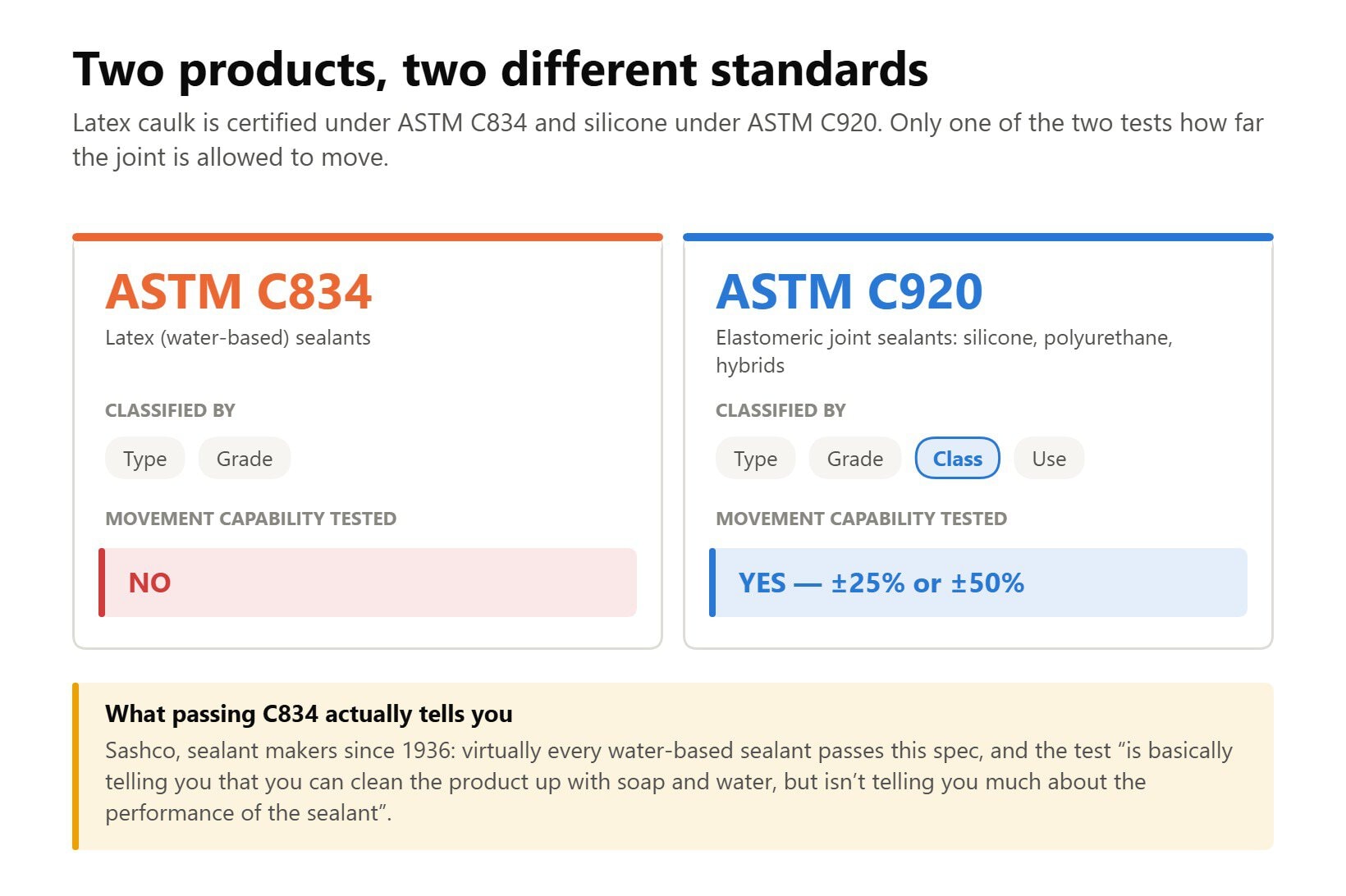
Latex caulk vs silicone comes down to one thing almost nobody mentions: they are tested to two different standards, and only one of those standards tests how far the joint can move. Latex caulk is certified under ASTM C834, silicone under ASTM C920, and the difference between them is not paint and water. It is movement.
Every comparison of these two says the same thing. Latex is paintable and cleans up with water; silicone is waterproof and cannot be painted; use latex on trim and silicone in the bathroom. That is a reasonable rule of thumb and it is not why beads fail.
Beads fail because the joint moved further than the sealant could stretch. The tube tells you whether yours can, in a code on the back that the advice never mentions.
Two products, two different standards
Sealant manufacturers test to ASTM specifications and print the result on the cartridge. Latex and silicone are not tested to the same one.
ASTM C834 is the specification for latex sealants. A product that meets it is classified by Type (opaque or clear) and Grade (how flexible it stays at low temperature). The specification also tests extrudability, shrinkage, color change, slump and adhesion loss. What it does not classify at all is movement capability.
Sashco, who have been making sealants since 1936, are blunt about what C834 compliance is worth: virtually every water-based sealant passes it, and the test “is basically telling you that you can clean the product up with soap and water, but isn’t telling you much about the performance of the sealant.” There are lots of winners and losers compliant with that specification.
Which is worth sitting with for a second. Google’s AI summary of this question puts “Cleanup: soap and water” in its comparison table as a feature of latex caulk. That is the one property C834 genuinely certifies, and the summary has repeated it while missing everything the other standard measures.
ASTM C920 is the specification for elastomeric joint sealants. A product that meets it is classified by Type, Grade, Use, and critically by Class — its movement capability, typically plus or minus 25% or plus or minus 50%. A sealant marked ASTM C920 Class 25 has been cycled through a joint opening and closing by a quarter of its width, under the ASTM C719 test, and survived.
| ASTM C834 | ASTM C920 | |
|---|---|---|
| Applies to | Latex (water-based) sealants | Elastomeric joint sealants: silicone, polyurethane, hybrids |
| Classified by | Type, Grade | Type, Grade, Class, Use |
| Movement capability tested? | No | Yes — typically ±25% or ±50% |
| What passing really tells you | It cleans up with water and will not slump or shrink badly | It survived a joint cycling open and shut by a quarter or half its width |
So the real question is not latex or silicone. It is: does this tube carry a C920 movement class, and is that class enough for the joint in front of me?
How much does your joint actually move?
More than you think, in the places people reach for caulk.
A tub moves. Empty it weighs very little; full, with someone in it, it carries a couple of hundred kilos and the rim drops. That is a joint cycling every time the tub is used, which is why tub seals fail at the tub line rather than the tile line and why manufacturers tell you to fill the tub before you seal around it.
Exterior joints move with temperature. Wood moves with humidity across the seasons. Baseboards against a plastered wall barely moves at all, which is exactly why latex caulk is fine there and has been for decades.
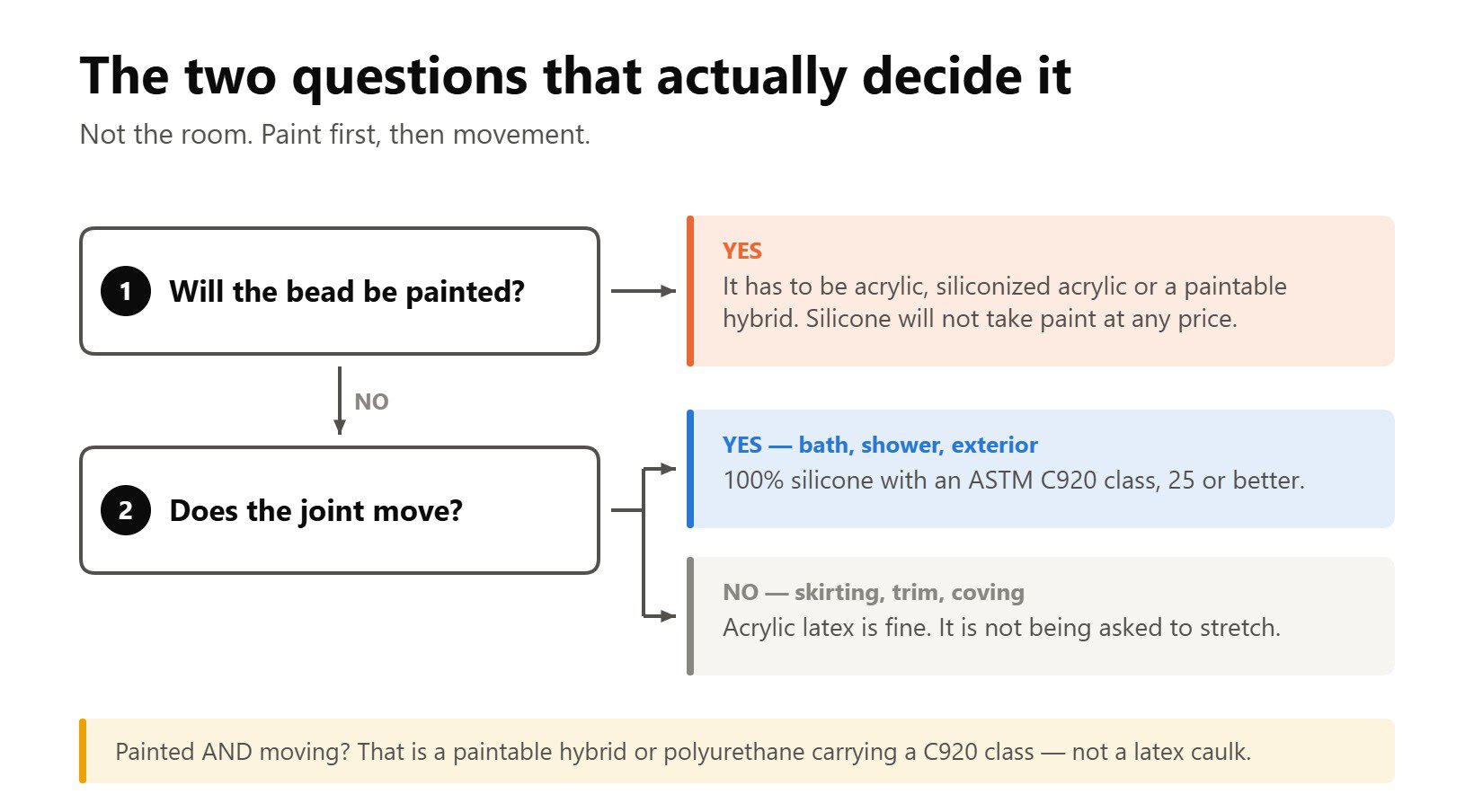
Match the sealant to that, not to whether the room has a faucet in it:
| Joint | Movement | What to use |
|---|---|---|
| Baseboards, door casing, coving, filling before painting | Very little | Acrylic latex. It is paintable, which is the whole point here. |
| Interior trim on a wood-framed wall | Some seasonal | A latex carrying a C920 class, or a paintable hybrid |
| Tub, shower pan, sink, countertop to backsplash | Real and repeated | 100% silicone, C920 Class 25 or better |
| Window and door perimeters, exterior | Thermal, year round | C920 Class 25 minimum; polyurethane or hybrid if it needs painting |
Joint shape matters as much as the material, and getting it wrong undoes a correctly chosen sealant. Our guide to caulking properly covers the 2:1 rule and backer rod.
Silicone is a one-way door
This is the part of the decision that has consequences, and every comparison files it under “cleanup”.
Nothing bonds to cured silicone. Not paint, not latex caulk, not fresh silicone. A joint that has had silicone in it is a silicone joint from then on, and the only way back is to physically remove every trace — not most of it, all of it, because a smear you cannot see is enough to stop the next bead sticking.
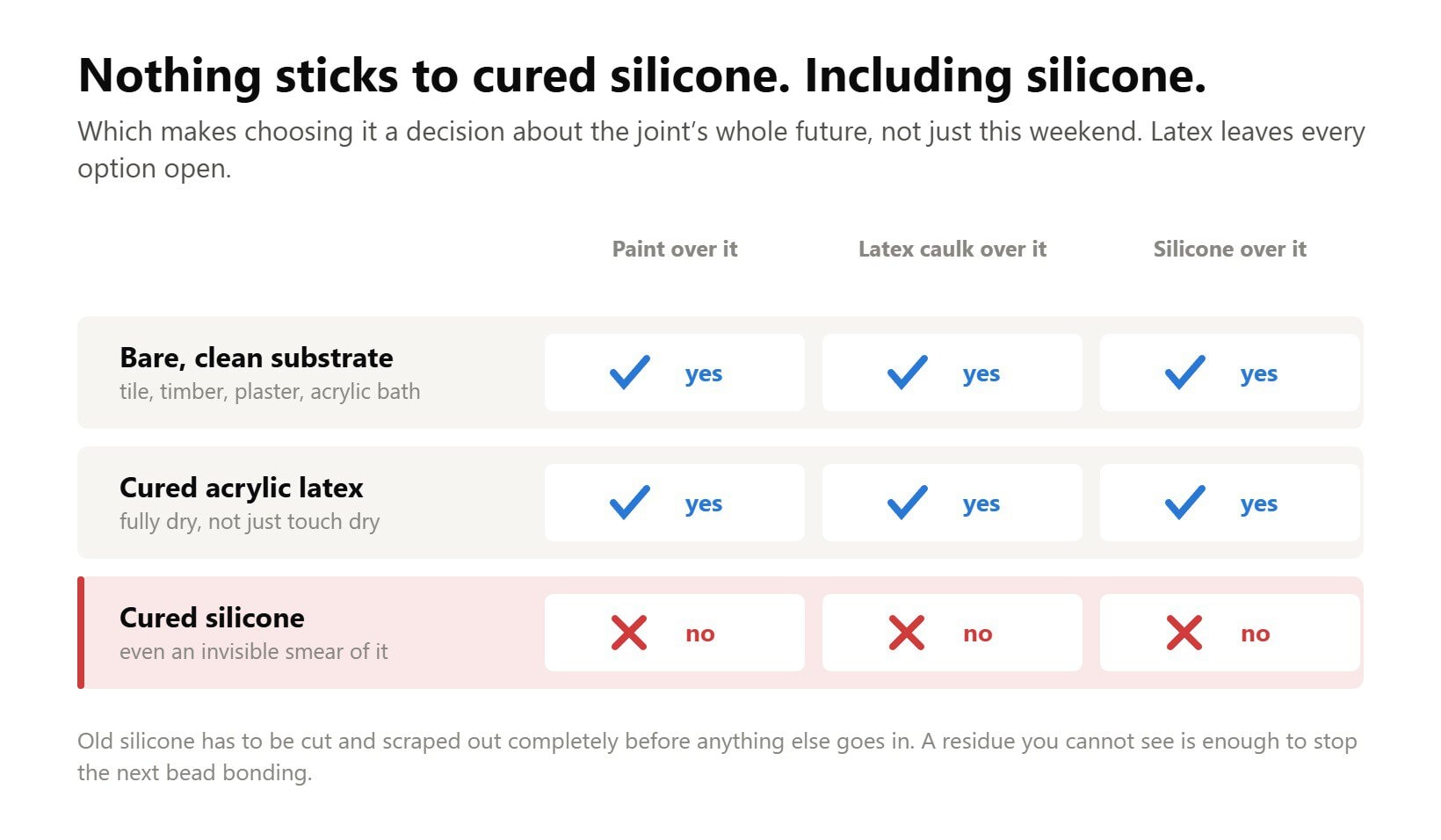
That is a real constraint on a decision people make in four seconds in a DIY shed. If you silicone a run of baseboards because it was the tube in your hand, you have just decided that baseboards is never getting a clean paint line again without stripping the bead off first. Our comparison of caulk removers covers getting it out when that happens.
Latex has no equivalent trap. It paints, it takes silicone over the top once it is fully cured and dry, and it comes off with a blade and water. If you are genuinely unsure which the joint needs, the reversible one is the safer mistake.
Mold is a separate question from water
The other reason silicone wins in a bathroom has nothing to do with the movement class, and it is worth separating out because people buy the wrong thing over it.
Sealants sold as “kitchen and bath” or “mold resistant” carry a fungicide in the cured rubber. Plain acrylic latex generally does not, and a latex bead in a wet room absorbs water into the surface, which is exactly the damp, soapy film mold colonizes. That is why a shower seal goes black along the bead rather than on the tile either side of it.
Two honest caveats. The fungicide slows colonization rather than preventing it, and it depletes over years, which is why even good silicone eventually discolors. And most of what grows on a tub seal is feeding on soap and body oils sitting on the surface, not on the sealant itself — so wiping the joint down after a shower does more for it than the label does.
Siliconized acrylic: the third tube on the shelf
Most comparisons treat this as a binary and the shelf does not. Between the two sits siliconized acrylic latex, sold as “acrylic with silicone” or “kitchen and bath caulk”, and it is what a lot of people actually buy.
It is a latex caulk with some silicone added. It paints, it cleans up with water, and it handles damp better than plain acrylic. It is not silicone, and the standard on the tube is the way to tell how much that matters: a siliconized acrylic that carries C834 alone is a latex sealant with better water resistance, not a substitute for 100% silicone in a joint that moves.
Where it genuinely earns its place is the middle ground the binary ignores — a kitchen backsplash, a downstairs cloakroom, trim in a bathroom that needs painting. Where it does not is a tub or shower pan, and for that the answer is 100% silicone. We have picked through the options in our round-up of caulk for showers and bathtubs.
The paint rule, and why it is absolute
Latex takes paint. Silicone does not, and this is not a matter of finding the right primer.
Cured silicone has very low surface energy, so waterborne paint beads up on it the way water beads on a waxed car. There is no undercoat that fixes this. Paint applied over silicone either crawls into islands straight away or sits there looking fine for a two weeks and then peels off in a sheet.
Which means the paint question has to be answered before the tube is opened, not after. If the bead will be painted, it is acrylic, siliconized acrylic, or a paintable hybrid — decided at the shop.
What about the lifespan figures?
Treat them carefully. Google’s summary of this question gives latex 10 to 15 years and silicone 10 to 20, in the same table where it describes latex water resistance as “moderate; can break down in wet areas”. Both cannot be true of the same bead. A latex caulk in a shower does not last a decade; it goes soft, then moldy, then it lifts, usually inside two years.
Service life depends on the joint, not the chemistry in the abstract. A latex bead on dry interior trim can genuinely last fifteen years because nothing is asking anything of it. The same tube on a tub rim is finished in a season or two. Quoting one number for a material across every application is where those tables go wrong.
Frequently asked questions
What is better, silicone or latex caulk?
Neither, in the abstract. Silicone is better wherever the joint moves or stays wet, because it is tested to ASTM C920 with a stated movement class, typically plus or minus 25%. Latex is better wherever the bead has to be painted, because silicone cannot be painted at all. The failure mode people actually hit is using latex on a joint that moves, and the tube tells you whether it can: look for a C920 class, not just C834 compliance.
Will latex caulk adhere to silicone?
No. Nothing adheres to cured silicone, including fresh silicone, latex caulk and paint. Cured silicone has a very low surface energy, so anything applied over it beads rather than wetting out. If there is old silicone in the joint it has to be cut and scraped out completely before anything else goes in, and a residue you cannot see is enough to stop the new bead bonding.
Can I use latex caulk in my shower?
You can, and it will not last. A shower joint is wet, warm and moving, which is the combination latex handles worst: it absorbs water, softens, grows mold in the surface and eventually lifts. Siliconized acrylic does better and is acceptable on a backsplash or a low-use cloakroom. For a tub or a shower pan, use 100% silicone with a C920 class.
When should you use latex caulk?
Where the bead will be painted and the joint barely moves. Baseboards, door casing, coving, the gap between trim and a plastered wall, filling before decorating. That is most of the caulk used in a house, and it is the job latex does better than silicone because it takes paint and tools to a crisp line with a wet finger. Our guide to smoothing a bead covers the technique either way.
What type of caulk is best for exterior use?
Something carrying an ASTM C920 movement class, because exterior joints cycle with temperature all year. Silicone for joints that will not be painted, polyurethane or a hybrid where they will. Plain acrylic latex outdoors is the classic false economy: it goes in easily and cracks out over the first winter. Our guide to exterior caulking goes through the options.
Is siliconized acrylic the same as silicone?
No. It is acrylic latex with silicone added, which improves water resistance and flexibility without making it a silicone sealant. The practical test is the standard on the cartridge: if it carries ASTM C834 only, it is a latex sealant and has not been tested for joint movement. Use it where you want paintability with better damp tolerance, not where you need a C920 class.
Can you put silicone over latex caulk?
Yes, provided the latex is fully cured and completely dry, not merely touch dry. Silicone bonds to cured acrylic well enough for most joints. What you cannot do is the reverse. It is still better practice to remove the old bead than to build up layers, because you end up with a deep composite joint that cures slowly and moves as two materials rather than one — and depth is what governs cure time, as our page on how long caulk takes to dry sets out.
Does latex caulk shrink?
Yes, and this is one of the properties ASTM C834 does measure. Latex caulk is a water-based latex paint and loses volume as the water leaves, which is why a deep bead sinks into a hairline down the middle as it dries and why painting it too early cracks the paint line a week later. Silicone cures by reaction rather than evaporation and barely shrinks at all.
Which is easier to apply and tool?
Latex, comfortably. It is softer out of the tube, so a lower thrust ratio gun handles it, it tools with a wet finger or a finishing tool, and mistakes wipe off with a damp cloth. Silicone is stiffer, sets the tooling window at roughly half an hour, and anything you get on your hands or the tiles is there until you scrape it. If the gun itself is the struggle, that is usually the thrust ratio rather than the sealant — see how to use a caulk gun.
How long does each one actually last?
It depends entirely on the joint. On dry interior trim that never moves, a latex bead can last fifteen years or more, and often outlives the paint over it. On a tub rim it may not see two. Silicone in a correctly shaped tub joint should give ten to twenty years, and the ones that fail early almost always failed on adhesion or joint shape rather than on the material wearing out.
What to remember
Stop choosing between latex caulk and silicone on the room, and start reading the back of the tube. ASTM C834 tells you it washes off with water. ASTM C920 with a Class tells you how far the joint can move before the bead lets go.
Paint decides it if the bead will be painted, because silicone will not take paint at any price. Movement decides it otherwise. And if you are still unsure, latex is the reversible mistake and silicone is not. The specifications themselves are set out by Sashco if you want to check a product against them.
