Last Updated on October 14, 2026
The best caulk for shower joints is a 100% silicone sealant with an ASTM C920 movement class printed on the tube. That one line does more work than any brand recommendation, because the phrase “kitchen and bath” on the front of a cartridge is marketing copy, while a movement class is a number a manufacturer has to stand behind. Silicone is the right family here, and the full caulk type comparison shows what it beats and where.
Google’s AI summary for this search currently recommends 100% silicone, which is right, and then offers a “best budget-friendly” alternative that is an acrylic latex caulk. That product needs a full 24 hours before water touches it. The top organic result underneath the summary is a homeowner who used exactly that kind of caulk in a shower and had black patches two months later.
The label is not the specification
Every cartridge in the bathroom aisle says something reassuring. Waterproof. Mold resistant. Kitchen and bath. None of those words are defined by anyone. The specification that is defined is ASTM C920, the standard for elastomeric joint sealants, and the part of it that matters in a shower is the movement class.
A movement class is the percentage of the joint’s width that the cured sealant can take, in extension and compression, without failing. Class 25 handles plus or minus 25%. Class 35 handles plus or minus 35%. Class 50 handles plus or minus 50%. The test behind it is ASTM C719, which cycles the joint repeatedly rather than pulling it once.
This matters in a shower for a reason that has nothing to do with water. A tub or a shower pan moves. It is empty and cool, then full of hot water and a person, then empty again. The joint between the tray and the tile opens and closes every time. A sealant with no movement rating is being asked to do a job nobody has measured it for.

What the “budget option” actually says about itself
DAP Kwik Seal Kitchen & Bath Adhesive Caulk is the product the AI summary names as the budget choice. It is an honest product and DAP describes it honestly. Its base polymer is an acrylic latex copolymer, its maximum joint size is three eighths of an inch square, and the instruction is: “Wait 24 hours before exposing to water.” That instruction appears twice, in bold, in a four-page document.
What it does not carry, anywhere, is an ASTM C920 reference or a movement class. The only ASTM numbers in it are C1183 for freeze-thaw stability and D2202 for sag. There is no published figure for how much this caulk can stretch in a joint that moves, because it is not sold against that standard.
That is not a scandal. It is a caulk designed to seal a backsplash, bond a loose tile and take paint, and for those jobs it is fine and it is cheap. It is being recommended for the wrong joint.
The three products the search results push, side by side
Retailer listings for the same product frequently disagree with each other.
| GE Supreme Silicone K&B | Gorilla 100% Silicone | DAP Kwik Seal | |
|---|---|---|---|
| Chemistry | 100% silicone, neutral cure | 100% silicone | Acrylic latex copolymer |
| ASTM C920 class | Class 50, Type S, NS, Use A, G, O | Movement Class 35, Uses G, A | Not published |
| Joint movement | ±50% (ASTM C719) | ±35% | Not published |
| Elongation | 483% (ASTM D412) | Not published | Not published |
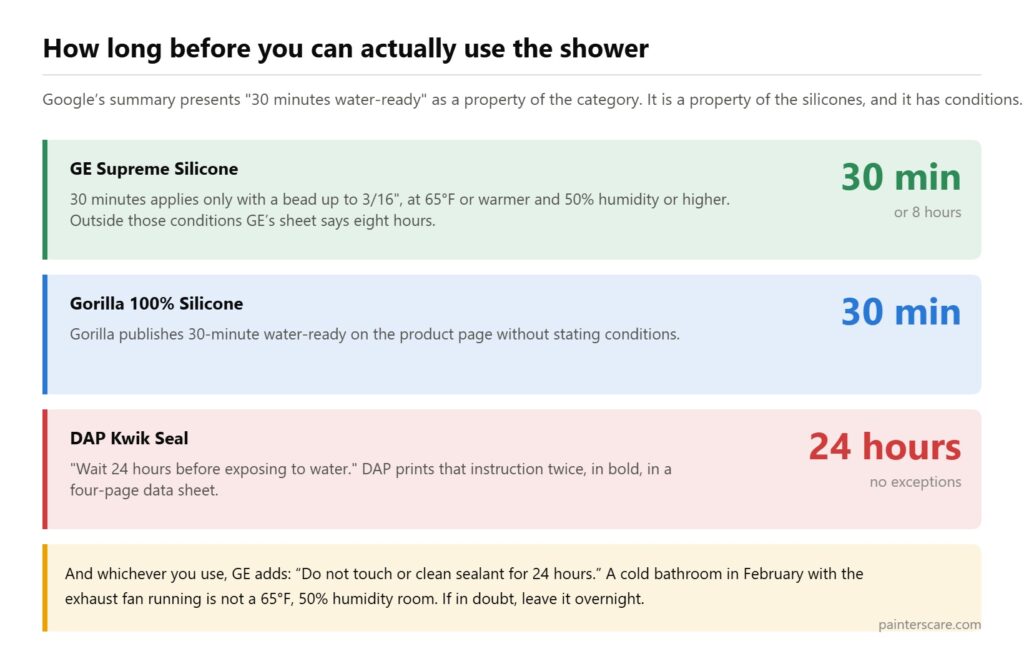
| Water-ready | 30 min, conditions apply | 30 min | 24 hours |
| Service temperature | −60°F to +400°F | −40°F to 350°F | −20°F to 150°F |
| Max joint without backer rod | 1/2″ × 1/2″ | 1/2″ | 3/8″ × 3/8″ |
| Paintable | No | No | Yes |
Read the water-ready row again. The AI summary presents 30 minutes as a feature of the category. It is a feature of the silicones. The budget pick is a full day, which in a one-bathroom house is the difference between a Saturday job and a Saturday-and-Sunday job.
The 30-minute claim has conditions on it
GE’s own footnote is worth reading before you plan your day around it. Thirty minutes applies with a bead no thicker than 3/16 of an inch, a temperature of at least 65°F and humidity of at least 50%. Outside those conditions it should not meet water for eight hours. And either way: “Do not touch or clean sealant for 24 hours.”
A cold bathroom in February with the exhaust fan running is not a 65°F, 50% humidity room. Plan for eight hours unless you have measured otherwise. Silicone also cures from the outside in at roughly 1/16 to 1/8 inch (2 to 3 mm) (about 1/8″) per 24 hours, which is why a fat bead in a wide gap is still soft inside long after the surface feels firm — the same mechanism covered in our guide to how long caulk takes to dry.
Mold-free guarantees do not cover the mold you will actually get
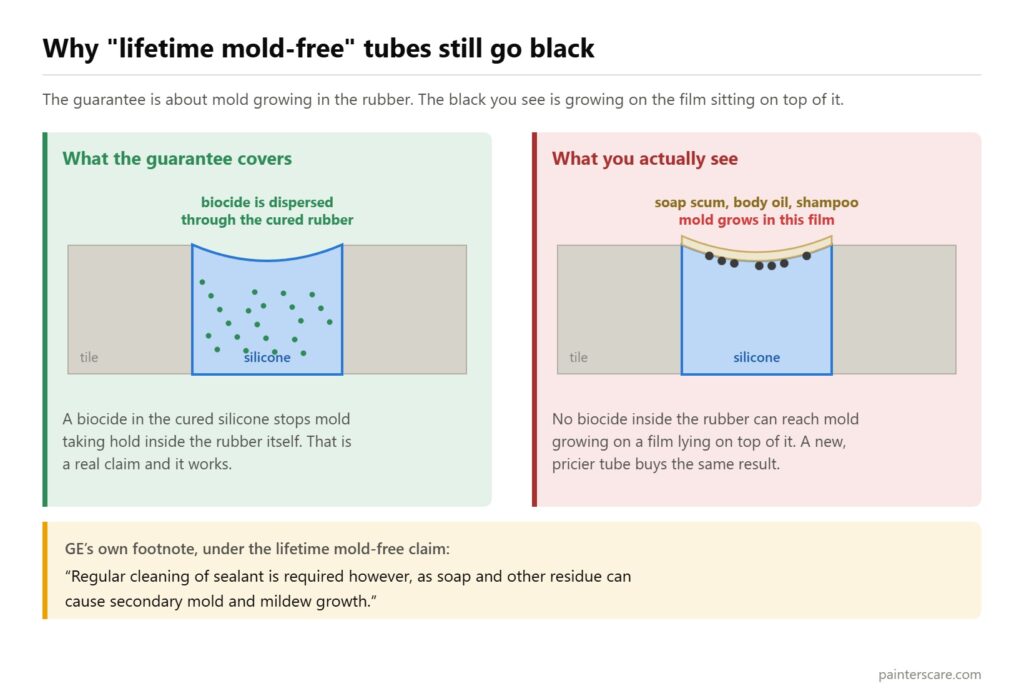
“Lifetime mold-free product protection” is the headline on the GE tube, and it is a real claim about a real biocide in the cured rubber. The qualifier that travels with that claim is the part worth reading:
Fully cured sealant is resistant to stain-causing mold and mildew. Regular cleaning of sealant is required however, as soap and other residue can cause secondary mold and mildew growth.
That is the whole game. The guarantee covers mold growing in the sealant. The black you see in a shower is almost always mold growing on a film of soap scum, body oil and shampoo residue sitting on top of the sealant. No biocide in the rubber can reach it, because it is not in the rubber.
So the honest answer to “best bathroom caulk to prevent mold” is that the caulk is the smaller half of the problem. A silicone joint that is wiped down occasionally will stay white for years. The same silicone left to accumulate soap film will go black on schedule, and replacing it with a more expensive tube will buy you the same result.
Class 35 or Class 50 — does the difference matter?
For a normal tiled shower with a 1/8″ to 1/4″ perimeter joint, both are comfortably inside their capability. Class 35 on a 3/16″ joint is about 1/16″ of movement; a tub perimeter does not move that much. The difference starts to matter on wide joints, on acrylic trays that flex a lot under load, and where the two substrates expand at different rates.
The more useful distinction is the one between “has a class” and “does not”. Going from Class 35 to Class 50 is a refinement. Going from Class 35 to no published class at all is a different category of decision.
Where silicone should not go
All three carry a version of the same warning, and it is the one homeowners miss. GE: not “for use underwater or in other applications where the product will be in continuous contact with water”, and “do not use in areas of ponding water”. Gorilla: not for underwater applications. DAP: not for continuous underwater use.
A shower perimeter gets wet and drains. That is fine. A joint that holds standing water — a badly falling tray, a shelf that pools, the inside of a wet room threshold that never dries — is outside what any of these products are sold for. If water is sitting in the joint, the fix is drainage, not a better sealant.
Neutral-cure silicone is also the safer pick around natural stone and metal finishes. GE Supreme is neutral curing and states it will not blemish chrome, bronze or nickel. Acid-cure silicone, which smells strongly of vinegar, can etch marble and corrode some metals.
The tube matters less than the joint
You can buy the Class 50 silicone and still get a joint that fails in a year, because the two things that kill shower caulk are not chemistry. They are a contaminated surface and a bead that never bonded to both faces.
Every one of these sheets says to remove old sealant, soap residue and surface treatments first. GE names isopropyl alcohol as an effective cleaner for non-porous surfaces; DAP recommends rubbing alcohol for removing soap film. Note the distinction, because it trips people up: alcohol is for cleaning the surface before you gun the bead. It is not a tooling aid, and using it as one is a different and worse idea, as we cover in how to smooth silicone caulk. If you are choosing something to shape the bead with, our look at whether a caulk finishing tool is worth buying has the short answer.
Gap wider than about half an inch, or deeper than it is wide? Use a closed-cell backer rod. GE asks for one above 1/2″ × 1/2″ and wants it 25 to 50% larger in diameter than the joint. DAP’s ceiling is smaller, at 3/8″. Without it you get a deep, three-sided bead that cannot stretch, and the full method is in our guide to caulking properly.
And do not caulk over the old bead. Every sheet requires a clean, sound substrate. Fresh silicone does not bond reliably to cured silicone, so the old material has to come out first — there is a comparison of the tools for that in our caulk remover roundup.
Frequently asked questions
Is silicone or caulk better for showers?
Silicone is caulk — “caulk” is the general word for a gunned sealant, and silicone is one chemistry within it. The comparison people mean is silicone against acrylic latex, and for a shower silicone wins on the measure that counts. Silicones like GE Supreme and Gorilla publish ASTM C920 movement classes of 50 and 35; the latex products sold for the same shelf typically publish no movement class at all.
Which caulk is better, DAP or GE?
Compare products, not brands — DAP and GE both sell silicones and both sell latex caulks. On the specific pairing the search results push, GE Supreme Silicone against DAP Kwik Seal, GE Supreme Silicone carries ASTM C920 Class 50 with ±50% movement and is water-ready in 30 minutes; DAP Kwik Seal carries no movement class and needs 24 hours before water contact. For a shower joint that is not a close call.
What type of caulk is best for sealing showers?
A neutral-cure 100% silicone with a published ASTM C920 movement class of 25 or higher. Neutral cure so it will not etch stone or attack metal finishes, 100% silicone so it stays flexible in a joint that moves with temperature, and a published class so the flexibility is a measured figure rather than a word on the packaging.
Is 100% silicone really necessary, or will siliconized latex do?
“Siliconized” latex is a latex caulk with some silicone added; it is not a silicone. Check the back of the tube rather than the front. If it carries an ASTM C920 movement class it is worth considering. If the only ASTM numbers are for sag and freeze-thaw, it is a latex caulk and the shower perimeter is not the place for it.
What is the best caulk for shower corners?
The same silicone you use on the perimeter, but the corner is where joint geometry matters most. A vertical interior corner is a change-of-plane joint and it moves. Do not fill it solid with grout and do not run a huge fillet; keep the bead narrow and tooled concave so it can stretch. Corners are also where a cheap sealant splits first, which is why corner failure is the usual early warning.
Can you put silicone over old silicone in a shower?
No. Cured silicone is one of the few surfaces fresh silicone will not reliably bond to, and every manufacturer sheet here requires a clean, sound substrate free of old sealant. A bead laid over old silicone looks acceptable for a few weeks and then peels away as a strip. Cut the old material out, clean the residue off, let the joint dry, then re-seal.
What is the best bathroom caulk to prevent mold?
Any 100% silicone with a mold-resistant formulation, but the choice matters less than people expect. GE’s own footnote says regular cleaning is still required because soap and other residue cause secondary mold growth. The black you see is usually growing on the film on top of the sealant, not in it, and no biocide in the rubber reaches that.
How long does shower caulk take to dry before I can shower?
For GE Supreme, 30 minutes — but only with a bead up to 3/16″, at 65°F or warmer and 50% humidity or higher. Outside those conditions it needs eight hours, and the sealant should not be touched or cleaned for 24 hours either way. For an acrylic latex like DAP Kwik Seal it is a flat 24 hours. If in doubt, leave it overnight.
Is it better to caulk with a tool or your finger?
Either works if it is dry and you make one pass. What matters far more is that you do not wet it. Soapy water and alcohol are the two things most guides tell you to use and the two things sealant manufacturers tell you to avoid, because they interfere with adhesion. Mask with tape, tool dry, pull the tape while the bead is still wet.
How much caulk do I need for a shower?
A 10.1 fl oz cartridge of GE Supreme covers about 51 linear feet at a 3/16″ bead; DAP quotes 55 feet from the same size. A typical shower enclosure perimeter plus the tray joint is well under 30 feet, so one cartridge does the job with room for the mistakes.
Should the joint between the tiles and the tray be grout or silicone?
Silicone. That joint is a change of plane between two materials that move independently, and rigid grout in it will crack out within a season. Grout belongs between tiles on the same plane. The perimeter, the interior corners and the tray joint are all sealant joints.
What to remember
Buy on the movement class, not the words on the front of the tube. A 100% silicone with a published ASTM C920 class of 25 or better is the right product for a shower, and whether that is Class 35 or Class 50 matters far less than whether there is a class at all.
Then accept that the tube is the easy part. Strip the old bead out rather than sealing over it, get the soap film off with alcohol before you start, use a backer rod in anything deep, tool it dry in one pass, and wipe the joint down occasionally afterwards. That last habit does more for keeping it white than any upgrade you can buy. The chemistry behind the silicone-versus-latex decision is set out in our comparison of latex caulk against silicone, the outdoor equivalent of this job is caulking exterior windows, and if you are still choosing a gun there is how to use a caulk gun. The full specification for Supreme Silicone is published in full if you want to check the footnotes yourself. The same moisture that attacks a shower joint is what makes the wall behind a toilet the first paint in the room to fail.
