Last Updated on October 6, 2026
How long caulk takes to dry is set by the depth of the bead, not by the number on the tube. Caulk skins in about 30 minutes and 24 hours is usually printed as the cure time, but that 24-hour figure is a rate rather than a deadline: silicone cures roughly 1/16 to 1/8 in deep per day, so a 1/4 in bead needs two to three days and a 3/8 in bead needs four to five.
Almost every answer to this question gives you a single number. Thirty minutes to skin, twenty-four hours to cure, wait a day before you shower. Those figures come off the tube, and they are correct for one specific bead: a shallow one.
The tube tells you the rest, in a line nobody quotes. It is worth going and reading it, because it explains every failed shower seal you have ever had.
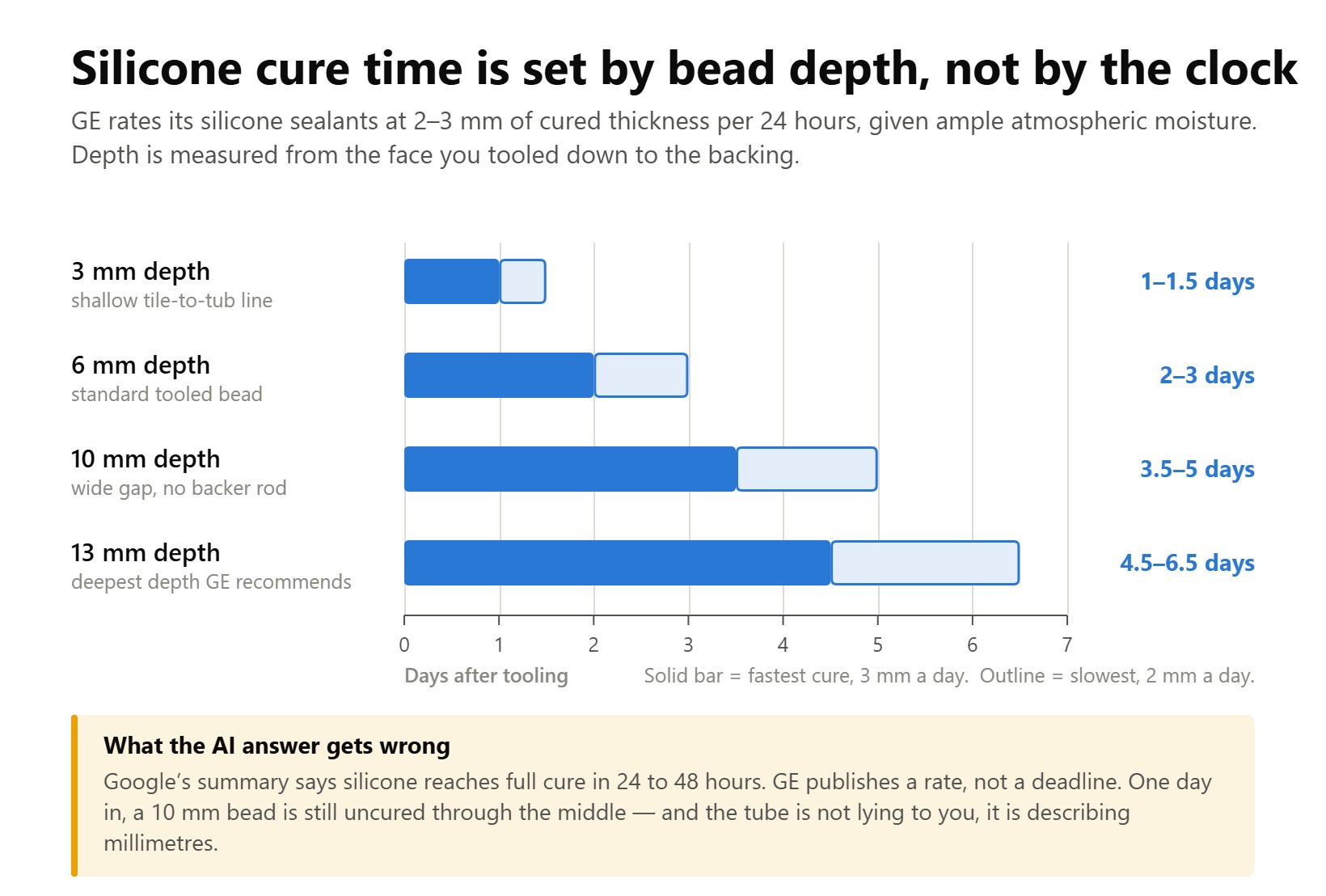
The 24 hours on the tube is a rate, not a deadline
Take GE Advanced Silicone 2 Kitchen & Bath, about as mainstream a bathroom sealant as exists. The summary table says tack free in 30 minutes, cure time 24 hours.
Further down the same sheet, in the notes: “this material can attain a cured thickness of 2-3 mm per 24 hours (assuming ample access to atmospheric moisture).” The All Purpose Silicone 1 sheet carries the identical line.
Both statements are true and they are not in conflict. Twenty-four hours is the cure time for a bead about 1/8 in deep, because that is as far as the cure gets in a day. Silicone is a moisture-cure sealant: it reacts with water vapor from the air, so it hardens from the outside in, and the skin it forms first is what slows everything behind it. The clock does not run on the bead. It runs on the millimeter.
So how long does your bead actually need?
Measure the depth, not the width, and divide by the rate. At GE’s 1/16 to 1/8 in a day, in a warm room at around 50% humidity:
| Bead depth | Where you see it | Cured through in |
|---|---|---|
| 1/8 in | A thin line on trim, a hairline refresh | About 24 hours |
| 1/4 in | A normal tub or shower joint | 2 to 3 days |
| 3/8 in | A wide or over-filled joint | 4 to 5 days |
| 1/2 in | The maximum depth any sealant should be | 5 to 7 days |
This is the real argument for not over-filling a joint. A deep bead is weaker, as our guide to caulking properly explains, and it also takes days longer to reach the strength it will never quite have. Backer rod behind the bead is not only a structural decision; it halves the drying time as well. Depth is decided at the moment you pull the trigger, so how you run the gun sets the drying time as surely as the product does.
Polyurethane behaves the same way with a slower number. Tremco put the cure rate for one-part polyurethane sealants at approximately 1/16 of an inch, 1/16 in, of depth per day at 75 °F and 50% relative humidity. That is why exterior polyurethane joints get quoted at ten days and more: the same arithmetic run on a deeper bead and a slower chemistry, not a different kind of promise.
Dry, skinned and cured are three different things
The confusion in every answer to this question comes from one word doing three jobs.
| Stage | Typical timing | What it means |
|---|---|---|
| Skinned | 20 to 30 minutes | The surface is no longer wet. Underneath it is still liquid. |
| Tack free | 30 minutes | It will not transfer to your finger. Still not cured. |
| Water resistant | 8 to 24 hours | It will survive splashes. Not immersion or scrubbing. |
| Cured through | 1 to 7 days, by depth | Full strength, full adhesion, full flexibility. |
Skinning is what makes people confident too early. Thirty minutes in, the bead looks and feels finished. It is a film over a liquid, and pressing it, washing it or flexing the joint at that point tears the skin and lets the uncured silicone underneath move where it should not. That half hour is also the only window in which the bead can be tooled: smoothing silicone after it has skinned drags the surface rather than shaping it, whether you use a wet finger or a caulk finishing tool.
Silicone wants humidity. Acrylic wants it gone.
This is the part that gets stated backwards more often than anything else in caulking, including by the answer Google puts at the top of this query.
The two families cure by opposite mechanisms:
- Silicone cures by reacting with moisture in the air. GE’s sheets put it plainly: the cure rate “is primarily dependent upon temperature and the availability of atmospheric moisture”, and “low moisture environments will also reduce the cure rate”. Dry air slows silicone down. A dehumidified room or a cold dry garage is the worst place to leave it.
- Acrylic cures by losing water. It is a water-based latex paint, and it hardens as that water evaporates. Damp air slows it down. A steamy bathroom is the worst place to leave it.
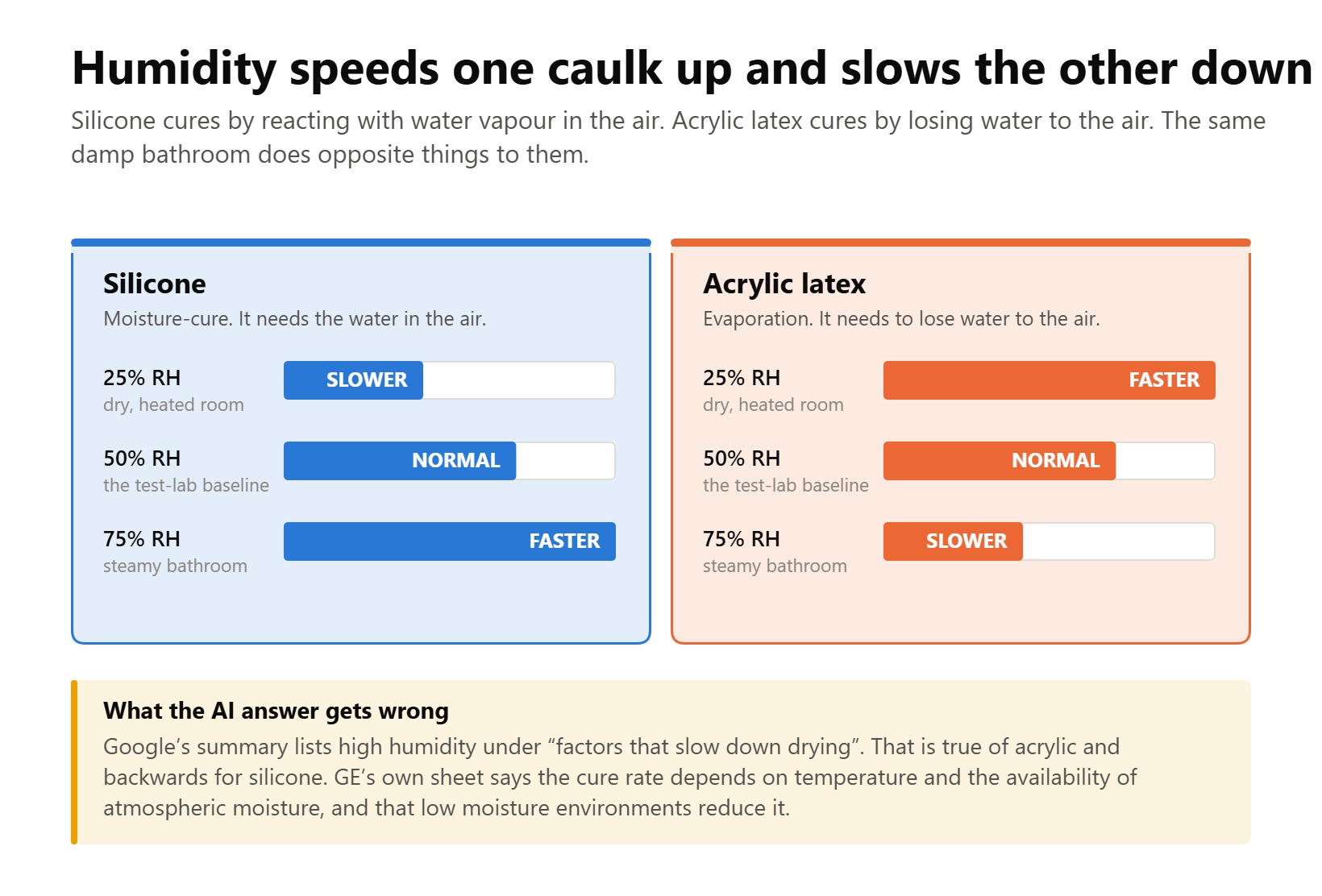
So the same advice cannot be right for both, and “humidity slows drying” is only half true. If you have just siliconed a shower, running the extractor on full to dry it faster is working against you. Leave the room at normal humidity and leave the window shut. If you have just used decorator’s caulk on baseboards, the opposite: ventilate. Tremco say the same of polyurethane: cure time increases as the temperature and/or humidity decreases. Two manufacturers, two chemistries, one direction.
Temperature pulls in the same direction for both. GE state it simply: “as temperature decreases, the cure rate slows down”. Below about 50 °F everything takes materially longer, which is why an unheated bathroom in February behaves nothing like the label. Tremco give a working rule for how much longer: an extra 24 hours of cure for every 10 °F, about 5.41 °F, that the temperature drops. If you are unsure which product you are holding, our comparison of latex caulk against silicone covers how to tell.
How soon after caulking can you shower?
Overnight at minimum, and longer than you think if the bead is deep.
The published figures are narrower than the advice you will read. GE’s All Purpose Silicone 1 says to allow a minimum of 12 hours before exposing the sealant to water. Their Advanced Silicone 2 is rated water-ready in 30 minutes, but only under stated conditions: a bead no more than 3/16 of an inch, about 3/16 in, at a minimum of 65 °F and at least 50% humidity. Outside those conditions it needs 8 hours.
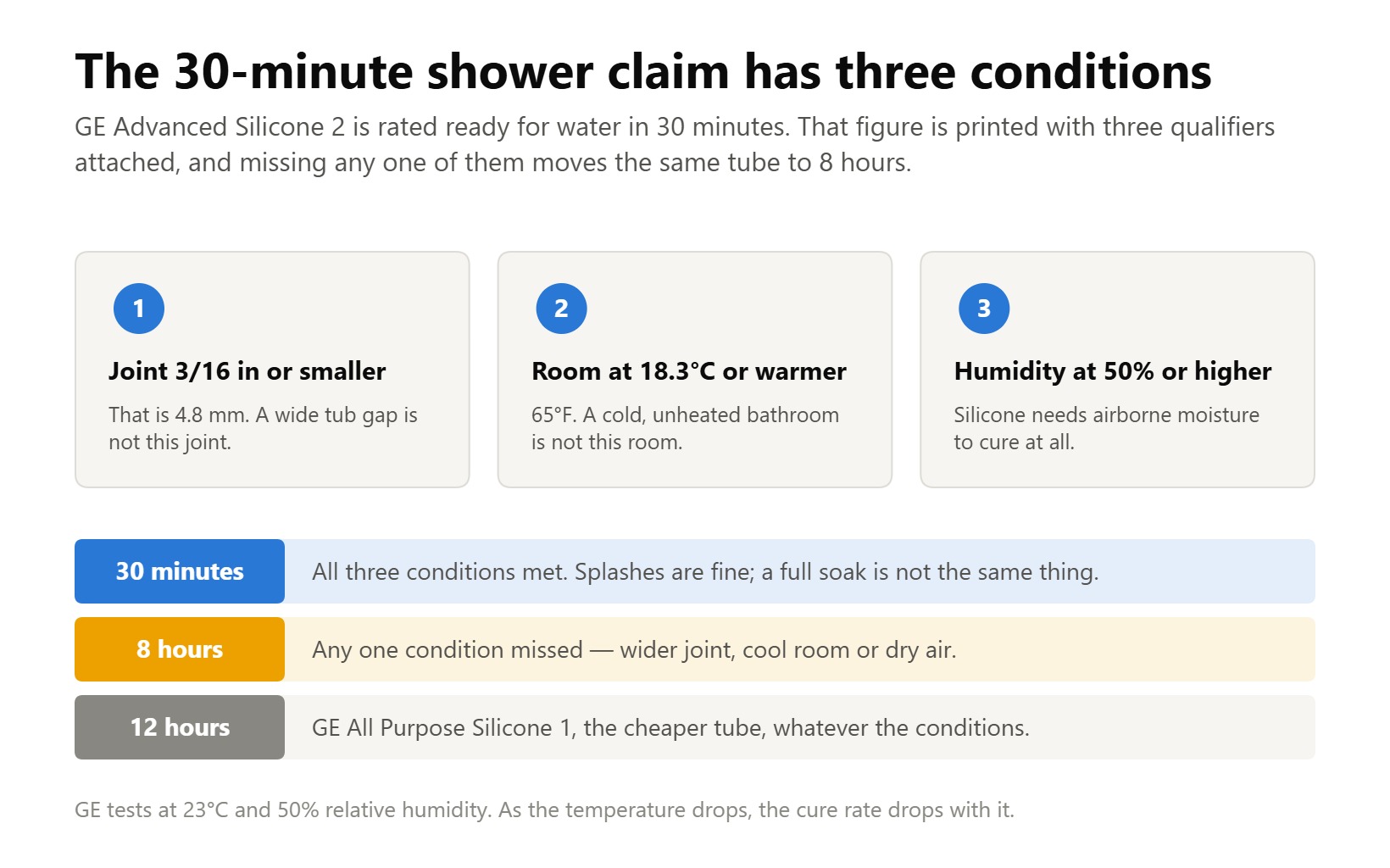
Notice what that fast figure depends on. It is capped by bead size, because a thin bead cures through quickly and a thick one does not. Nobody quoting “30 minutes” mentions the 3/16 in limit, and almost no tub joint is that shallow.
Practical version: splashes overnight, a full shower after 24 hours on a normal bead, and 48 hours if the joint is deep, the room is cold, or you want to stop thinking about it. Standing water is the real test, not steam. If you are still choosing the tube rather than timing one, our round-up of caulk for showers and bathtubs covers the mildew-resistant grades. And fill the tub before you seal around it, so the joint is sealed at its widest and every later tub compresses the bead instead of stretching it.
How long before you can paint over it?
For acrylic decorator’s caulk, one to two hours on a thin bead in a warm room, and overnight on anything deep or in a cold one.
The failure here is not the paint refusing to stick. It is shrinkage. Acrylic caulk loses volume as its water leaves, and paint applied over a bead that is still losing water ends up spanning a bead that is still moving. The result is a hairline crack down the middle of the caulk line a week later, and it looks exactly like a bead that failed structurally. Paint over the top runs on a separate clock again, set out in how long paint takes to dry and cure.
Silicone is a different conversation: you cannot paint it at all. Not with a primer, not with a special paint. If the bead needs painting it has to be acrylic or a paintable hybrid, chosen before you gun it rather than discovered afterwards.
Why is my caulk still tacky?
Three causes, in the order they are likely.
- It is not tacky, it is uncured underneath. A skinned bead that dents under a fingernail is behaving normally at 12 hours and abnormally at 5 days. Check the depth before you worry.
- The conditions are wrong for the product. Silicone in very dry air, or acrylic in a steamy room, or either below 50 °F. Fix the room rather than the bead, and give it another day.
- The tube was old. Silicone has a shelf life, usually a year or two, and an out-of-date cartridge can skin and then simply stop. If a bead is still soft at a week in normal conditions, it is not going to cure. Cut it out and start again with a fresh tube.
One more that is easy to miss: silicone applied over old silicone will not bond, and the join can stay soft-looking at the seam. Our guide to removing old silicone covers getting the previous bead out properly.
Frequently asked questions
Does caulk really need 24 hours?
A shallow bead does. A deep one needs longer. The 24-hour figure on the tube is the time it takes silicone to cure about 1/8 in deep, because the published rate is 1/16 to 1/8 in per 24 hours. A 1/4 in bathroom bead is therefore two to three days, not one. For light use and splashes, 24 hours is a reasonable line; for standing water, scrubbing or anything structural, measure your bead and multiply.
How soon after caulking can I shower?
24 hours on a normal bead, 48 if it is deep or the room is cold. Manufacturers publish shorter figures with conditions attached: GE rate one of their kitchen and bath silicones water-ready in 30 minutes, but only for a bead under 3/16 in at 65 °F or warmer with humidity above 50%, and 8 hours otherwise. Their All Purpose silicone asks for a minimum of 12 hours. A typical tub joint is deeper than the fast figure allows for.
How long do you let caulk dry before painting?
One to two hours for acrylic decorator’s caulk on a thin bead in a warm room; overnight for a deep bead or a cold one. The risk is shrinkage rather than adhesion: acrylic loses volume as its water evaporates, and paint over a bead that is still shrinking cracks along the line a week later. Silicone cannot be painted at any point, so if the bead needs paint it has to be acrylic or a paintable hybrid from the start.
Does caulk dry faster in heat or humidity?
Heat speeds up both types. Humidity depends entirely on which you are using. Silicone cures by reacting with atmospheric moisture, so humid air speeds it up and dry air slows it down — GE is explicit that low moisture environments reduce the cure rate. Acrylic caulk cures by losing water, so humid air slows it down. This is why the common advice that humidity delays drying is only right for one of the two.
Can you speed up caulk drying?
A little, and only in the right direction. Warmth helps both types, so heating the room a few degrees is worth doing. For silicone, leave normal humidity in the room rather than running an extractor, since the cure needs that moisture. For acrylic, ventilate. What does not work is a heat gun or a hairdryer on the bead: concentrated heat skins the surface faster and traps everything behind it, which is the opposite of what you want.
Why is my silicone still soft after 3 days?
Either the bead is deeper than you think, the air is too dry or too cold, or the tube was past its shelf life. Silicone cures at 1/16 to 1/8 in a day, so a deep bead at three days may be perfectly on schedule. If the room is warm and normally humid and the bead is shallow, an expired cartridge is the likely answer, and the only fix is to cut it out and redo it with a fresh tube.
Is it okay to caulk over old caulking?
No, and it is the most common reason a new bead fails early. Silicone does not bond to cured silicone, so the new bead sticks to a layer that is already lifting rather than to the surfaces either side of the joint. It also looks thicker and worse. Cut the old bead out completely, clean off the residue, let the joint dry, then seal.
What will caulk not stick to?
Old silicone, anything greasy or dusty, wet surfaces, and some plastics and powder-coated finishes. Silicone residue is the big one, because a smear you cannot see is enough to stop the next bead bonding. Damp is the other: a tub rim that looks dry can still be holding water in the joint, and silicone applied over it skins fine and lifts within weeks. Dry the joint properly and give it longer than feels necessary.
How long does caulk take to dry in cold weather?
Substantially longer, and below freezing most products should not be applied at all. GE’s silicones state that as temperature decreases the cure rate slows down, and set an application range above 32 °F. As a working rule, an unheated room in winter can double the times in this article. If you are sealing an outdoor joint in cold weather, check the specific product’s minimum application temperature rather than assuming. Our guide to what caulking to use outside goes through which products are rated for exterior joints.
How long does decorator’s caulk take to dry?
Touch dry in 30 minutes to two hours, paintable in one to two hours on a thin bead, and fully cured in two to seven days depending on depth. Decorator’s caulk is acrylic, so it dries by losing water rather than by reacting with the air, which makes it faster to overpaint than silicone is to cure but slower in a humid room. On a deep bead, give it overnight before painting.
How long does polyurethane caulk take to dry?
Skin in 30 minutes to two hours depending on the product, and a full cure measured in days rather than hours. Tremco put the rate at about 1/16 in of depth per day at 75 °F and 50% humidity, so a 1/4 in bead needs roughly four days and a 3/8 in exterior joint closer to a week. The 10 to 12 day figures you see quoted are that rate applied to a deep joint, not a slower product than the one you bought.
How long does caulk take to dry before rain?
Give an exterior bead a full day before rain is forecast, and longer in the cold. Most exterior sealants print a rain-resistant time on the tube and it varies widely, so check yours rather than working from a general figure. Rain on an uncured bead can wash uncured material out of the joint and break the adhesion at the edges, and that damage often does not show until the joint starts leaking months later.
What are the most common caulk drying mistakes?
Four, and three of them are about time. Using the shower before the bead has cured through, so water gets in behind a skin that looks finished. Painting acrylic caulk while it is still shrinking, which cracks the paint line a week later. Over-filling the joint, which multiplies the cure time and weakens the bead at the same time. And ventilating a room hard after siliconing it, which strips out the airborne moisture the silicone needs in order to cure.
What to remember
The tube gives you one number and your joint has a depth. Those two facts together are the whole answer, and almost nobody puts them side by side.
Three things to hold on to. Twenty-four hours is the cure time for about 1/8 in of silicone, so measure the depth and multiply. Skinned is not cured, and a bead that feels finished at thirty minutes is liquid underneath. And humidity helps silicone and hinders acrylic, so the right advice depends on which tube you picked up. The figures above can be checked against the full specification if you want to check your own product against them.
